"When vibrations from piling work exceeds acceptable levels, decorative features such as finials and bouquets can get loose, dislodged and fall down,” conservation architect Vikas Dilawari informed Parsiana when asked for comments on the 100-kg limestone finial decoration on the J. N. Petit Institute’s 119-year-old Neo Gothic building that fell down on August 25, 2017. Excavation work for the proposed Colaba-SEEPZ Metro 3 line was ongoing on Dr Dadabhai Naoroji (D. N.) Road on which the building is situated. Dilawari was the conservation architect who led the restoration work at the building which was recognized with 2015’s United Nations Educational, Scientific and Cultural Organization’s (UNESCO) Asia-Pacific Award for Cultural Heritage Conservation (see "A landmark library,” Parsiana, September 21, 2015).
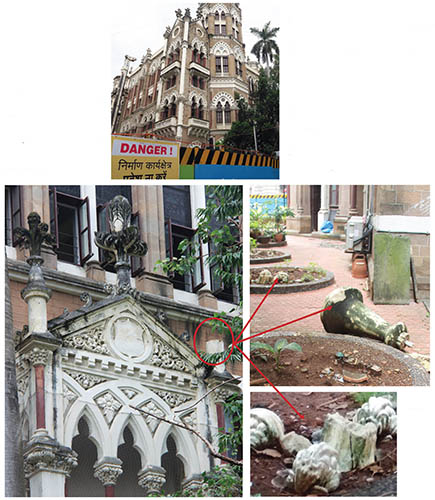
Clockwise from top: Award winning building of the J. N. Petit Institute Photo: Farrokh Jijina;
the finial that fell; broken pieces of the ornament in the Institute compound; side entrance
where the mishap took place Photos: Jasmine D. Driver
While conceding that the underground line will be built by the Mumbai Metro Rail Corporation Limited (MMRCL) with the "tunnelling method which does least or negligible damage to the structures above,” he is concerned about the "cut and fill system” employed for the construction of the underground Hutatma Chowk station near the Institute. In this method, piles are inserted "closer to the heritage building edge (two to three m, around 10 feet) to make a protective barrier so that the cut and fill can be done later without impacting these buildings.” According to Dilawari, the impact of the cut and fill system, "will be felt more and seen later as the work starts on the northern end of D. N. Road, where the buildings are in relatively poor condition, if proper precaution and mitigations are not considered.”
The Institute has appointed engineer Kamal Hadker of Sterling Engineering Consultancy to represent them on a three-member committee of structural engineers set up to carry out a survey of the heritage structure. Percy Wadia, assistant administrator of the Institute informed Parsiana on September 19, 2017 that MMRCL has not yet submitted the name of their engineer. Prof R. S. Jangid from the Indian Institute of Technology, Bombay will be the third member. The committee was mandated by a two-judge bench of the Bombay High Court comprising Chief Justice Manjula Chellur and Justice N. M. Jamdar on September 15, while imposing a two-week stay on the work outside the Institute. Earlier, Petit trustees Dadabhai Patel and Homa Petit had moved the Court for the stay citing concern about damage to heritage structures along D. N. Road.
News reports said senior counsel Fredun Devitre argued on behalf of the Institute that the vibrations due to drilling exceeded the permissible level of 5 mm per second by up to four times. While MMRCL informed the Court that the vibrations were within permissible limits, Devitre pointed out that the measurements were recorded when drilling was not underway outside the building. The lawyer reportedly stated that "the earlier pre-construction survey got done by the metro rail authorities had wrongly stated several facts about the building,” reported The Afternoon Despatch and Courier of September 15.
According to news reports, the Metro 3 may also endanger other Parsi heritage structures along its proposed route. Concern has been expressed about possible damage to the Bhikha Behram Well at Flora Fountain, the Seth Hormasji Bomanji Wadia Atash Behram at Princess Street, Zarthoshti Anjuman Atash Behram at Dhobi Talao and the Ardeshir Dadibhoy Dadisett Agiary at the start of D. N. Road.