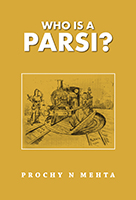
Who Is a Parsi? by Prochy N. Mehta. Published in 2022 by Niyogi Books, Block D, Building No. 77, Okla Industrial Area, Phase - 1, New Delhi, 110020. Pp: 488. Price: Rs 795.
The greatest act of religious merit in Zoroastrianism is converting an alien into the faith, contends Prochy Mehta (pictured). She has currently moved an originating summons in the Calcutta High Court to establish who is entitled to enter the Late E. B. Mehta Zoroastrian Anjuman Adaran contending that a child of an interfaith married Parsi woman is as much a Parsi Zoroastrian as one of an interfaith married Parsi male.
 A sprightly grandmother and successful businesswoman, Mehta is a multiple medal winning Indian athlete and Asian Games record holder. Her book shows she is not going to rest until this race is won.
Fali Nariman, the high priest of law, has penned a brilliant foreward to the book. Interpreting Article 25(1) of the Constitution of India, the eminent jurist has drawn a chilling conclusion for the orthodox:
"Article 25(1) is to be observed by all, including individuals and trusts. The word ‘freely’ in this Article means ‘without anyone trying to prevent or control.’ It therefore includes the right to enter and worship at a fire temple even though the trustees of the fire temple trust are not agreeable or offer hindrance or resistance; the only condition necessary for the recognition and enforcement of such right is that the person so entering is a Zoroastrian by religion — even if he or she is not a ‘Parsi’ by race or caste.”
Forget the contradictory cases of Petit vs Jeejeebhoy and Saklat vs Bella (see "The French Revolution” and "Bomanji ni Bella,” Parsiana, April 21-May 6, 2022 and May 21-June 6, 2022), the great jurist says one has to only look at the Constitution of India after January 1950 and the following position is crystal clear:
"So, after January 26, 1950, where trustees of a trust for Parsi places of worship refuse to admit a child (of a Parsi mother and non-Parsi father) then a suit for a declaration (and injunction) has to be filed in a competent civil court for declaring the right of such a child to be recognized as a Zoroastrian by religion; and to claim admission into the agiaries and atash behrams for worship on the basis of a constitutional right conferred by Article 25(1); and a permanent injunction restraining the defendant trustees (and all other persons) from denying such a child entry into the fire temple for purposes of worship.”
The Supreme Court of India hearing the Goolrookh Gupta and Sanaya Dalal matters, and the Calcutta High Court in Mehta’s daughter’s case, are highly likely to adopt Nariman’s reasoning.
No prizes for guessing how Mehta’s question: Who is a Parsi? will be answered shortly by the Indian judiciary.
Mehta’s arguments for gender equality are near irrefutable. Had the mainstream orthodox (like the World Alliance of Parsi Irani Zarthoshtis) not deviated from their ultraorthodox brethren (like the Khshnoomists) and maintained that the children of an interfaith married Parsi, whether male or female, cannot be classified as Parsi Zoroastrians, it would have been slightly more difficult for Mehta. However, in the present situation, the orthodox appear to be on a sticky wicket.
 The author demonstrates that Justice Dinshaw Davar (of Petit vs Jeejeebhoy fame), extolled by the orthodox as a "savior of the community,” though heavily biased in favor of the traditionalists yet had to reluctantly hold that Zoroastrianism not only permits but enjoins conversion.
Mehta has daringly brought on record several less known but shocking facts about the entire controversy including: "The 1865 Parsi Marriage and Divorce Act explicitly protected the right of a Parsi husband to have sex with prostitutes. It specifically stated that a man’s extramarital sexual relations would not be considered adultery if the woman was a prostitute. This was legally stopped by the Parsi Marriage and Divorce Act of 1936. All children born of prostitutes were accepted as Parsis. The occupation-wise Census of Bombay in 1864 mentioned 41 Parsi prostitutes, four percent of the total Parsi female population.”
With the tenacity of the sportswoman she is, Mehta’s research is meticulous and extensive, unearthing some hitherto unknown facets of the two above cited leading cases and how extra judicial considerations had weighed heavily at that time.
Ancient custom favors acceptance of children of all interfaith married Parsis, irrespective of gender, submits the author. The Zoroastrians in Iran have always been more aligned with the liberal view than the Parsis.
Analyzing ancient historical texts, correspondence with high priests, the Rivayats from Iran, the Mazgaon Dock navjotes (see "The saint,” Parsiana, December 7-20, 2019) and the views of eminent Parsis like Dadabhai Naoroji and K. R. Cama, Mehta constructs a formidable case in favor of her proposition.
The author, though not a professional writer, has managed to keep the reader engrossed over 500 pages in a non-judgmental and lucid style where facts speak for themselves, though the book could have been crisper and better edited. She has wisely refrained from discussing the pros and cons of outright conversion.
However, this reviewer was recently informed, in all seriousness, by some ultraorthodox fire temple trustees that regardless of what the Court orders, they will not permit children of interfaith married Parsi women to enter the fire temple. Contempt of Court? Imprisonment? We care not, say the ultras.
The stage is set for a battle royale.
BERJIS DESAI
Desai is a lawyer in private practice and a part-time writer.