One Night in the Sunderbans by Tannaz Daver. Published in 2011 by Happy Squirrel, an imprint of Leadstart Publishing Private Limited, Trade Centre, Level 1, Bandra Kurla Complex, Bandra (East), Bombay 400051. Pp: 38. Price: Rs 145.
The passion that created this eloquently worded and colorfully illustrated book for children is palpable in every telling sentence and powerful picture. The book’s visual appeal is enhanced by the glossy art paper on which it is printed, the clear type, double spacing. But above all it is a story so well told that it holds the reader’s rapt attention from beginning to end. The adventures of eight-year-old Diya, a girl of the Sunderbans and her pet goat Mishti are so enthralling that it is only later that the reader realizes that there is a deeper message here, about nature and the need to conserve it.
Tannaz Daver: a deeper message
The mangroves, waterways and dense forests of the Sunderbans, a unique eco-system located at the delta of three rivers on the eastern coast of West Bengal are home to the Royal Bengal Tiger, crocodiles, king cobras and other forms of wildlife, in addition to human settlements such as the village in which Diya’s family lives. It is an area of fierce beauty and grave dangers, both aspects evocatively delineated by Tannaz Daver.
With human encroachment seriously threatening this eco-region, several plant and animal species are now endangered, most famously the tiger. "At the start of the last century, India had 40,000 tigers in the wild. Today the estimated number is less than 1,500, with three species of tigers already extinct,” Davar notes in her introduction to the Sunderbans. It is her stated endeavor to raise consciousness about the need to save our natural heritage or else our wild animals will be "reduced to being relics in museums or imaginary creatures in stories.”
But, back to the charming story. Born and raised in the Sunderbans (literally, ‘beautiful forest,’ though the area may be named for the Sundari trees that abound there), Diya has been taught by her parents to respect the forest, its flora and fauna. Her father, a fisherman, makes a living catching fish from the lakes and rivers which flow into the region and selling most of his haul in the local market. What is left over is transformed by her mother into mouthwatering curries and stews. During Diya’s school hours her mother attends to household chores but in the afternoons mother and daughter often venture into the forest to collect firewood. Diya’s natural curiosity is aroused by the bird calls which, her mother explains, are warnings to baby birds about the dangers lurking there. Diya also gathers colorful flowers that flourish there to fashion garlands for the forest goddess who protects woodcutters, fishermen and honey collectors.
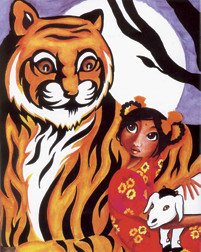
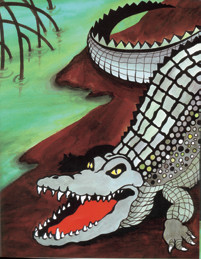
Diya and her pet goat Mishti meet the tiger and a crocodile in the forest
Like Mary’s little lamb, Diya’s goat Mishti follows her everywhere. One night Mishti scampers away, escaping from the safety of the compound and entering the forest. A terrified Diya slips out of the house in the dead of night to search for her naughty pet. In the fearsome forest with its shadowy shapes and strange sounds she meets and interacts with a creepy king cobra, condescending crocodile and the unexpectedly kind king of the jungle. Each one complains about the harm that humans are doing to the eco-system. The tiger concludes his tale with "Man has become our enemy and it need not be so.” The little girl promises to convey his message to the outside world. Safe once again with her family and friends, she tells them about her adventures in the forest, its laws and the need for all species to respect each other’s space and lives.
Diya with her mother
Meticulously edited, with large illustrations by Ratna Moriniaux Rege on each facing page, Daver’s first story for children ends with a two-page list of the more advanced words used and their meanings to aid the younger reader. Strangely, the pages are not numbered. Though meant for children, the story holds equal appeal for the not so young. With a degree in English literature from Calcutta University Daver, a former copywriter who has lived in Europe and Australia, eventually came to Bombay where she pursues a career in the social sector. Illustrator Rege, an alumnus of the J. J. School of Arts, Bombay was art director in an advertising firm but moved to France after her marriage. There she heads an art workshop in a center for mentally handicapped people and indulges her passion for art in her spare time.
SHERENE VAKIL