Unusual, hygienic and environment friendly, the fish
supplied by the Daruwallas has a loyal clientele
Mehroo Kotval
The swing door of the shop does its job effectively. It opens every few minutes with customers breezing in and out of Off the Hook (OTH) at Warden Road. Firdosh Daruwalla who along with his brother Roozbeh and Roozbeh’s son Junaid run a thriving business in exporting and retailing fish, makes several attempts to continue his line of thought about questions on the neatly packed fish in Thermocol trays and cling foil. Relentless ringing of the phone interrupt our questions asked whilst he is serving customers. Sitting there, you observe fish staring at you with labels underneath – grouper, snapper, prawns, scampi, halibut, squid and the Indian fare of surmai (seer), pomfret, rohu (carp) betki and the NRI-must — the Bombay duck or Parsi boomla aka bombil. Different types of crabs, lobsters and prawns also lie still under the thermostat glass.
Clockwise from top: Firdosh, Junaid and Roozbeh Daruwalla;
the façade of the shop; fish display in ice Photos: Jasmine D. Driver
The South Bombay outlet was inaugurated in May 2015 and Firdosh takes pains to educate his customers about freshness of the stock of the day, being environmentally friendly and hygienic. Questions like "How will you cook this? When do you want to serve it?” are overheard. The knowledgeable vendor enquires about preferred cooking style to be able to make a recommendation. Firdosh swims through the cooking styles "For curries and thick masala type, I recommend grouper, if you are going to steam the fish then thin slices are made… and yellow fin tuna is popular for western style preparations.” The expert specifies different fish, or varied cuts for poaching, steaming, frying, baking and curries and spices his information with the assurance that "their price reflects the same as in the market but volume drives our business. More service is offered for the same price.” He refers to the cleaning, filleting and packing of each portion before it reaches the customer.
In fact, OTH acquired its name since it deals only in line-caught fish. The trio named their concern to distinguish it from the ubiquitous trawler produce. Firdosh says that trawling or catching fish in large drag nets scraping the ocean floor, destroys the seabed and the lack of selective fishing is environmentally disastrous — leaving less fish available at the table because of over farming.

L to R: Firdosh serving a customer as Junaid looks on; Bombay duck, prawns Photo: Jasmine D. Driver; Coral trout
Chef turned retailer Firdosh had just retired from Indian Hotels (the Taj) after 35 years. He claims that his family, cumulatively six or seven members have served the Tatas for a total of 350 years. Junaid smiles indulgently at Firdosh kaka’s pride and we learn that Junaid trained to be an automotive engineer from University of Illinois Urbana Champaign. "If not this, I would have done something with cars. I love cars,” he informs us. Roozbeh has been exporting fish for the past 30 years, from early 1980s. It is he who got into the fish business as an exporter and broadened his line of work to retailing. OTH’s exports are mainly to Mauritius, the French territory of Réunion, Maldives and Seychelles. Junaid specifies that Seychelles restricts fishing. To support the 1.2 million local population, and two million tourists a year whose prime purpose of visit is seafood and beaches, the Government has imposed severe restrictions on fishing rights. Their Mauritius importer has dealt with them for the past 20 years, whilst OTH entered Malaysia and Thailand markets later. The export house also deals with the Middle East — especially Saudi Arabia where again tourist and expatriate demand is high.
Fishing for the cognoscenti
The fish is mainly sourced from the Andaman and Nicobar Islands, Kochi in Kerala and Kanyakumari in Tamil Nadu, where Roozbeh found that his suppliers threw back unknown fish such as grouper (local ekdu), snappers (taam), halibut (which does not seem to have a local variant) into the sea, pleading there were no takers. He immediately saw the market potential for local customers and acquired these cast-offs as well as the Indian favorites — surmai, rawas, pomfret, etc. He set himself a mission to popularize these rejects in the local market. So from the past familiar business of exports, Roozbeh graduated to local supplies, casting his net over local customers through OTH. Firdosh reveals that they do not import fish — the entire catch is sourced from Indian waters.
So far retailing is only effected from one shop in Bombay, with the resolve of expanding within the megacity as well as other towns. Their per-kilo pricing of red snapper is Rs 500; pomfret, surmai and rawas at Rs 750; fillets range from Rs 600 to Rs 1100. Squid is for Rs 300 while their fast moving squid rings are priced at Rs 600. Prawns and scampi vary from Rs 550 to Rs 900. Juanid expertly informs us that "there is a 35% difference between fillets and fresh meat as it depends on how much meat (versus bones) you get, that is the question.” They currently give free home delivery for an order more than Rs 500 and also pack the fish heads separately as heads are said to add body and relish to curries — currying "flavor!” Deliveries span Colaba to Dadar and if the time to deliver is long they pack the order in insulated bags. Firdosh says with pride, "If we label a product 900 gms it will not be 899 gms. It may be 900 plus but not less.” This is the reputation OTH has acquired with customers, most of whom are regulars.
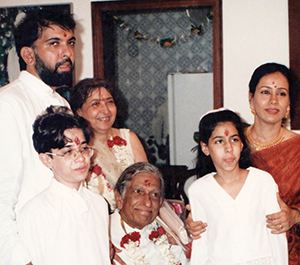
Roozbeh’s family at Junaid and Zeeba’s navjote
Parzan, Karina, Roshni and Firdosh
"We don’t supply farm prawns or Vannamei prawns (a farmed, exotic species of the crustacean). We prefer sea caught prawns,” Junaid specifies. He then adds, as Firdosh attends to an order, "Dad (Roozbeh) wanted to popularize the unusual fish locally. We even sell Mahi-mahi which is the same fish species as in Florida — the Indian one being greenish whilst the Florida one is greyish.”
The Daruwallas started promoting Christmas hampers of fish from their outlet at the Indian Oil gas station, adjacent to the well-known Ben Nevis clinic and residence which allows for parking and selecting at leisure — the add-ons are the tips shared keeping in mind when, how and where you are going to cook the angled produce. They also want to display sauces which will ultimately be part of the basket of goods supplied.
On asking how they compete with international suppliers for gourmet restaurants, Junaid announces unhesitatingly, "We don’t do the same products… (we supply) only prawns, red and rose snapper, groupers, squid rings and lobsters (to the fine-dine).”
Firdosh’s wife Roshni (née Sethna) used to make "delicious cakes and chocolates” but has stopped taking orders. Daughter Karina, 27, is a graphic designer, while younger son Parzan, 26 is an architect.
Junaid and his wife Shaan, who is into construction management, try new recipes and the successful ones are then introduced to customers as well. His mother Shaheen (née Durazi) also experiments when she is not busy with the export of clothes and leather bags. Junaid’s PhD sister Zeeba, a neuroscientist in New York works on drugs affecting children.
Firdosh and his entire family are regular agiary goers and are sudreh kusti wearing Zoroastrians. In fact he goes daily to the agiary. Though Junaid feels a kinship with the religion as Roozbeh is fairly ardent, he is unsure how he is accepted by the community at large. Both Zeeba and he have been navjoted and the young man also has his topi (cap) ready for any religious ceremonies.
OTH can be reached at telephone number 65506556.