From Dreams to Reality narrates the tale of a Bombay couple that achieved success in the garment industry in New York
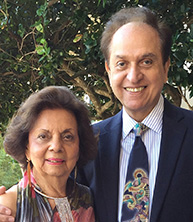
Garment designing entrepreneur Phil (Pheroze) Shroff has published a lush 457-page coffee table memoir titled From Dreams to Reality last year. The book dedicated to his wife Dhunnie (Dhun), son Zubeen, daughter-in-law Anahita and grandsons Zal and Kaivan tells the story of his life in Bombay and his journey to, and success in, the United States of America.
Parsiana caries extracts from the book with the author/publisher’s permission:

I was born on January 24, 1935 in Bombay. I grew up in a comfortable middle class environment. We had a car, refrigerator, radio, two servants (no cook because my dad wanted mom’s cooking only) and a chauffeur in later years when my dad could not drive due to a stroke. At that time in India, slightly above the poverty line meant that the family had a primus stove instead of a charcoal stove and an ice box (not a refrigerator) since they did not have electricity. We lived in Dadar which was then considered a suburb. Parsis used to put their nose up when they heard you were from Dadar. I guess a lot of them belonged to "clubs” while the only time we Dadar boys went to the clubs was for Christmas Eve and New Year’s Eve dances.
Going to the movies every week-end was the main source of entertainment. We only saw Hollywood movies; so naturally every Sunday night you dreamt of being in Hollywood with one of those beautiful actresses you had just seen. This created the hunger and the passion to one day be in that fairy land of our dreams.
In the early 1900s, in general, the women were not highly educated. They were expected to take care of the children and run the house. My mom (Soona Jasumoney), I believe, had not even passed her high school, However, she could speak and write English and was ready to help anyone and everyone at the drop of a hat.
With my dad Savak, it was a different story. He was tall, fair, had a good personality but was extremely hot tempered. I used to shiver when he called me to do anything. He did love both my sisters and me very much, but I was always afraid of him. He was trying to make a man out of me. I was constantly hiding behind my mom’s and my aunt Naju’s petticoats. He would get very upset about it but could not do anything. I was always protected by them and my maternal grandpa and grandma who also loved me very much.
Media coverage featured in the book
From left: Kaivan, Zal, Anahita and Zubeen Shroff
Dilemma range created by Dhun and Phil Shroff
He insisted that all three of his children should play an instrument. My sisters began to learn the piano; when my turn came, he indicated that I should perhaps take up the violin. When I went to J. P. D’Costa (he was a guest conductor of the Bombay Philharmonic), he told me to select the piano. Since he knew my dad, he felt that the violin would one day land on my head if I played the wrong note. I hated playing the piano and hated going to school.
He never discussed his parents or background. Maybe in those times, the family dynamics were different. We never asked and we were never told. The only thing I knew was that he left home because of his step-mother; why and at what age, I don’t know. In contrast to my mom, who was the simplest, mildest and most loving, my dad was different. He, I presumed, came from an educated, affluent family and was a voracious reader, constantly reading textile or engineering magazines, hardbound books and novels he brought from the library. Very fond of quotations and poetry, my father would recite them freely in everyday life and at dinner parties. He played the violin and the harmonica and one could always hear him humming or whistling classics or popular songs of the era. You have to remember, that at that time, there was no television and limited English radio stations. Having gramophones with a large record collection was a rarity in any home. Although I was always afraid of him, I guess, I was absorbing all the literature, poetry and music through osmosis.
My dad put himself through Victoria Jubilee Technical Institute and got an L. T. M. diploma. He was obviously brilliant; worked his way up to becoming the managing director of Courtlands Inc (a British firm) and ultimately starting three manufacturing facilities with partnerships in all of them… India Rayon Mills, Saraswati Silk Mills and Phiroze Razing Works He provided us with a comfortable life. He was very forward thinking; confident that women would branch out in professions that were dominated by men and was eager to make my sister Amy one of the first women textile engineers and run a factory. In her first year of college he got her an apprenticeship at ICI Labs to study dyeing. Unfortunately he died very young at the age of 52 after suffering for a few years with diabetic paralysis, and could not fulfill his dream.
Both my sisters were very fond of me. We were a closely knit family. Amy (who was eight years older than me) was more like my father and my younger sister Silloo (five years older than me) was more like my mother. Both of them guided me as I was growing up. Amy was practical. When I graduated and started work at Kohinoor Mills, which happened to be across from her bungalow, she would bring lunch for me at 11 a.m. and she noticed that the chaiwalla (tea stall) was making more money in one hour than I was making in a day; after a couple of weeks she thought I should give up the job and set up tea stalls at all the mills. Luckily I got my letter of admission to Lowell Tech and did not have to confront her.
"Reverse the charges”
Arrived late in the evening (in the USA); I believe it was a Saturday. Only contact I had was Adi Guzdar (couldn’t find his phone numbers) who was supposed to pick me up and Lowell Tech. Adi never showed up. The airport agent tells me I couldn’t go to Lowell that evening, and that I would have to stay over in a motel and catch the train the next day. Had to ask her what was a motel. Took a shuttle to Logan International Motel. I had a Sheaffers pen and pencil set that Aunt Naju had given me when I was in high school. It was the one with the white dot, meaning lifetime guarantee. This was my most precious and cherished possession. I was asked to empty out the ink when I got on the plane because of it squirting out due to the air pressure. So when the agent at the desk asked me to fill out the form, I asked for an ink pot and proudly pulled out my pen. They looked at me as though I had arrived from Mars. She told me, "We don’t have ink, throw away that junk” and handed me a ball point pen to keep. I knew then, this was America, where the streets were paved with gold. Till then, I had only heard and read about a ball point pen that worked without ink, and here some stranger was giving it to me. All I had was $ 25 on me and I had already spent a little from it in Rome and Paris. Some funds were transferred for me to Lowell Tech where I was supposed to collect them; I wasn’t allowed to carry it with me. Then a young man took me to my room and I saw a box in a corner which was identified as being a TV. I told him it was the first time I had seen one and to show me how it worked.
Took a train from Boston to Lowell. Must have been a Sunday since the taxi driver told me the school was closed. He knew I was totally lost since I had no other address. He took me to YMCA (Young Men’s Christian Association) lodgings and told me that under the circumstances this would be the best place for me to stay and he spoke to the manager. It was late evening and a bit cool. I remember walking across the street to a coffee shop. Above the door, they had a sign that read, "the most beautiful girls pass under this door.” I thought I was in heaven, not realizing that in America they wrote whatever they liked on their property. I stood at the counter and looked around and I saw girls and boys drinking a glass of milk and eating something. I felt brave and asked for a glass of hot milk. The waitress looked at me quizzically and repeated "hot.” I asked her what were they drinking and she said "cold.” I could not imagine anyone drinking cold milk in that weather. Luckily I saw a sign "hot chocolate and donuts” and immediately switched my order.
Somehow I had my cousin Adil’s number on me and I was dying to make a phone call but did not know how. I had seen a phone booth so in the morning before going to Lowell Tech, which was a couple of blocks away, I got the courage to step in and dial the number. The operator immediately came on the line and asked me to deposit some amount. I wasn’t too sure of the currency and the exchange, having never travelled. I figured the best thing would be to put a dollar and get the change. I asked where to put the dollar bill and she tried explaining one can only use coins. Adil listened to all this, and with exasperation, told the operator to reverse the charges.
Once connected, Adil sounds very aloof. So I question him, "Adil, this is Phiroze, I am in America, aren’t you excited to hear my voice?” and he replied, "You dodo. You woke me up. It’s 4 a.m.” I thought he had gone bonkers since my watch was showing 7 a.m.
New York
Dhun, my son Zubeen and I shifted to New York in the mid-60s; an era of women’s liberation and sexual revolution. Zubeen was perhaps three or four years old. We were staying on 24th street and 2nd Avenue in a building that was filled with airline stewardesses because of its proximity to the East Side air terminal. Dhunnie was doing four-days designing for Darlene Swimwear in Rochdale, Massachusetts. So she had to fly there. She would take the helicopter from the East Side to Newark and from there a shuttle to Worcester. We were friendly with four of the stewardesses. They loved Zubeen because he was extremely friendly and always smiling, so we made a deal with them to take care of Zubeen, depending on their schedules. It worked beautifully. The day it was not possible for them, Dhunnie would take Zubeen with her on the helicopter and the plane, and make arrangements in Worcester for one of the sample hand’s husband to pick him up from the airport and take care of him. He was so fond of Zubeen he sent us a picture with the caption, "The most beautiful and loving baby in the world.” I completely capitalized on the situation. I made sure everyone in the office as well as in the industry knew this scenario. You can imagine the impact it made. While American women were beginning to exercise their rights and trying to break into the business world, a woman from India was leading the way. All my peers and my trade associates would tell their wives about it, and the wives would talk about it at social gatherings and look at Dhunnie with awe.
Since my office was in the Empire State Building, I would invite my colleagues to join me for a drink at my apartment which was just 10 blocks away. They would come to the apartment and would see these gorgeous girls (remember in the 60s an airline stewardess was smashing most of the time) in shorts running around, and some times they would have baked some cake or cookies for me. It just drove them bonkers that I was living a life that only happened in the movies or novels. The next day, naturally, the whole office would hear about it and this went on for years.
I had to constantly sprinkle tit-bits about myself, so people would talk, and start forming an upscale image of me. My mantra always was, "No one is going to blow your trumpet, you have to blow it for yourself.” With the ammunition I had under my belt, I had built up tremendous self-confidence. Consequently, anytime an offer came to get up on the stage in front of an audience, I never refused it. I started taking offers at times on subjects I knew very little about. I convinced myself, that if they are asking me to participate, it meant there aren’t that many individuals around who are very proficient in it. I always felt, if I let my emotions control me, I would always have an excuse not to tackle something, but you have to grab the bull by the horn, and accept the challenge. A word of advice to the reader… you will never have all the data about a topic, never have enough time to take extra load, never have all the support needed to achieve something, etc; but you have to grab the moment and make the most of it. That opportunity once missed, is an opportunity lost. Not having the full breadth of knowledge about the subject always gave me butterflies in my stomach when I got on the stage, but I did it, and it always worked.