Mid-day’s editor-in-chief comments on
challenges faced by the print medium and
adapting to an increasingly digital world
Farrokh Jijina
Don’t come to journalism for the money. There isn’t much. Don’t come for the fame; we’ve seen the rot unfold when editors choose to become the news. Come if you want to be a voice, a chronicler, change maker, story teller. It’s one of the most magical ways to be of value to your people by using the same talent you would to progress in your career,” stated Tinaz Nooshian, editor-in-chief at mid-day (MD), the 10th largest English language daily in the country. She could possibly be the first Parsi lady editor of a national daily [Dina Vakil was the resident editor of the Bombay edition of The Times of India (ToI) and Freyan Bhathena, editor of the erstwhile The Afternoon Despatch and Courier]. MD’s first editor was a Parsi, Behram "Busybee” Contractor, when the then afternoon daily was launched in 1979. Nooshian is the second Zoroastrian to occupy the post.
"We’ve made it to the Top 10 English newspapers in India list repeatedly. For a homegrown newspaper — and now the city’s only tabloid — it has taken relentless effort to present distinct content and publish what the others don’t and won’t. What matters is to break stories and offer lifestyle features no other newspaper/news site will.” She reiterates that "the sole focus” is to keep MD relevant in a morning market driven by behemoths.
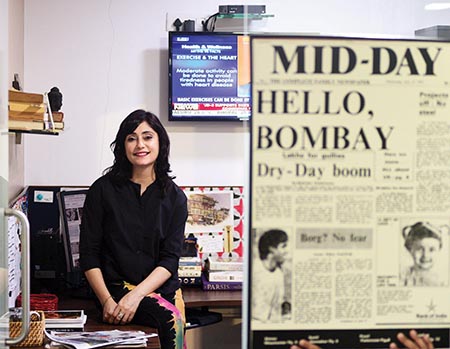
Tinaz Nooshian: Leading a "legacy brand that cuts through the hype" Photo: Ashish Rane
Above: Tinaz and Shahrokh with parents Katie and
Behram Nooshian in earlier times and in recent times
MD is published by Mid-Day Infomedia Private Limited and has a reported readership of 14.14 lakh with a collective social media reach of 136 million. Nooshian manages a 65-odd member editorial team, additionally overseeing the 30-odd editorial team of Gujarati MD edition since 2019. The company’s plant at Rabale in New Bombay prints the flagship MD, Gujarati MD, Sunday MD (SMD) and their Urdu broadsheet The Inquilab. The company is a subsidiary of Jagran Prakashan Limited, a listed company that also publishes Dainik Jagran.
"At Rs 10, our SMD is one of the city’s most expensive reads, but it continues to have a loyal readership … With it, we are taking the burden off advertising and placing the choice in the hands of the reader… For an editor to not care about business interests would be conspicuously old-fashioned.”
Nooshian responded in vivid detail to Parsiana’s questions via email and spoke to us on February 5, 2022 over refreshments at a downtown coffee shop.
Parsiana queried her about an apparent dichotomy — a newspaper called MD that comes out in the mornings. "When you say mid-day I don’t think people wonder what time of the day it hits the market. They think of a legacy brand that’s strong on local reportage, objective news, entertainment, and information that cuts through the hype.” Over the years, MD has gone from having three editions — morning, city and late — to being an afternoon paper to offering a.m. and p.m. editions, and then competing solely with the morningers. "These have been largely business decisions driven by a cluttered segment and expansion opportunities.”
The journalist says she has learnt to be "dispassionate, at least in part,” about the platform through which news is disseminated. "I say, read us in print, engage with us on Insta(gram), watch us on YouTube, explore the epaper on your tablet — experience us wherever you like, but do.” Offering the example of her Sunday paper, she stated that its core print target audience is aged 30 to 50 years. "But 25% of its Instagram followers are between 18 to 24 years. This lot may never transition to print or epaper; this is where they will consume us and may want no more. And we have to accept it if we wish to stay relevant…
"Print’s challenge in the digital world is defined by the truth that everyone is now a creator and publisher. Traditional media had to deal with bloggers, bloggers are dealing with crowd sourced-content aggregators; they in turn are fighting ‘YouTube’ journalists. Everyone is competition for everyone.” An adherent of "we are going to have to adapt on-the-go,” Nooshian stated that "each new accurate and trustworthy source of news added is good for journalism.”
According to the Reuters India Digital News Report 2019, 24% of those under 35 years surveyed said they got their news from social media, Facebook and WhatsApp primarily. "Interestingly, 34% of those surveyed also said they don’t trust the news they see on social media,” notes the editor. Fake news has helped print re-find respect…especially during the pandemic when accurate information was tough to come by… The rigor of print gives it an edge — on-ground reporting by experts, vetted by specialists through multiple checks.”
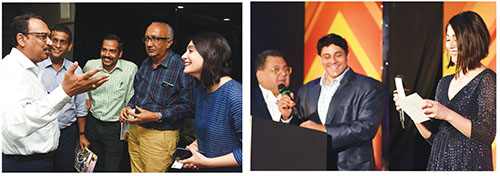
Tinaz with former deputy municipal commissioner (gardens) Kishor Kshirsagar (l)
and humorist Cyrus Broacha (2nd from r)
MD is known for its focus on community stories. "Over time I’ve realized that the idea should be not only to cover conventional communities historically associated with Bombay — Parsis, Jains, Bohras, East Indians, Kolis, Anglos, Jews — but also the recent arrivals: the Northeast Indians in Kalina, the Korean pocket in New Bombay, Africans in Vashi… And extend the idea to ‘tribes’ or groups of people bound by a common something.”
The editor considers the New York magazine (not to be confused with The New Yorker) as a benchmark. "It harbors all the interests we do — city life, restaurant criticism, culture, fashion, politics, people and their ideas. If we are able to look at not just the city but everything of significance around the country and world from the Bombay lens that would be something.”
The slowdown resulting from the pandemic has been a worry for Nooshian. "That we’ve managed to survive in a tough market has helped us with market share… Innovative selling is where things are headed… Editorial advertising continues to grow, and we’ve embraced it while being entirely transparent with our readers… One addition to epaper subscription we have recently introduced is ‘pay three rupees per exclusive story you’d like to read’ on mid-day.com while also inching closer to full-price print copies…Think of the flexibility and freedom it allows the readers… To believe that advertising will continue to subsidize content for the reader is foolish.”
Parsis and the Press
"Given that the community has given journalism some prolific editors and publishers, including Framji Cawasji Mehta of Kaiser-e-Hind (who coincidentally like so many journalists today reporting on the pandemic, was consumed in the late 1890s with reporting the Bombay plague, even shifting the press to the more economical Matheran after it became unviable to run a business out of ravaged Bombay) and Dadabhai Naoroji who edited Rast Goftar, it would be lovely if Zoroastrians continued the legacy,” stated Nooshian, but added there are no Zoroastrians in her editorial team.
She cautions, "You can’t ‘do’ journalism. You have to ‘be’… Harking back to the days before the lockdown, the editor said, "When Prime Minister (Narendra) Modi announced an overnight coronavirus-induced lockdown, it meant that newspaper vendors wouldn’t ply. We had eight hours to figure. We didn’t miss a day’s edition, turning MD into a pdf version and manually WhatsApping it to everyone for free. We did this for four months straight.”
Of glasses and cherries
Nooshian is a third-generation Iranian migrant to India. "My father Behram came to Bombay from Yazd, following his maternal uncle… He waited tables at Irani restaurants before he ran one himself — Church Restaurant at Girgaum,” she stated. Behram eventually ran a bakery and took to horticulture. "Like so many before him, this city and its people gave him a chance, making the corner Irani joints a symbol of inclusiveness that allowed ‘outsiders’ to assimilate — something that we are wanting right now.”
The young entrepreneur rented a room on the ground floor of a building in Chira Bazaar "where my mother, Katie (née Bhurekhan) and her family lived, falling in love with his Parsi neighbor whose family would oppose their union because ‘he had come from a faraway country we don’t know and is hardly a match for my graduate daughter.’” Behram survived the opposition with eventual support from Tinaz’s feisty grandmother, Homai, "who would remind her husband Framroz, that they too had followed their heart.”
Behram embraced the Parsi and Indian way life, learning Hindi, Marathi, even Konkani chatting with Goan visitors at his restaurant, states Tinaz. "And yet, in silent moments, he’d recite lines from Persian poetry, pining secretly for a lost land where pomegranates bled onto his hands in the garden… On her part, my mother made the occasional Ush-e-berenj and Abgoosht for lunch and tried speaking Persian. But after her first and only visit to Iran, when her mother-in-law requested for gilas and she presented the woman with a glass instead of cherries (gilas in Farsi) from the house garden, she lost a bit of the mojo,” she laughed. Brother Shahrokh is an electronics engineer by training and horticulturist by passion and profession. He lives with his family in Dahanu.
An alumna of The J. B. Petit High School for Girls, Rishi Valley and St Xavier’s College, Tinaz earned a postgraduate diploma in mass communications from Sophia Polytechnic. Before taking over as editor of MD in 2015, she held senior positions at The Asian Age, Mumbai Mirror and TOI. "This is my second stint at mid-day. Between 2005 and 2011, I was its features and Sunday editor,” she stated.
The editor, who is single, believes that love and marriage are equally personal. If racial purity is a religious obligation and right for inclusion, Tinaz believes the child born from a Zoroastrian mother is as "pure” as the one from a Zoroastrian father.
Zoroastrianism, to her, is a unique ethnic culture and faith that calls for preserving, but questions, "Must we do it with enforced inbreeding? ... How do you protect something — by keeping the door to it shut? Or do you empower its presence by raising awareness about its value so that others are inspired to defend it?” she asks rhetorically. Bemoaning lack of resources for religious knowledge, she asks, "Do we have an Indian app where I can easily access and learn Persian? Is someone hosting a room on ‘Why it’s cool to be Zoroastrian’ on Clubhouse (the social media app)? Have our religious representatives and Zoroastrian academicians worked at setting up a Zoroastrian studies center or university level program in India of quality and stature that rivals that of the School of Oriental and African Studies (London)?” Not espousing the virtues of or critiquing sky burial, she stated that "disposal of the dead is a choice that we must allow individuals to make in modern society.” She left us with one final rhetorical question: "Has the coming up and running of the Worli Prayer Hall undermined the status of Doongerwadi, or threatened dakhmenashini?”
"For me, religion is embodied in humata, hukhta, hvarshta (good thoughts, good words and good deeds)… In a piece that I read about the controversial return of Iranian Kurds to Zoroastrianism, the head of an association that’s been promoting the religion there asks a young man looking to join if he’d respect nature, its four elements, and mankind... If you strip away the rhetoric, it’s perhaps this simple principle that sits at the core of our faith.”