Navsari’s 100-year-old Dosibai Kotwal Parsi Boys Orphanage now also provides a venue for social functions
Farrokh Jijina
The spacious grounds of Navsari’s Bai Dosibai Kotwal Parsi Boys Orphanage now house an air open venue for marriages, navjotes and other cosmopolitan functions.
Dosibai Kotwal Parsi Boys Orphanage complex: from l, office building;
dining hall with kitchen and dormitories; study rooms and hall
Views of functions at Behramji Shirvai party plot
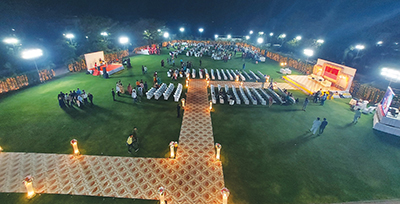
The 1,00,000 sq ft Behramji Shirvai party plot includes a wide stage and has two air conditioned rooms alongside equipped with toilets and bathrooms. In addition, accommodation is available for families of those booking the venue. Comprising two en suite private rooms as well as dormitories, this can house up to 10 persons. Approximately 20 to 25 functions are held annually, including five to seven community ones, superintendent Barjis Bamji explained. Booking fees for the grounds are Rs 48,000 for Parsis and Rs 95,000 for members of sister communities. Income from the party plot helps fund the activities of the Orphanage.
The Orphanage was established in 1923. The land around the institution was converted for non-agricultural use when it came under threat of acquisition a decade-and-a-half ago. "Amune aa property java dévi nahi hati (We did not want to let go of this property),” Bamji, who has served the institution in various capacities since 1985, told Parsiana on December 28, 2022.
"Twenty-two boys, ranging in age from three-and-a-half to 25 reside at the facility,” Bamji told us. Residents are mostly from the interiors of Gujarat or from the border areas of Maharashtra and Gujarat, and include two from Bombay. Education, boarding, lodging and health care is totally free, he added. Stating that they attempt to take in children from the villages when very young "so that they can adjust to life at the facility,” Bamji said that it is necessary for the father of the child to be a Parsi. With the dwindling Parsi population, "ammé bané tya sudhi naa nathi kéhta (As far as possible, we do not refuse admission),” he stated.
The superintendent estimates that about 1,200 boys would have benefitted from the institution since it was established 100 years ago. Many of the inmates have gone on to become chartered accountants, lawyers and engineers, he noted. A modest get-together is planned with ex-residents to celebrate the upcoming centenary.
"Providing good education, better living conditions and essential support including food, healthcare, clothes, shoes, bedding and psychological support to help them build and sustain their lives” is the Orphanage’s credo, details a note from Bamji. Six staff members look after the welfare of the boys. Fees for the nearby schools and colleges, as well as costs for the boarders’ extra coaching are provided by the Orphanage. Of the current residents, four are college-goers, Bamji told us. The boys pray in and maintain the dadgah fire on the adjacent premises. Meals include snack boxes which the children can carry to their schools. "The students are provided three to four pairs of new clothes and two pairs of shoes every year. Medical care includes childhood immunizations and vitamin supplements for children under five, and routine medical checks for all.”
The running of the Orphanage is overseen by a seven-member board of trustees comprising Dastur (Dr) Firoze Kotwal, Yazdi Kasad, Kaiwan Kasad, Ervads Khurshed Desai, Sorab Vajifdar, Shahrukh Desai and Navzar Desai.
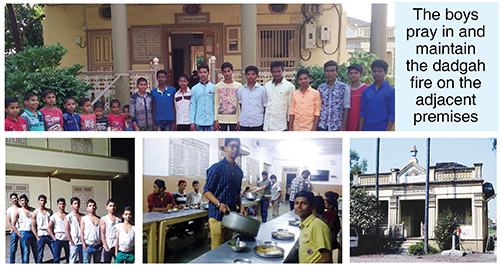
Top: residents of Orphanage; 2nd row, from l: differently aged boys; at mealtime; dadgah building
The early days
The Orphanage opened its doors in January 1923 with six children. Inaugurated by Navsari-born gynecologist Dr Sir Tehmulji Nariman, the number of residents grew to 14 by the end of the year, noted trustee emeritus Kotwal. In response to Parsiana’s request, the High Priest dug into his personal notebooks to provide information on the institution’s past. "The Kotwal Orphanage was founded by the trustees of Dosibai’s estate… Dosibai was the sister of my paternal grandfather Pirojshah Adarji Kotwal… She passed away in July 1920… On account of her close relationship with philanthropist Behramji Nusserwanji Seervai, she inherited a large sum of money and a spacious bungalow in the posh area of Navsari called Lunsikui,” he stated. Seervai had earlier presented a fire-vase (afarganyu) made of Chinese silver to the Navsari Atash Behram in 1866, noted Kotwal. "Before that a copper fire-vase presented by Lal Bahmanji Athugar, a layman (behdin) of Surat was used for the holy fire,” he said. Seervai died in 1914.
In accordance with Dosibai’s will, her executors, Dr Sir Jivanji Modi, Dr Jehangirji Dordi and Ervad Rustamji Ranji, arranged to install a dadgah fire within one of the rooms of Seervai’s bungalow. "The trustees of the Orphanage had instituted a scheme for the performing of ceremonies under which death anniversaries of donors were observed under the supervision of the superintendent of the Orphanage… The number of ceremonies became numerous in the course of time and the trustees thought of constructing a separate building for the dadgah fire” on the Orphanage grounds. In the meantime, Gujarati writer Desaiji Sohrabji Mancherji, who was president of the late Seth Nowroji Chandjibhai Mehta Yadgari Fund, wrote a letter to the trustees of the Orphanage offering to build a separate abode for the dadgah in memory of the late Seth Nowroji Mehta. The kind offer was gratefully accepted, noted the High Priest. "A big beautiful fire-vase was presented by the sons of Seth Nowroji for the sacred fire.”
From the August 23, 1931 issue of the weekly Navsari Prakash the High Priest listed the other causes supported from Dosibai’s estate, in addition to Rs 1,00,000 set aside for the Orphanage, The main charities include: Rs 27,000 for the performing of religious ceremonies; a donation of Seervai Hall with adjacent land to the Anjuman, with Rs 5,000 set aside for its maintenance; a donation of Rs 2,000 to the Navsari municipality for the maintenance of land at Lunsikui called Seervai Park; Rs 5,000 to the trustees of Behramji Seervai Dharamshala at Baroda. "If any sum of money remained, the same to be donated to the Navsari Anjuman for the… Atash Behram building.”