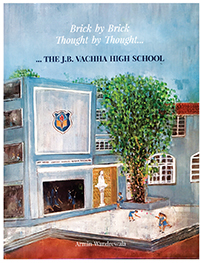
Brick by Brick, Thought by Thought… The J. B.Vachha High School by Armin Wandrewala. Published in 2024 by The J. B. Vachha High School, Mancherji Joshi Road, Parsi Colony, Dadar, Bombay, 400014, email: jbv.historybook@jbvaccha.org Pp: 162. Price: Rs 950.
The J. B. Vachha (JBV) School completed 100 years in June 2024. It is an iconic institution with over 5,000 alumni, from within and outside the Dadar Parsi Colony (DPC), and deserved a commemorative book. Armin Wandrewala, a JBV ex-student, attempts this with her Brick by Brick, Thought by Thought… The J. B.Vachha High School, half-way between a serious history and a coffee table tome. Her book captures the perceptions of ex-students and their love for JBV and their teachers very well. The distinct personalities of different principals and teachers over the decades also emerge sharply, even if the non-linear structure of the book means that the French teacher, who used to break into tears in class, returns three times.
Armin Wandrewala: capturing the essence
Those with a connection to JBV will love the book for its details and for capturing the essence of what made it special. As an alumna noted nonchalantly, "In DPC almost all girls were sent to JBV.” That would not have happened if it were not special [and no one speaks of the boys’ schools in the area — DPYA (The Dadar Parsee Youths Assembly High School) or Don Bosco High School in the same way]. JBV alumni also display a confidence that is not often found among the products of other girls’ schools. Since Wandrewala rarely generalizes, I will identify five things that appear to have made JBV special.
The first would be the immense nurturing care teachers took of their students, going all the way back to the founding decades when in other schools "spare the rod and spoil the child” was the norm. The second would be its socially inclusive policies. It was early in admitting non-Parsi girls to fill vacant seats (though not before Lady Hirabai Jehangir pushed for it, and M.C. Chagla’s 1954 High Court judgment permitted it). And JBV trustees provided half and even full scholarships to needy Parsis (though it may have been odd for scholars to receive their mug of porridge while the full-payers received a full school lunch; the government’s mid-day meal idea certainly didn’t originate in JBV!).
The third would be the good fortune of long-serving principals: Perin Nagarwalla (1945-76), P. B. Rajan (1977-89), Khorshed Bharucha (1989-2005), and Banoo Makoojina since then. These principals not only ran a tight ship (only in 2002 did the School stop accepting state government assistance), they were clearly able to retain dedicated teachers and draw Parsi role models into the School to inspire the girls. The imperial Lady Jehangir was a mentor and frequent visitor. Other celebrity visitors to JBV included playwright Adi Marzban, columnist Behram ‘Busybee’ Contractor and Field Marshal Sam Manekshaw (who, we are told, declared a two-day holiday at the end of his graduation speech, to the great consternation of principal Rajan)!
Without continuity of principals, fostering of a distinct culture would have been difficult. It was a culture that was quintessentially 20th century Parsi. It is a testament to JBV’s success with its non-Parsi admits that is best articulated by an ex-head girl Vasanthi (who said she never felt she was a "Hindu student studying at a Parsi school”): a "broad liberal outlook, a spirit of idealism, a sense of compassion.”
The final determinant of JBV’s success would probably be its carefully calibrated curriculum, simultaneously progressive and practical. JBV was progressive in introducing sex education as early as 1969, but it was taught within the interesting label of "Sexology and Mothercraft.” The girls put on very mature plays like Othello but teachers like Shroff insisted on "poise, deportment and an erect posture” and Bana went around ripping open the hems of uniform skirts she deemed too short! We are told of sophisticated debates about Gandhian methods, and one grade IX class took the initiative to write to British novelist Agatha Christie (to which Christie replied saying she had no idea she had fans in Bombay)! Yet these initiatives co-existed alongside "entire poems learnt by heart,” a teacher "entirely intolerant of perfect pitch,” and marks being knocked down for poor handwriting. Language offerings were rich and included Persian, French and Gujarati; but not at the cost of a curriculum which would "equip girls for life”: embroidery and needlework, "laundry class,” and cooking taught by the author of a book called Gharni Rani (Queen of the Home)!
What were the debates that went on over the decades between conservative and progressive educators in JBV? What did parents want for their daughters? How Zoroastrian was the "moral science” curriculum which led an alumna Vyoma Parikh to recount that she could recite her one Ashem and two Yathas 50 years later? Why was the JBV School band only started in 1989 (till then the DPYA boys came over to play!)? How, for that matter, was the DPYA boys’ school viewed by JBV? Given that the JBV pre-primary has always had boys, was co-education ever considered by the trustees? Why and when did JBV back away from electioneering (which had proven to be very educational) to a system where teachers selected captains? Why did JBV wait till 2020 to move from the SSC (Secondary School Certificate) to the ICSE (Indian Certificate of Secondary Education) curriculum? These are all an educator’s questions that Wandrewala, a lawyer by profession, does not even pose, let alone attempt to answer. We will await JBV’s 125th to get more analysis of JBV’s role in the evolution of progressive schooling in Bombay.
But her carefully curated alumni testimonies leave no doubt that JBV’s educators lovingly shaped modern Parsi female identity, girl by girl. If Parsis stand almost unique today among Indian communities in their rejection of traditional patriarchy, where girls have surpassed boys educationally, and where gender equality is not just an aspiration but a reality, JBV must receive a lot of that credit. CYRUS VAKIL
Vakil, with a PhD in British and colonial history from Yale University, recently retired as principal of Bombay International School.