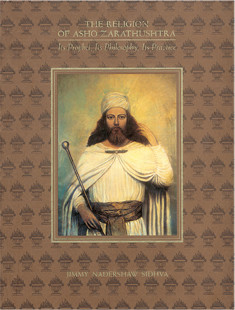
The Religion of Asho Zarathushtra: Its Prophet, Its Philosophy, Its Practice by Dr Jimmy Na-dershaw Sidhva. Published in 2006 by the author, 140 Backbay Reclamation, Bombay 400021. Pp: 156. Price: not mentioned.
Dr Farokh E. Udwadia
The Religion of Asho Zarathushtra: Its Prophet, Its Philosophy, Its Practice by Dr Jimmy Na-dershaw Sidhva. Published in 2006 by the author, 140 Backbay Reclamation, Bombay 400021. Pp: 156. Price: not mentioned.
Dr Jimmy Nadershaw Sidhva’s book The Religion of Asho Zarathustra is a simple yet elegant and learned exposition of the very first monotheistic religion in the world. This book, which should find a revered place in every Zarathushtrian home, lucidly unveils the very heart and soul of our great religion — the Prophet, the majesty of his message to the world, the beauty of the basic tenets and practices that govern our ancient faith. I am sure the book will also appeal to non-Zarathushtrians, particularly those interested in the study of comparative religions, or for that matter to any and every individual with an inquiring mind who wishes to contemplate the meaning of our existence on earth.
Dr Jimmy N. Sidhva
Each of the several chapters is self-contained and self-explanatory so the reader can start with any chapter he or she chooses. The opening chapter, "The Life of Spitama Zarathushtra,” is a delightful sketch of the life of our Prophet and the origin of our religion. The author believes that the Zarathushtrian era dates back 8,000 years, though many current historians would place his epoch-making presence in the world between 1500-2500 BC. Be that as it may, the dawn of Zarathushtrianism is steeped in antiquity; it is a faith and religion ancient even to the ancients. The revelations of Zarathushtra remain path-breaking as they were proclaimed in an age dominated by polytheistic beliefs and cults.
The birth and early years of Zarathushtra are partly legend, but as he grows to manhood his yearning for spiritual perfection and for communion with his maker, Ahura Mazda, is evocatively brought out by beautiful quotes from Gatha Ahunavaiti. The author then quotes from the Gatha Ushtavaiti describing the ultimate spiritual enlightenment that enabled Zarathushtra to reveal Ahura Mazda’s message to the world. I find the numerous quotes from the Gathas thrilling, spiritually uplifting and luminously beautiful. The chapter on sudreh and kusti is educative and is a must for all Zarathushtrians. The sudreh and kusti, Sidhva explains, are the emblems of our faith in the Mazdayasni religion.
The next chapter on the holy fire starts with a beautiful quote from the Ahunavaiti Gatha: "Oh Ahura,Thy Divine Fire/Grown mighty through Asha, do we earnestly desire!”
The fire that we Zarathushtrians worship is the symbol for the divine fire within Ahura Mazda.
I wish that the chapters on the Mazdayasni Zarathushtrian religion and the Zarathushtrian prayers had been presented in tandem. They are both written with exquisite clarity, illustrated by quotes from the Gathas, which I read over and over again. Sidhva explains the concept of good and evil, the creation by Ahura Mazda of Spenta Mainyu, the good, beautiful spirit and its twin Angra Mainyu, the evil or destructive spirit, and the freedom given to man to choose between the two. He quotes from Gatha Ahunavaiti: "Listen well with your ears, to my best teaching./Consider with enlightened mind, all ye, before reaching/A decision on the choice between two paths shown,/Each man to himself, his decision his own.”
Yet Zarathushtra preaches righteousness and truth and enjoins that each act of a man or a woman in this world has its own reward or punishment, quoting from Gatha Vohu Khshathra: "The fate of the deceitful is full of sorrow and sadness/But for the truthful, there is illumination and happiness!”
What is the essence of our religion and our prayers? This is again discussed with engaging clarity. The essence is the ‘good life’ — good thoughts, good words, good deeds. Righteousness for the sake of righteousness. The essence is not just to be good but to oppose and fight evil wherever and whenever one encounters it. The author emphasizes the principle of justice in the Zarathushtrian faith and quotes Gatha Ahunavaiti again: "Thou art… the Unrivalled/Judge of the acts of all men in this world.”
The book next goes on to explain our Avestan religious literature and gives the English translation of our treasured kusti prayers. Prayers enable the devotee to reach out to Ahura Mazda. I am reminded of the apt lines of a 19th century poet: "Prayer is the soul’s sincere desire,/Uttered or unexpressed,/The motion of a hidden fire/That trembles in the breast.”
The section on rituals and practices is enlightening and I learnt from it a great deal I did not know. Rituals form an essential element of all religions — they bind the flock to their faith. Yet rituals and practices are the vestments that clothe religion; one should look through them to see and appreciate the core and essence of Ahura Mazda’s message.
One chapter is devoted to many quotes by famous scholars on the sanctity and beauty of the Zarathushtrian faith. I wish the author had included the views of Arnold Toynbee, one of the great historians of our age. Toynbee felt that the best explanation of the world of today is to be found in the Zarathushtrian belief of Ahura Mazda and the presence of the twin forces of good and evil in the world.
I found the last chapter, "The Divine Plan” quite fascinating and in some ways inspiring. It constitutes the author’s personal beliefs and convictions, to an extent based on the Gathas, on how Ahura Mazda ordained the creation of the universe, of man, and of the ultimate evolution of our universe and of man within it. The concept of time is in tune with that in other religions — notably with the Vedic belief. It also embodies within it the intuitive feelings of great poets and litterateurs. As T. S. Elliot put it: "Time present and time past/Are both perhaps present in time future/And time future is contained in time past./If all time is eternally present/All time is unredeemable.”
One is also amazed to see how today the views of modern science, philosophy and religion seem to converge towards a common ground on the origin of our universe and the laws that probably govern it.
The author believes in reincarnation and his beliefs in this respect are akin to the Hindu philosophy of "karma,” wherein our present life is conditioned by the past and the future conditioned by the present. Will Ahura Mazda’s divine plan for creation culminate, as the author believes, "in the renewal or renovation of the world” — the promised Frasho Kereti, wherein good ultimately conquers evil and all souls ascend to immortality? Toynbee, an ardent believer in the basic tenets of the Zarathushtrian faith, felt that he could not subscribe with certainty to the triumph of good over evil as informed by the Mazdayasni faith.
Sidhva deserves to be congratulated for this excellent work. Beautiful and instructive as the book is, it has just one lacuna. Sidhva mentions in the Preface that he has avoided all controversial issues. I can understand his reasons for doing so; even then, I do wish he had expressed his learned views on some of them. I quote from page 25 of his first chapter: "Thereafter Ahura Mazda bestows Divine Wisdom and the knowledge of 21 Nasks of the Avesta on Zarathushtra and appoints him a world teacher who should spread His word and His religion to all mankind.
The religion of Asho Zarathushtra is clearly a world religion, for the benefit of all mankind. Should it be restricted by the bigoted to a community dwindling in numbers and predicted within the next 50 years to become a tribe? If so, this great ancient faith will be imprisoned and perhaps stifled out of existence. Or should it be allowed to spread its wings, reach for the skies and fly to every corner of the world, so that those who listen to it and accept it of their own volition may, if they so wish, embrace it?
I pray that Ahura Mazda in his infinite wisdom breaks the chains of bigotry and enjoins all Zarathushtrians to practice their faith tempered with love and humility rather than with arrogance and pride. May He instil wisdom in the minds of all men, tolerance and charity within all hearts, and may the Mazdayasni religion of Spitama Zarathushtra point the righteous path not merely to one dwindling community but to all mankind.
Sidhva has managed in this book to capture the quintessential beauty, sanctity and wisdom of Zarathushtra’s message to man — a message that should guide all Zarathushtrians to tread the path of righteousness during their sojourn in this world.