Friendship, fun and food featured at the FOZYA meet in Goa where Zoroastrian youths discussed their role in the community
Dr Shazneen Limjerwala
Thirty-three participants, aged between 19 and 35, came from Ahmedabad, Hyderabad, Bombay, Calcutta and Poona to attend the holiday meet organized by the Federation of Zoroastrian Youth Associations (FOZYA) in Goa from May 15-17, 2011. As conveyed FOZYA president Mabrin Nanavatti, the meet’s raison d’etre was to bring Parsi/Irani youth together to encourage networking and long-term friendships. A number of them, motivated by reports of previous fun filled FOZYA meets and lured by the setting, Goa, were attending for the first time, looking forward to making new friends and having loads of fun.
On the first day, we introduced ourselves, enjoyed water sports at the Calangute beach, splashed in the pool and played games. In the evening, well into the night, we sang songs, danced to karaoke music and had a sumptuous meal at a beachside hotel. Not to mention, chatting till the wee hours of the morning. Roj savaré Mabrin megaphone laiyné uthadva aavé (Every morning Mabrin would come with his dictaphone to wake up everybody)!
The next morning groups were formed based on preferred activity. Some went shopping for clothes, shoes, goggles, bags, cashews, feni and Goan food masalas. Others returned to Calangute beach for the water sports. The culturally inclined admired the beautiful architecture of churches in old Goa. We enjoyed Goan delicacies like chicken xacuti, calamari in rechado sauce, rawa fried white snappers, recommended by our very own food connoisseur, Aaftab Vakil of Hyderabad! We were left with no doubt that the one thing that binds us bawas (and bawis) is our love for (non-vegetarian) food!
That evening, in a session aimed at exploring our relationship with the community, participants were asked, "What has your community given you?” Though some felt like we were appearing for an exam, the opportunity to deal with this question was appreciated. Some interesting answers emerged: an identity, recognition, shelter ("beautiful baugs to live in”), strong values, discipline, hostel facilities, schools, beautiful girls, support, a sense of safety, heritage, knowledge, freedom of speech, the Zoroastrian religion — humata, hukta, hvarashta, sudreh kusti and a good image amongst other communities, "There’s a big smile on people’s faces when they learn I’m a Parsi.”
The question that followed was: "What have you given/want to give/do for your community?” Initially feeling slightly lost, the youngsters soon came up with interesting answers. Participation in social service through organizations such as Zoroastrian Youth for the Next Generation in Bombay, Parsi Youth League of Ahmedabad, Zoroastrian Youth Association in Poona, youth groups in Hyderabad and Calcutta and the World Alliance of Parsi Irani Zarthoshtis (WAPIZ). Visits to Parsis in old age homes and hospitals, maintenance of Zoroastrian institutions and trusts, cleaning agiaries and helping out during muktad ceremonies, collecting grains and household items to distribute to the needy, helping organize community gahanbars and get-togethers, participating in community events, introducing Parsi youth for matrimony and careers, mentoring the youth, marrying and raising good Parsi children; doing well in our careers; and remaining loyal to the community were some of the ways to "give back” to the community.
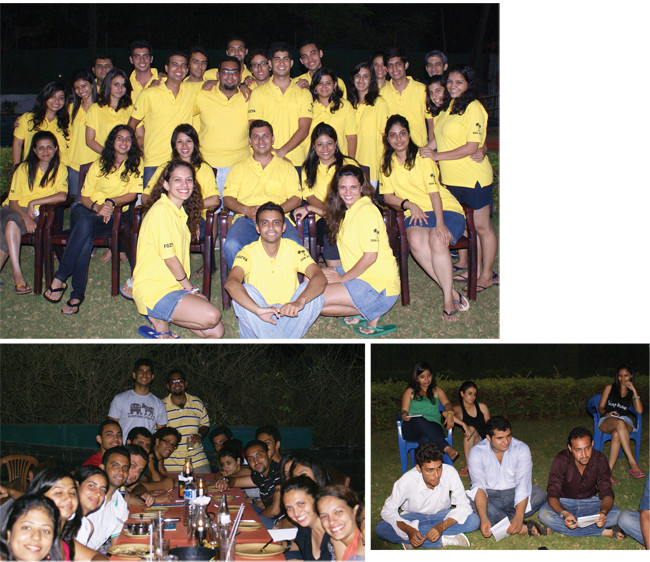
Participants at the holiday youth meet orga-nized by FOZYA in Goa;
Bonding over food (left); thinking session
At the end of this thought provoking and enlightening session, participants stood in a circle, held hands, closed our eyes and soaked in the moonlight. It felt beautiful…
On the final day everyone filled in questionnaires framed by Nanavatti. These aimed at collating youths’ views on marriage, after-death ceremonies, conversion, FOZYA, youth meets and career related aspirations. The responses revealed that participants were clear about career goals and preferred marrying Parsis/Iranis. Happy with FOZYA’s work, they had recommended youth meets to their friends. Some suggested organizing meets at an international level, perhaps going abroad or inviting participants from other countries. One, addressing FOZYA wrote, "Keep up the good work and spread like wild fire.” FOZYA’s response was "Keep fuelling and we sure will!”
For our small, scattered community any effort that brings and keeps us together is a step in the right direction. The numbers at the Goa meet were consciously limited so that all participants could be accommodated in the same hotel, facilitating greater interaction. There was also a balance in the ratio of boys and girls. The inclusion of games, informal conversations and shared travel within Goa allowed for greater opportunities for youth from different cities to mingle and make friends. Information was exchanged about the demographics of Parsis in different cities, their activities, agiaries, dharamshalas, youth initiatives and the like. And, of course, as at any Parsi gathering, many managed to find common friends and relatives. It also allowed for some thinking on relevant community issues. Some participants, Kunashni Meherji of Calcutta, Pearl Tirandaz of Bombay, Farah and Nikita Wadia and Vakil of Hyderabad wrote essays on "Religious practices and customs,” "Crisis in the Zoroastrian faith” and other current themes.
How can such meets be improved? By ensuring greater interaction between youths of different cities. Sometimes, participants tend to stick to their own groups. This restricts the exposure that individuals would get by interacting with others from different groups. It also impedes effective networking. During future meets and at youth organizations of various cities, this aspect needs to be looked into and worked on. Also participants don’t adhere to the time schedule, resulting in dilution of planned activities. This is another area that needs scrutiny keeping the temperament of youth in mind.
The next FOZYA youth meet will be held in Bombay from October 27 to 29, 2011.
Dr Shazneen Limjerwala (née Commissariat) who has a doctorate from the University of Lancashire was a facilitator at the Goa meet. She has conducted workshops on "Nurturing relationships,” "Reflections on matrimonial searches,” "My relationship with the community (at various FOZYA meets),” and on "Emotional hygiene (at the Holiday Programme forYouth in Bombay).”