Papers on Alexander’s military conquests and the influence of the Greeks on Iran and India mark the second session of the Indo-Hellenic seminar
Mehroo Kotval
When Alexander of Macedonia defeated King Porus the ancient Indian ruler, at the Battle of Vitasta in 326 BCE, all of India lay before the Greek warrior to conquer. "The army (was) poised to take not only the remainder of Punjab, but also the Ganga valley and with it the whole of Hindustan,” stated Daniel Seldon, professor of comparative literature at the University of California, Santa Cruz. He was addressing the session on ‘Conflict and Co-existence: Alexander’s Legacy in the Indo-Iranian Borderlands’ at the K. R. Cama Oriental Institute on January 19, 2013. This was the second of five sessions at the seminar on Indo-Hellenic Cultural Transactions. ‘The Face of Porus’ was Seldon’s specific paper.
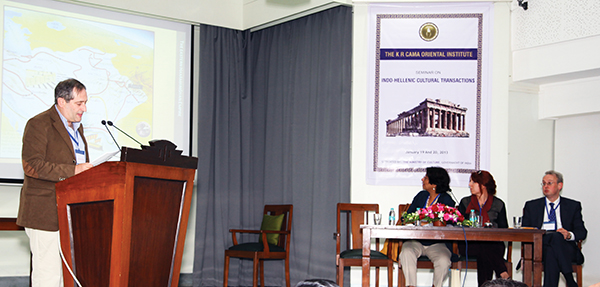
L to r: Daniel Seldon; Albert de Jong; Rachel Mairs and Rashmi Poddar
"When the Macedonian troops reached the river Vipasa, they baulked at the prospect of proceeding further. Over the past eight years, they had piece by piece subdued the entirety of Darayavahus III’s imperial domain… and the army realized that they were, in fact, nowhere near the limits of the earth. The Macedonian troops grew restless, and mutiny threatened in all quarters... Koinos, one of the ablest and most faithful of Alexandros’ generals appealed to Alexandros on their behalf in the following fictional oration:
"‘Whatever mortals were capable of, we have achieved it. We have crossed lands and seas. We stand almost at the end of the earth... You are preparing to enter another world, and you seek out an India that even the Indians do not know... That is a plan appropriate to your spirit, but beyond ours. Your valor will ever be on the increase, but our energy is already running out. Look at our bodies — debilitated, pierced with all those wounds, decaying with all their scars! Our weapons are already blunt; our armor wearing out. We put on Persian dress because our own cannot be brought to us — thus have we stooped to wearing the clothes of foreigners!... Conquerors of all, we lack everything…’”
In the end, Alexander had little choice but to comply with his troops’ clamor for retreat. "Alexandros marched directly westward through the deserts of Balochistan, where, among the uninhabitable terrain and shifting dunes that obliterated every sign and trail, what remained of his Macedonian cohort lost their way and largely perished for lack of provisions. Pressed by hunger and fatigue, moreover, and having eaten their pack animals for food, the troops had no choice but to abandon their dying comrades along the way. ‘It was a dreadful thing,’ Diodoros Sikeliotes comments, ‘that they who had excelled all other in arms should perish ingloriously from want of sustenance in a wasteland.’
"Alexandros, who unlike the Homeric hero that he so badly wanted to become, barely survived the rigors of the terrain, though he managed to push onward to Pura, the capital of Gedrosia, and then to Babilim, where he died in 323 BCE at the age of 32, having opened up new political and commercial opportunities for the Macedonians and Greeks but effectively destroyed the Haxamanisiyan royalty together with the Good Religion.”
Seldon quotes Diodoros who provides us with the fullest account of the engagement of the ‘Indic Other’:
"Poros arranged his elephants in a manner so as to strike terror in the opposing troops. As fighting began, practically all of the Indians’ chariots were put out of action by Alexandros’ cavalry. Then the elephants came into play, trained to make good use of their height and strength. Some of the Macedonians were trodden underfoot, armor and all, by the beasts and died, their bones crushed. Others were caught up by the elephants’ trunks and, lifted on high, were dashed back down to the ground again, dying an exotic and terrible death. Many soldiers were pierced through by the tusks and died instantly, run through the whole body… Mounted on the largest of the elephants, Poros’ javelins were flung with such force that they were little inferior to catapults. The Macedoninas who opposed him were amazed at his manly goodness, but Alexandros called up the bowmen and other light armed troops and ordered them to concentrate their fire upon Porus… Many weapons flew toward the Indian at the same time and none missed its mark because of his great size. He continued to fight heroically until, fainting from loss of blood from his many wounds, he collapsed upon his elephant and fell to the ground. The word went about the king was killed, and the rest of the Indians fled.”
Alexandros not only approached the wounded Poros in person, but faced him directly — not as master to slave, but as equal to equal:
"Alexandros rode in advance and met Poros face to face. Halting his horse, he marveled at Poros’ stature, which was over five cubits in height, as well as at his good looks. He appeared to be a man not enslaved by disposition, but rather looked as if one man of honor were meeting another after a fine struggle against another king for his own kingdom. Alexandros spoke first and urged him to say what he desired to be done with him. The story goes that Poros replied: ‘Treat me, Alexandros, like a king.’… Alexandros was so pleased with his reply, that he gave Poros dominion over his Indians and added still further territory even greater in extent to his former realm. In this way, Alexandros himself acted like a king in his treatment of a man of honor, while in Poros he found complete fidelity from this time forward.”
Both individuals are not only human beings; more specifically, they are men of honor and good standing, who comport themselves magnanimously as kings. As such, the passage explicitly targets the opening of Aristotle’s Politics where Alexandros’ tutor explains: "There is no natural ruler among barbarians; rather, they form a community of slaves – wherefore the poets say, ‘It is seemly that Hellenes should rule over barbarians.’”
Don de Jong
Drawing a parallel with India and Iran, the historian Albert de Jong, professor of comparative religion at the University of Leiden, the Netherlands, stated that the Iranians were familiar with the benefits of writing, irrespective of the language. Like ancient Indians they did not see the benefit of "applying this craft to the domains of literature and religion.” He stated that writing was left to "one’s servant, clerks, who existed alongside other personnel who looked after the domains of literary entertainment and religion.” There were, however, the gosans who were specialists in the literary domain, who crafted stories based on their knowledge and wove traditional stories with current concerns. His paper was titled ‘Local Identities and Transnational Cultures: Parthia between the worlds of Greeks and Indians.’
Participants registering; Audience
"I have argued elsewhere that Zoroastrianism as we know it today is the result of the activities of the Achaemenids and the Sasanians, who both used and transformed this religion to sustain their empire… Even more importantly, the restructuring of the religion, its organization and its texts and rituals, and its priesthood, under the Sasanians and it is this version of Zoroastrianism, the Sasanian one, that has survived to the present,” indicated de Jong.
The Parthian empire stretched from the northern reaches of the Euphrates, in Turkey to north-eastern Iran (west Khorestan) and became a center of trade and commerce. It adapted to Grecian culture and later, Iranian culture. This led de Jong to state: "The Parthians are the step children of ancient (Iranian) history.” According to the scholar, one of the reasons why Parthians did not fit into Iranian history is that "they were not Iranian enough,” as reflected in Greek and Latin sources. He further stated that one scholar considered Parthians to be Mughal kings of India; another, the Ottomans of Turkey. Both these scholars asserted that the two dynasties availed "themselves of territories where, in the ultimate analysis, they did not belong. They were alien to their culture and could be described in terms of an occupying military force… Scholars…continue to base many of their observations on Parthian culture of nomadic customs among the Parthians, which would place them outside the sphere of ‘real’ Iranian culture.”
De Jong studied Old and Middle Iranian languages at the School of Oriental and African Studies, University of London and his PhD thesis was on Zoroastrianism in Greek and Latin literature in Utrecht, Holland.
Conflict and co-existence
Rachel Mairs, lecturer in Classics at the University of Reading, UK, compared the Greek presence in north-west India from the fourth BCE with other historical instances of cultural encounters, similarities and dissimilarities of power imbalance and cultural understanding on either side, relying on the Journal of the Asiatic Society of Bengal (JASB), 1832. The scholar also offered analogies between European colonization of India and Central Asia. She attributed the ‘opening up’ of Central Asia to British and Russian colonial ventures where "European travellers, soldiers and spies (who were often all three)… brought back curios, coins and artifacts.” Articles on Alexander and his successors were carried in practically every issue of the JASB, many with special mention of coins, which Mairs termed "the numismatic gold rush.”
Her paper was titled ‘Cultural encounter and political ideology in the Indo-Greek states after Alexander: a comparative approach.’ Her special interests are in the interaction between Greeks and ‘non-Greeks’ in the Hellenistic world, with particular emphasis on Egypt and Central Asia. Her PhD was on ethnic identity in the ‘Hellenistic Far East’ (Bactria-Sogdiana, Arachosia and India) at Cambridge, UK.
Dr Rashmi Poddar, who chaired this session, is currently a director of Jnanapravaha, a center that facilitates critical thinking in the arts. She was also associate editor of Marg — India’s renowned publishing house of art books and journals.