Nurse Tehmina Adranvala and her doctor brother
Jehangir were both active in the field of public health
Tehmina Kaikhashru Adranvala is an important figure in the history of nursing in India. She began her career as a trainee nurse at the Sir Jamsetjee Jejeebhoy (J. J.) group of hospitals, Bombay, where she trained in nursing and midwifery in 1930. Thereafter, she completed the health visitor’s course at the Royal Sanitary Institute, London in 1934 and Sister Tutor Diploma and Hospital Administration Diploma, University of London in 1947. From trainee, she progressively became ward sister, assistant matron, tutor and matron, between 1939 and 1946, and was finally nursing superintendent. In 1948, she was appointed chief nursing superintendent, Director General Health Services, Government of India (GOI) and was promoted as nurse advisor to the GOI in 1957, a post she held till her retirement. Adranvala was a recipient of the Kaiser-i-Hind medal in 1943 and the Florence Nightingale medal in 1956.
symbol of nursing in many countries Image: Wikipedia
Kaikhashru, Meherbai and Tehmina Adranvala, 1955
Tehmina, seated 3rd from l at Sir Currimbhoy Dental School and Hospital function on July 12, 1941
Adranvala joined the Trained Nurses Association of India (TNAI) in 1934 and served on its council for several years. By virtue of her position with the GOI she was president of TNAI from 1948 to 1954 and treasurer from 1954 to 1957.
In her inaugural speech as TNAI president Adranvala discussed the objectives of the student association and informed members of the many opportunities open to nurses, such as the exchange program which had been inaugurated by the International Council of Nurses. Even in the early days of the World Health Organization (WHO), Adranvala was on the expert committee on nursing and attended the meeting in Geneva in 1950. During her tenure with the GOI, she made study trips to Austria, Denmark, Sweden, Canada and the USA on Rockefeller and WHO fellowships. In 1956 it was observed by A. Wilkinson who has written History of Nursing that "on the WHO she is greatly respected as the representative of the nursing profession in India.” Adranvala was appointed by WHO as nurse advisor to the WHO Nursing Education Project in Kathmandu, Nepal, in 1966.
What was the status of nursing when Adranvala trained? Ward sisters were then all European, while probationers were AngloIndian or Indian. There were inequalities in salaries paid to European and Indian nurses and instances of discrimination, which were highlighted in the debates in the 1920s and 1930s in the Bombay Legislative Council. This was the situation in the colonial period. In a detailed review of nursing in India Adranvala has stated her views about the profession, focusing primarily on the post-independence period.
In an article entitled "Vital Aspects of Nursing: The Historical Perspective,” published in The Nursing Journal of India, 1982, Adranvala traced the history of nursing and midwifery services in India. She observed that "in a country as large and varied as India, there has naturally been much variation in the rate of development, even though there are similarities in the basic pattern.”
In the early years, nurses came from Britain to work in government hospitals, while nurses from Canada and USA came to serve in mission hospitals. In her private correspondence, Adranvala cited the view that J. J. Hospital could not have accomplished the work it did without the devoted work of the All Saints Community, who kept the flag flying for many years with meager financial assistance. The All Saints Sisters of the Anglican Community of St Mary the Virgin (Wantage) came to work in Bombay in 1878 and began visiting patients in the J. J. Hospital. Subsequently, in 1880 the authorities asked them to take on the nursing of all patients. In response, qualified nurses of the Community came from England, and in 1885 all nursing was taken over by the All Saints Sisters. They established a high standard of efficiency, trained others and even made home visits. The Poona Seva Sadan encouraged and assisted Hindu women to take up training in nursing and midwifery. Adranvala referred to the apprenticeship system of training of nurses. In 1908 TNAI was formed and The Nursing Journal started in 1910. The Bombay Presidency Nursing Association (BPNA) was established in 1909 as an examining and affiliating body to coordinate the different nursing associations. Till 1935, when the Bombay Nursing Council was set up, the BPNA was responsible for the inspection and recognition of training schools, prescribing curricula, conducting examinations and registration of nurses and midwives.
World War I saw the advent of the Indian Military Nursing Service. Adranvala attributed the preparation of nursing workers for public health to the Lady Reading Health School established in 1918.
Shortage of nurses became markedly apparent during World War II years, mainly because of the demands of military hospitals and the expansion of civil hospitals. There was an acute dearth of candidates for training partly due to the more attractive conditions of service offered by the Women’s Auxiliary Services. Two steps were taken by the GOI to ameliorate the situation. To meet the shortfall in numbers, the Auxiliary Nursing Service (ANS) was created in 1942 and a chief nursing superintendent appointed in the office of the director general, Indian Medical Service to organize the service and also to be the adviser in nursing to the director general.
Tehmina, outside her Delhi home
Dr Jehangir Adranvala, UK, 1937
Tehmina Adranvala, c 1939
There was considerable development in nursing during the period 1948 to 1965 corresponding to developments in other fields of health. A particular interest was evident in establishing training programs for all categories of nursing personnel. Social service organizations recognized that training women for nursing not only provided a needed community service but also a means of livelihood. The extension of health services in rural areas created a demand for nursing services, and the authorities in the expanding number of hospitals found that the service provided by nursing students was a definite asset. This completely changed the picture and in 1948, instead of a shortage of candidates for nursing training, there were waiting lists. The upheaval caused by the Partition gave an unexpected stimulus to recruitment for nursing, and a 100 girls were undergoing training at the refugee camp hospital in Kurukshetra.
Adranvala was appreciative of international aid which made a very valuable contribution to the development of nursing in India. Fellowships for studies abroad enabled nurses to specialize or qualify for senior positions. Stipends granted by UNICEF (then United Nations International Children’s Emergency Fund) not only enabled nurses to take the midwifery tutor and public health nursing courses, but had also given the courses a good start by assuring a steady flow of students. Stipends for refresher courses helped nurses to keep up-to-date in various fields. Teaching equipment and transport provided for hospitals and health centers by UNICEF brought great improvement in the teaching programs, and raised the morale of nursing workers by giving them useful tools for their work.
In the conclusion to her review, Adranvala noted that since 1965 there had been many developments in nursing education and service and the number of nurses being trained and employed had increased considerably. Nurses had gained positions of authority in the health service and could speak with confidence on academic matters. To what extent these developments were reflected in the status of nurses and standards of nursing practice was something that had to be watched continuously and carefully. Adranvala identified two areas that deserved special attention: clinical specialization and community health nursing and a close co-relation between nursing education and nursing service in institutions and in community health. She contended that clinical nurse specialists and public health nurses should be given responsibility for teaching nursing students and be recognized accordingly. "To gain the ear of authority and the support of the people we serve, nurses should speak with one voice. There are bound to be many differences, but these should be ironed out by nurses among themselves.”
In connection with economic welfare, there was a need for nurses to analyze the nature of nursing practice, basic education, training, functions, responsibilities, etc and "weightage should be given to these in determining emoluments, particularly so for the rank and file who constituted the largest number of those in direct touch with people and by whose performance nursing is judged.” The most appropriate channel for doing this, she maintained, was the professional organization: TNAI.
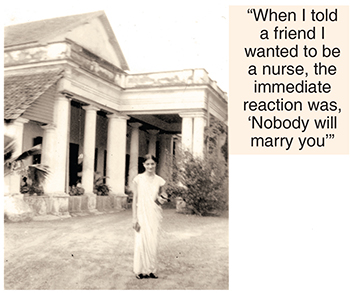
It is worthwhile to look at the profession, per se, in the colonial period, when Adranvala trained. Gopal Krishna Devadhar, who was associated with the efforts of the Poona Seva Sadan to promote nursing, contended at the All India Child Welfare Conference that orthodoxy or conservatism were not solely responsible for the paucity of women workers, but no tradition for such training and work existed. He maintained that the growing demand for the training of nurses and midwives was the outcome of the dissemination of knowledge about hygiene and sanitation. He further pointed out that though there was no purdah in Western India, they found it extremely difficult to attract a sufficiently large number of intelligent women to take "kindly” to the nursing field. It was also observed that nurses were often exploited by nursing bureaus which had an "unsavory reputation.” Adranvala commented on the attitude of Indian society towards nursing, "When I told a friend I wanted to be a nurse, the immediate reaction was, ‘Nobody will marry you.’”
The following tribute to Adranvala sums up her contribution: "Her efforts to raise the status of the nursing profession in India have been outstanding and her wise counsel is sought by many.” She had a pleasant disposition, essential for a nurse. She was a great teacher and efficient administrator. As her review of nursing and the suggestions she made have shown, she was deeply involved with the profession. The Nursing Journal of India, 2000 refers to her as "Revered Nurse Leader,” and states, "Today the nursing profession in India owes a tremendous amount to her.” Adranvala died in 2000 at the age of 93.
Dr MRIDULA RAMANNA
Ramanna is a medical researcher and former head, department of history, S.I.E.S. College of Arts, Science and Commerce.
Clockwise from r: Tehmina, Navaz, Jehangir Jr, Dr Jehangir and Arnavaz Adranvala, 1984
The family connection
My father, Dr Jehangir Adranvala, Tehmina’s brother was two years her senior. Both were born in Lonavla and initially studied at St Peter’s School, Khandala. Tehmina was made to leave school in the fourth standard and was largely self taught, with help from her brother. Both were very close and shared a love for reading. When Jehangir moved to Poona to complete his schooling from St Helena’s School, the two were constantly in touch exchanging detailed letters with news about Poona and Lonavla.
After leaving school, Jehangir did his Inter Science at St Xavier’s, Bombay and then joined Grant Medical College where he did his MBBS. He then went to the UK where he obtained his LRCP, MRCS, DPH and DTM&H degrees.
On his return, my father worked briefly in Matheran as a health officer and later during World War II joined the army as a medical doctor, leaving the service as a Lt Col. He was briefly in Ahmedabad after the War and then spent the rest of his professional life primarily in Poona. He set up the primary health center in Sirur (near Poona) and later joined the municipality as Medical Officer of Health. We were always told that he was responsible for eradicating plague from Poona, but he never referred to this achievement.
Jehangir served briefly as Assistant Director of Public Health (Malaria) and then joined B. J. Medical College, where, I believe, he started the Department of Preventive and Social Medicine. He was highly respected as a teacher and fondly remembered for his dedication and thoroughness. In May 1961 he was appointed as the first Director of Public Health in Maharashtra, retiring on superannuation that October. In 1964 he joined the Àll India Institute of Hygiene and Public Health at Calcutta as professor of Public Health Administration, where he served until his 60th birthday. He was also chairman of the Sassoon Hospital Enquiry Commission, but I cannot recall whether this was before or after his stint in Calcutta — most likely before.
Tehmina and Jehangir were seldom together after their formative years in Lonavla, but the closeness they had developed lasted throughout their lives, communicating mainly through letters. Both siblings were highly successful and respected both by their superiors and subordinates for their expertise, knowledge, fairness and honesty.
RUSTUM J. ADRANVALA
Rustum is a retired chemical engineer.
A student remembers
Right from my primary school to my MD, I had a series of excellent teachers. However, the most unusual and memorable of them was Dr Jehangir K. Adranvala (1906-1991). There were many facets of his personality that endeared him to his students and made an indelible impression on them.
My MBBS batch of 1956 was the first under the new rules in Poona University. The previous batches had a course of five years, with exams at the end of two, four and five years. The new course was of four-and-a-half years, with exams at the end of one-and-a-half, three, and four-and-a-half years, followed by a rotating internship of one year: three months at a primary health center, and nine months at a district civil hospital.
When the first term opened, we learnt that we had to do a one-year course in biostatistics, and to pass an exam to be eligible to appear for the first MBBS exam. The spirit behind this move was Adranvala. He had been a student of Sir Austin Bradford Hill who pioneered the use of statistics in medical research for testing the efficacy of streptomycin in tuberculosis. At that time we were reluctant to study this subject, but our professor sat with us to do the exercises and tried to persuade us that this was the need of the future. Later, when I enrolled for MD in pharmacology and worked as a medical and research director in international pharmaceutical companies, I realized the value of the favor he had done to us.
At college term examinations, he would sometimes join the students and write the answer paper. He would say he ought to check whether it was possible to answer all the questions within the given time. At other times, half-an-hour after the exam started, he would put out model answers on the notice board outside, emphasizing that they were model answers, not ideal answers, and that ours could be better.
Adranvala had a fine sense of humor. For the college annual magazine, he had written an article titled "How to fail in the examination” where he had listed a number of tactics that a student would use to annoy, anger, frustrate or otherwise harass the examiner so that he would not give passing marks even if he wanted to. Uneven and illegible handwriting, leaving no margins, making no paragraphs, scattering blobs of ink on misspelled words, and writing answers not relevant to the questions were some of the methods suggested. In a hilarious way, he had helped the students learn what not to do if they wanted to pass.
Compassion was another facet of Adranvala’s nature. One of my classmates came from a poor family and enjoyed a full freeship from fees as long as he passed each exam. In one terminal exam, he got 48 marks, or just two short for passing. So he went to Adranvala to plead for two marks so that he could retain his freeship. Adranvala gave him a patient hearing and asked him to leave the answer paper with him so he could check whether there was any scope for increasing two marks somewhere. The next day, when the boy went to see him again, full of hope, Adranvala told him, "I have gone through each of your answers very carefully, but I cannot find any answer where I could give you two marks more. I feel sorry for you, but I cannot do what you want. However, I understand your distress, and so I have paid your term fees.” The boy had tears in his eyes, expressing sorrow, joy, and gratitude all at once.
Adranvala did not just teach us, he encouraged us to learn. When asked which textbook we should buy, he would say, "One which you like.” When queried further on which textbook he had used for setting the paper, he would reply, "I set questions on the subject, not on a book.” He wanted us to read books which we liked to read, and which were in tune with our learning pattern. He would also remind us that even the most recent edition of a textbook is a few years behind the current knowledge on a subject, and hence we should read periodicals such as The Practitioner, The Lancet and the British Medical Journal. He also encouraged us to consider different points of view on a topic and avoid being dogmatic.
A most unusual and unforgettable teacher! Dr A. S. NANIVADEKAR
Nanivadekar is a retired consultant in medical research and former medical and research director of a pharmaceutical company.
A brief encounter
I had been invited, along with my teacher Dr Gajendra Sinh, to participate in a symposium at the B. J. Medical College in Poona some decades ago.
I am unsure now about the topic I spoke on but it may have been related to the poor state of medical ethics in India. At the end of the talk, a dignified and obviously Parsi gentleman approached me. He introduced himself as Dr Jehangir K. Adranvala. I recalled that his sister Tehmina had been the matron in my alma mater, Sir Jamsetjee Jejeebhoy Hospital.
"I noted that you had a printed version of the talk in your hand though you did not read from it. May I please borrow it for a few days? I promise to return it to you by post,” he said to me.
I demurred. I showed him the typescript that had been modified by me using my pen where paragraphs had been deleted and sentences added. I asked whether I could tidy it up and then send him the new version.
To my surprise, he said, with some emphasis, "No! I would like this version with revisions as it tells me how your thinking was modified as you re-read your draft.”
True to his word, he later returned the draft with a kind and courteous note attached to it. Dr SUNIL PANDYA
Pandya is a neurosurgeon and a student of medical ethics.