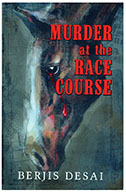
Murder at the Race Course by Berjis Desai. Published in 2024 by Shree Book Centre, 8, Kakad Industrial Estate, S. Keer Marg, Off L. J. Road, Matunga (W), Bombay 400016, email: sales@shreebookcentre.com; website: www.shreebookcentre.com. Pp: 237. Price: Rs 400.
It’s difficult to understand why Berjis Desai continues to be less than famous as a writer of tales that expose the underbelly of society with wit and humor not unmixed with compassion. Could it be that at heart he has the morals of a tabloid writer intent on titillating his readers with nuggets of gossip that might best have been avoided? Or that he is a reformist with the basilisk gaze who turns every individual into stone?
Berjis Desai: wit, humor, compassion
Certainly, in his extraordinarily complex work of fiction, The Towers of Silence, his first full length one after the short story collections about his Parsi community set for the most part in Navsari, he exhibited all these facets of his approach. It’s not surprising that many members of the Parsi community felt that by describing the rituals connected with the sacred rites of mourning the dead, as also those regarding the initiation ceremonies connected with Parsi priests, he may have betrayed the sanctity enshrined in them through time.
In matters of faith, opinions will always vary. Let us add that if not for the very provocative title, Desai’s could well be regarded as a long meditation on the meaning of death and the afterlife, for those who have had to live with the sudden ending of a life. Including, one might add, with the inexorable dwindling of a once vigorous and thriving Parsi community as it fades into the twilight keeping the faith with admirable conviction.
This somewhat long digression may have nothing whatsoever to do with the rollicking murder mystery set in the environs of Bombay’s famous race course at Mahalakshmi and its equally elite world of an entrenched racing aristocracy during an era of change. Do we add that Desai, as a lawyer, businessman, owner of horses, aside from his earlier attributes as an alumnus of colleges in Bombay (as it was known then), Cambridge, and writer for a Gujarati daily, is perfectly trained to initiate the reader into this world? He is an outlier with an insider’s track record.
You could read him as a Bombay version of Dick Francis, the legendary chronicler of the British race tracks set in an Ismail Merchant and James Ivory scenario of exotic Bombay as it used to be lush with Maharajas and their emerald-eyed wives of foreign ancestry. Though probably in today’s context it would be Bollywood wives with their glittering baubles but limited vocabulary as seen on Netflix. If so inclined, you could add a dash of John Mortimer whose legendary barrister Horace Rumpole finds a legal eagle in Vistasp Adenwalla who leads the charge in defending the legacy of the race course that is under attack from vigilantes and land sharks.
Or to underline one of the main issues that forms the subtext to Desai’s account of the murder at the race course: When the judges in the High Court ominously rumble: "We are disgusted… This is nothing but a gambling den, and that too, an inefficient one. We see nothing wrong if the land is used for the benefit of the general public,” there is an instant riposte from an enraged Adenwalla: "All these senior counsel who charge a bomb are so bloody mild! Next time, I shall appear in person, dikra (son).”
To a certain extent there are similarities in the issues that are at the heart of the Towers story and the race course one. The greed that motivates the different parties to appropriate the land either adjoining the Towers of Silence in the first instance, or the entire race course by the Bombay Municipality in the other by the connivance of interested parties in the other, lifts the narrative to a different level. It’s not merely entertainment, but an indictment of issues that are of far greater value. In his own way Desai is playing the devil’s advocate in veering the reader to his way of thinking. Or to use one of his racing metaphors, he is a seasoned jockey who mounts his hobby horses to a narrow victory against the odds.
Another recurring feature in both novels is the one about a connection between a father and son, wherein one of them does not know of the hereditary link with the other. The past comes back to haunt some of the main players in ways that belong to the pages of history, if not legend.
In the Towers, there is an extraordinarily vivid chapter about a group of marauders from the North West, that we may now identify as Afghanistan, though certainly not specifically in the book. They are known as the Pindaris. They regularly ride down even as far as Navsari and the erstwhile princely State of Baroda and help themselves to whatever suits them, in some cases the beautiful young women of the Parsi community. In the Race Course murder, their role appears to have been reduced to those left behind in the almost forgotten trails in the aftermath of Partition. Like members of a Costa Brava mafia, they have scores to settle with those who have made a fortune in devious ways in New India, or maybe just resume old ties of blood and DNA.
We will only focus on one of the main characters, Nari Mansukhani, since Desai gives him all the attributes of a Don Corleone when we first meet him wearing his 1950 Rolex Sterlite Gold watch, clutching a pair of binoculars. He is there to watch his champion filly, Private Banking, ridden by a jockey — "a little Irishman” we are told — race to the finish line as planned.
Further to underline Nari’s pre-eminence we are given to understand that "a doddering Parsi industrialist known for his rough ways, would tell Nari himself, ‘Nari, you bastard, you would fuck someone’s mother and simultaneously salute his father, won’t you?’ Nari never remonstrated. He would simply smile, shrug his shoulders and walk away to plan yet another gamble.” Ruzbeh Mansukhani, his fabulously well-endowed wife, is even more spectacular in the role she has been assigned to play in the story.
However, despite Ruzbeh’s evident charms and those of some of the other women with equally endearing if ruthless ways, the horses win over the humans. Some of the best parts of the book are those in which Desai initiates the reader into the roller coaster world of horse racing in the country. It’s where a horse’s pedigree and blood are critical to the success of a champion horse.
Through Desai’s expert initiation into this arcane world the reader becomes an armchair voyeur of what happens during a race — and there are several here that are documented with passion and precision, as also before and after. It’s laid out like a game of chess on a giant chessboard that is the race course. The trainers, the stewards, the jockeys, the syces, the vets, the manufacturers of the vaccine that play a role in enhancing the metabolism of a favorite colt or filly, take on the role of the main chess pieces, while the pawns are the punters, the public who come to make it all happen. Do we include the guardians of the law, the police who play a significant part in Desai’s chessboard, or the vigilantes who would like to close down the racing fraternity on grounds of morality and a love for horses?
Finally, perhaps, it’s love that defines Desai’s oeuvre. He rides with a measured pace, burning the race track with consummate style and strength of purpose. No matter whether he makes it to the finish line and grabs the winning cup, the ride is always exhilarating. GEETA DOCTOR
Doctor, a longtime contributor to Parsiana, is a writer and critic.