Man Manqué: A Memoir of Sorts by Zend Lakdavala. Published in 2020 by Zero Degree Publishing, No. 55(7), R Block, 6th Avenue, Anna Nagar, Madras 600040; website: www.zerodegreepublishing.com; email: zerodegreepublishing@gmail.com. Pp: 182. Price: Rs 250.
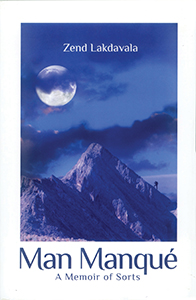
In Man Manqué, Zend Lakdavala decides to climb Lone Mountain in Las Vegas, Nevada. He had made a spot decision the very first time he was driving past it and though he had climbed it in daylight, this was the first time he was attempting the ascent on a  full moon night. At the outset, the tone is not a cheerful one; the clouds are black and "shroud-like” and he clearly states that the ache is not a physical one but, "in the main, mental.”
As he climbs, his mind is assailed with a host of memories, some pleasant, some unpleasant, most of which pertain to his growing up years in Bombay. The memories do not come sequentially but in a haphazard and random manner, as reminiscences most often do. Hence, it is no surprise that a character who dies in one chapter is happily proceeding to the red light area in search of a prostitute in the subsequent one.
Many of the memories are light-hearted and entertaining, such as his visit to the dentist who suffers from bad breath and finds seven cavities that need to be filled. The dentist uses an old-fashioned pedal-operated drill which falters many times during the session and requires a kick to re-start it. Lakdavala skilfully adds a constant stream of colorful swear words which go through the protagonist’s mind during the process, including referring to the dentist as Mengele and the Angel of Death (Josef Mengele, a German Schutzstaffel officer and physician during World War II, was known by that epithet).
The protagonist, whom Lakdavala calls Jimmy, stays in a Parsi colony, Homiyar Baug, and the activities and life in the Baug are humorously depicted. Most effective are the ones of his adolescence when his hormones are raging and Lakdavala describes Jimmy’s sexual angst. His trysts with girlfriend Amy and servant girls are dealt with in a humorous as well as touching manner. His first visit to a prostitute, his shyness which results in his inability to express his choice and his discomfort are sensitively depicted.
However, not all is laughter and games. Jimmy has a sympathetic attitude to the downtrodden and the underprivileged. This is evident from almost the very beginning when he sees the deprived fishermen and thinks about "the thousand worries riddling their poor lives like so many holes in their fishnets.” He paints a rather dismal picture of the gutter cleaners who are ill-clad and work in manholes exposed to filth and excrement while performing their jobs. He is upset by the unsympathetic treatment of domestic help by his family members at Gholvad and is uncomfortable seeing his father, who ran an automobile body-building factory at Sewri, travelling in a Mercedes whereas his employees commute in crowded trains and buses from their insalubrious hovels in the distant suburbs.
 There are moments of great sadness when the protagonist’s father, whom he always admired, falls on difficult days and takes to the bottle. Also, Jimmy’s search for suitable means of earning money, his failures in most of the business ventures he undertakes and the fraudulent behavior of people he trusts are distressing.
Lakdavala expresses great anger against the Parsis and Zoroastrianism. His irritation is evident when an article he wrote for a community magazine was edited, making it sound like a "remedy for a mild ailment” rather than a "malignant tumor.” He is critical of the cliché "good thoughts, good words, good deeds;” he feels no one has bothered to define the word "good” and he wonders if this can ever be done. Through a conversation with Jimmy’s school friends, Lakdavala expresses his disgust with the conventional way of disposal of the dead with bodies lying in the dakhmas waiting for "winged scavengers, bloating, undevoured for days on end.” He believes that the religious Zoroastrian has shrouded himself in a veil of ignorance with scant respect for reason.
Many of the names of places and people have been changed: Byculla becomes Myculla, Wadia Baug at Parel Tank Road becomes Wankatia Baug at Barel Tank Road, New Era School is converted to New Hira School, J. B. Petit School is transformed to K. C. Small School, Kemps Corner is changed to Lamps Corner to mention a few. The names of Lala Lajpatrai College and H. R. College, however, remain unaltered, which seems to be rather arbitrary.
The only drawback with the book is the style. Gujarati and Hindi words, especially abusive ones are explained by way of chapter end notes. It would have been easier for the reader had this been introduced in the text itself. Also, some of these explanations seem superfluous: the word "flat” is explained as "apartment,” probably for the sake of the American reader. Perhaps Lakdavala could have used "apartment” in the text itself and done away with the end note. Good style does not necessitate the frequent use of difficult and unusual words. The "Acknowledgement” at the very beginning of the memoir is off-putting: "Properly, even if at the cost of sounding maudlin or overly expansive, I feel compelled to give credence to the world entire…for the spawning of this book.” Words like "milquetoasts” and "excarnation” tend to slow down the pace of the narrative which otherwise moves quite briskly. This is all the more distressing because Lakdavala can write very well. He describes the prostitutes in Foras Road: "Their cherubic cheeks glowing a garish red (melting) under the scorn of sodium vapor street lamps.”
Though Lakdavala creates the persona of Jimmy as his protagonist, one feels that it is a memoir of his own life, thinly veiled. Lakdavala paints a vibrant and affectionate picture of growing up in Bombay and captures the speech and the rhythms of living in a baug admirably well.
FIRDAUS GANDAVIA
Gandavia holds a doctorate in English literature and is a retired chartered accountant. He is a compulsive reader of fiction.