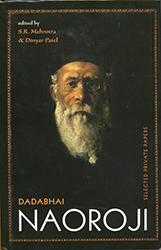
"The book is not about Naoroji alone,” said author Dr Dinyar Patel, assistant professor of history at the University of South Carolina at the launch of Dadabhai Naoroji: selected private papers which he has edited jointly with eminent historian S. R. Mehrotra. "It is about a vibrant period of India’s history.” The event was hosted at Kitab Khana, the book store in downtown Bombay on August 6, 2016 where the editor of special features for The Economic Times, Vikram Doctor was in conversation with the academician. Patel’s dissertation for his doctorate at Harvard was titled The Grand Old Man: Dadabhai Naoroji and the Evolution of the Demand for Indian Self-Government. Patel had previously published four conference papers on various facets of the intellectual and the first Indian member of the British parliament.
Calling Patel "the new Masani,” (the last comprehensive work on Naoroji was written by Sir Rustom Masani in 1939), Doctor asked him to guide the audience through the Bombay landmarks of Naoroji’s time. Recapitulating that the book store was at one end of the arterial road now named after Naoroji, Patel said that the venerable politician was born in Khadak, a very modest locality which would have been somewhere in the Bhendi Bazar area. His family home would have stood somewhere between 5th and 6th Khetwadi Roads, "outside the Fort.” During his professorship at Elphinstone College, Patel surmised that classes were held in the Town Hall. Naoroji’s commercial venture into the cotton business, had its offices in the nearby Meadows Street, he added. Parsis would have lined up at the seafront to pray at sundown, not far from where the book shop is located in busy Flora Fountain, said Patel. (The reclamation of land from the sea was done later.) "Naoroji who was born (in 1825) in the reign of King William IV, died 91 years later … Bombay must have had a sea-change in its landscape during his lifetime,” commented Patel.
"He was a terrible businessman,” stated the academician, referring to Naoroji’s failed commercial venture in cotton trading in the UK. Highlighting his stint as the Dewan of Baroda State starting in 1874, Patel said that "the princely states and their involvement in the development of India and the freedom struggle is an under-researched subject.” Some princely states did fuel nationalism, stated Patel, giving the example of Sir Bhagwatsimhji Sangramsimhji of Gondal State who was a significant donor towards Naoroji’s election campaigns in the UK. Early nationalists looked to the princely families to function as catalysts for political reform in India, said Patel.
After his failed attempt to win a seat from Holborn, the politician looked to the Irish for support. "There was lots of sympathy on both sides,” he said, letting on that it was even suggested by some that he contest from a constituency in Ireland. "Imagine, people from the colony nearest to the UK, befriending a man from the richest colony,” said the assistant professor, referring to support from the Irish people for Naoroji’s campaign for a seat in the British Parliament. Doctor reminded the audience that Naoroji was not only the first Indian, but also the first non Christian member of parliament there. The campaign for the seat from Finsbury Central started in earnest in 1888 with the ardent support of the Jewish community there, mentioned Patel.
The academician narrated incidents from the furore created by then prime minister Lord Salisbury’s comment about how horrible it would be for a "black man” to represent the British in Parliament. There were demands for apologies, but the arguments were more on the lines of "Naoroji is not as dark as Salisbury, referring to portraits juxtapositioning both men,” laughed Patel. "A muted apology” was offered when Naoroji won the elections (with a margin of five votes). Patel rued that the politician could serve only for two years as an election was called in 1894.
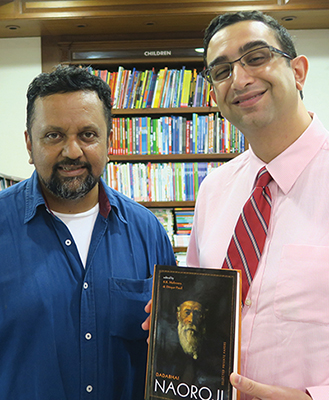
Vikram Doctor (left) with Dr Dinyar Patel at the book launch
Referring to the fact that even Mohandas Gandhi had called the grand old man as The Mahatma, Patel bemoaned that Naoroji was "superseded” by later political activists and was thought to be "slightly anachronistic.” In reality, he said, Naoroji’s thinking was not very different from that of Gandhi, as both at one point, demanded more empowerment for India within the British empire.
Naoroji was a keen supporter of technology, remarked the co-author. His admiration for "the first Indian techie” Shankar Bhisey, the scientist who passed away in 1935, and who was responsible for patents for several of his inventions including a toilet that flushed itself and modern methods of using a typewriter, led him to invest in Bhisey’s somewhat eccentric ventures and to promote him through his writings.
In the last decade of Naoroji’s life he was a socialist, said Patel, and involved himself in supporting demands for minimum wages, better education, support for workers, and for suffragettes in the UK. He retired to a villa in Versova, "and anyone who wanted to reach him were given directions to take the BB&CI (Bombay Baroda and Central India) train to Andheri and then take the dirt road” to the seaside villa, he laughed.
In response to a question from the audience as to why Naoroji was remembered more than his contemporary social reformers like Furdoonji Naoroji and Behramji Malbari who campaigned for similar social issues, Patel stated that his stint in England helped Dadabhai in getting more visibility. The label of "first Indian member of the British Parliament,” helped him to a degree. "After all, that is the first thing all of you would remember about him,” said the assistant professor, gesturing towards the audience.
Speaking to Parsiana, Patel revealed that the tome was six years in the making, of which he spent a significant amount of time at the National Archives in Delhi, poring through documents originally written in English, Hindi, French and even Telugu. Skeptical of the mode and preservation of archival material in India generally, the academician said that the number of documents now available on the venerable visionary total only 30,000, when at one point there were nearly double that number. A lot of material was lost in the shifting of the documents to a central location, and in the World War, he said.
Assessing Naoroji’s role as secretary of Rahanumae Mazdayasna Sabha, Patel in an email to Parsiana communicated that the association’s main aim was to get rid of certain rituals, customs, and superstitions within Zoroastrianism which they believed to be irrational. He said that when describing such customs, the Gujarati word for "harmful” appears quite often in Naoroji’s transcripts. "I think it is fair to say that many of their objectives were met — certain customs and superstitions did fade out — but other customs, such as spending lavish amounts on weddings, persist to this day,” he concluded.