The Tata Central Archives in Poona is a custodian of the rich Tata heritage
Delshad Karanjia
"This is a remarkable milestone for an institution that not only promotes the genesis and history of the Tata group, but also highlights the integral role that the group has played in India’s industrialization. The Tata Central Archives (TCA) has created this opportunity that will allow future generations to witness and relive the rich legacy of the Tatas,” stated chief guest Dr Pheroza Godrej, chairperson of the Godrej Archives Council (GAC), while inaugurating an exhibition on the TCA premises in December 2016 to mark 25 years of the Archives’ existence.
A two-storey bungalow on the sprawling, tree-lined campus of the Tata Management Training Centre (TMTC) in Poona houses the TCA, a historic repository of the wide ranging accomplishments of the 149-year-old Tata Group. India’s first business archive, TCA celebrated its silver jubilee with the exhibition showcasing its achievements and a symposium on collaborative leadership and the evolution of archiving.
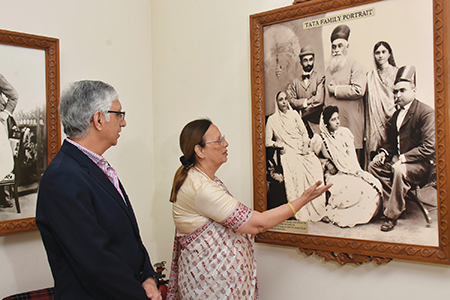
Farokh Subedar and Dr Pheroza Godrej at the silver jubilee exhibition
Above left: Subedar with portrait of J. R. D. Tata; right: Godrej with bust of Jamsetji Tata
Artefacts from Tata family with Jamsetji Tata’s attire at extreme right
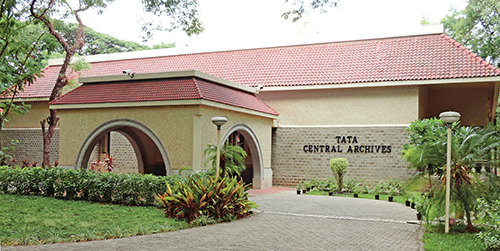
"The Tata Central Archives is the custodian of the Tata heritage,” stated Farokh Subedar, chairman, Tata Services, and chief operating officer, Tata Sons. "It gives me immense pleasure to celebrate its 25th year, which is a testament to the deep respect for records and their historical significance that J. R. D. Tata desired to institutionalize.”
The exhibition highlights several landmarks in TCA’s journey. It traces the saga of its inception, its inauguration at Bombay House in 1991, and subsequent relocation to the current premises in Poona in 2001. It reveals its initiatives in adopting preservation and conservation methods and installation of climate-controlled repositories with sophisticated security and surveillance systems. Visitors also get an overview of TCA’s exhibitions and outreach programs. In addition to other artefacts, the attire worn by Jamsetji Tata (courtesy Noshir Dastoor), the uniform of honorary air vice-marshal of the Indian Air Force worn by JRD in 1974 and the suit worn by him when he received the Bharat Ratna in 1992 are also on display.
Participants at the one day symposium included Sabyasachi Mukherjee, director general of the Prince of Wales Museum (POW) Bombay, who gave a talk on "Heritage - A Thread of Continuity” and S. Girikumar, eminent Indian conservator, who spoke on "Preserving the Memories —An Insight into a Conservator’s World.” Attendees included representatives from museums and cultural institutions from around the country, including the National Archives of India, Delhi; the POW, GAC, Maharashtra State Archives, Chinmaya Archives, R. D. Sethna Scholarship Fund and the National Centre for the Performing Arts, Bombay; the State Bank Archives and Museum from Calcutta; Reserve Bank of India Archives, Poona Archives, Southern Command War Memorial Museum, and the Raja Dinkar Kelkar Museum from Poona. Delegates from the Russi Modi Centre of Excellence and the Tata Steel Archives, Jamshedpur, Tata Power and Tata Motors also participated.
Over the past 25 years, TCA has grown to become the proud custodian of over 16 lakh Tata-related archival records, including more than 15 lakh print and digital documents such as annual reports, minutes of board meetings, publications, speeches, in-house journals and advertisements, nearly 75,000 still images, and hundreds of audio and video recordings and collections of memorabilia spanning the last 15 decades. The group’s philanthropic activities, dating back to 1892, are also well documented.
TCA conserves and protects this priceless historical legacy for future generations. Not surprisingly, TCA has become a valued source of information and a center for research for Tata companies, scholars and members of the public. It has also curated and organized more than 20 thematic exhibitions on various Tata personalities, companies and institutions across the country. The displays in the Archives’ main exhibition hall are frequently changed and added to as new material becomes available. An entire room on the first floor of the TCA is a re-creation — down to the minutest detail — of JRD’s office.
Like many great ideas, the TCA was born out of necessity. In 1980, Russi M. Lala, publisher and author, while researching his book (The Creation of Wealth: The Tata Story) found it deeply frustrating that the company’s records were disorganized and not readily accessible. Lala realized that the company needed a centralized archive, but his dream did not begin to take shape until 1989. As the group prepared to mark the 150th birth anniversary of Jamsetji Nusserwanji Tata (JNT), founder of the House of Tata, Lala suggested the setting up of an archive. In a memo to JRD, Lala, then director of the Sir Dorabji Tata Trust, wrote: "I feel that the archives will not be just a collection of historical material with some modern gadgets but a lively heritage of the House of Tatas.” A year later, Lala submitted a project outline for a business archive to JRD: "Business archives are a relatively unknown field in India… In organizing the archives of a House like Tatas we may be embarking on yet another pioneering effort.”
Lala’s proposition must have found favor with JRD whose comprehensive records form the core of the Archives’ collection. As a young boy studying in France, JRD had been advised by his father to cultivate the habit of "keeping copious daily notes… I hope you will always follow this advice of mine. The utility of it you will find later on.” The collection at the TCA reveals that JRD followed his father’s instructions and carefully preserved the letters he received throughout his life.
JRD’s personal collection of documents throws a great deal of light on the contemporary socio, economic, political and religious nature of the societies in which he grew up. This correspondence, comprising more than 70,000 pages of documents, was organized by JRD himself under the following classifications: family correspondence (which include letters his father preserved and bequeathed to him — they form the mainstay of the early history of the group) in alphabetical order; subject order; and master files in chronological order.
In January 1991, the TCA was formally launched by JRD at a function held in the Bombay House Auditorium. At the inauguration ceremony it was announced that a new facility to be set up at the TMTC campus in Poona would be the Archives’ permanent home. In the meantime, group companies were encouraged to start their own archives. Tata Steel responded immediately and set up its own archive at Jamshedpur in 1992. In August 2003, Tata Chemicals set up its archive at Mithapur. The majority of group companies preferred to deposit their records directly with the TCA.
TCA was formally inaugurated at its present premises in Poona by the then chairman, Ratan N. Tata on February 13, 2001 and opened to the public on March 3, 2001 with an exhibition on JNT to mark the founder’s birthday.
It remains to be seen how the Archives will reflect the changes at the Tata’s holding company, but a visit to the TCA fills one with hope that this extraordinary global enterprise comprising over 100 independent operating companies in more than 100 countries across six continents will continue to live up to its mission "to improve the quality of life of the communities we serve globally, through long term stakeholder value creation based on leadership with trust.”