The Everlasting Flame and other exhibitions held in
Delhi two years ago brought moral precepts to the fore
Text: Pheroze Nowrojee Photos: Jasmine D. Driver
The function of exhibitions is to repeat the obvious, but also to surprise: to pass on the imprint of approval to what is familiar to some, and to offer the wonder of discovery to those who come later.
Two years ago around Navroz, the landmark exhibitions, "The Everlasting Flame (TEF): Zoroastrianism in History and Imagination” and its three major companion displays opened in New Delhi. They brought together artifacts, erudition, sculpture, curators, paintings, thoughts, documentaries, the latest studies, garas, publications. This was an assembly that will not be seen again this century. Determined not to let the four exhibitions end without a visit, I flew from Nairobi, Kenya to New Delhi. The exhibitions were a delight, exceeding all expectations.
The exhibitions provided an opportunity to reflect on Zoroastrianism and on the daily struggle to make the choices the Gathas persuade us to make.
On entering TEF, one was immediately immersed in reflection on the religion. Several Avestan handwritten texts were exhibited. One was Yasna 44, "arguably one of the most poetic sections of the whole Avesta.” Another was the manuscript referred to as The Ashem Vohu Fragment of the ninth century CE. The prayer itself is written in transcription, in Sogdian, of a pre-Avestan language. I love the relevance of these 12 words written millennia ago. Through them one understands that good thoughts, good words, good deeds are the spiritual creation of Ahura Mazda towards a life of good purpose.
Other exhibits and texts dwelt on the detailed involvement of Dastur Meherjirana at Fatehpur Sikri and the deliberations there of all religious scholars towards a Din-i-Ilahi at the court of Emperor Akbar. These books, manu-scripts and pages give a physicality and a continuity to our religion. This was a major strength of the four exhibitions.
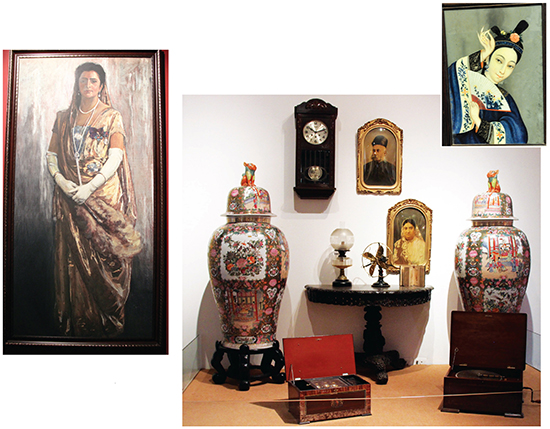
Exhibits on view: (above, left) portrait of Meherbai Tata and curios in Parsi homes;
(inset) glass painting of a Chinese woman
Top: popular portrait of Zarathushtra (l) and Pestonji Bomanji’s oil painting of A Parsee Girl;
above: copy of Khordeh Avesta and other religious symbols
The historical sweep of the many exhibits reminded us that there were Zoroastrians in China in the fourth century CE, that at one time Navroz was celebrated in Korea, and that our religion was spread over many races and countries other than Iran. That Zoroaster was not born in Iran, and nor did the religion start there. Their geography was different. We must stop seeing our current political boundaries as theirs, and realize therefore that the logic of their movements and contacts was different. It is those facts we must apply in our current debates on race, purity and the concepts of our religion.
Not everyone was overawed at the feats of museology. A Parsi matron’s efforts to show a group of young Parsi girls their inestimable heritage only drew gentle mirth from the irreverent group. Imitating their mentor’s high-pitched voice, one of the girls mimicked, "Girls, look at that lovely border. (Giggles) Hamara vakhat-ma (In our time)...” (More giggles). One drawls, "My, how nice.” But truly, the embroidered sudreh is exquisite.
I enjoyed a quirky put down of that undesirable force: "as usual in Zoroastrian manuscripts, the name of Ahriman is written upside down.” And also that it was artist M. F. Pithawalla (1872-1937) who by painting an image from a rock freize, popularized the portrait of Zarthust found in agiaries and in our copies of the Khordeh Avesta.
A non-Parsi guide is taking around a group of out-of-town Parsis. A loud voice: "No, we do not convert because it is forbidden by the religion.” "No, no,” a louder voice declaims, "the Gathas do not forbid conversion. In fact, they enjoin the spread of the religion.” "Rubbish,” cry several voices together. They are supported by a contemptuous voice, "Ai, junglee-o kathee lavéch ai badhu (from where do these crude people come up with all this)?” Through all that, the guide kept repeating feebly, "I only said that the number of Parsis is declining.”
A sober group, visibly Parsi, passes by. Another silent lot follows after a while. The groups happen to reach the display of paintings by Parsi artists. The small hall fills up with increasingly louder inquiries of origin and recognition. Everyone is talking at the same time in decibels and hilarity of the sort more usually found around midnight outside the intensive care unit of Bombay’s The B. D. Petit Parsee General Hospital. No one is embarrassed at Parsis being themselves. The non-Parsis look on indulgently.
A constant subject of portraiture was Lady Meherbai Tata, one of my heroes, the wife of Sir Dorab Tata. Lady Meherbai sold her hugh Jubilee Diamond to form the corpus of the funding for the to-be-constructed Tata Memorial Hospital for cancer patients. In 1948, the Dorab Tata Trust gave a generous donation to establish what became the University of Nairobi.
Other family portraits with connections to East Africa, particularly Zanzibar, are those of the Cowasjee Dinshaw family. There is Sir Hormusjee Cowasji Dinshaw and his nephew Ruttonjee. Ruttonjee died young in Zanzibar. The headstone of his grave in the Parsee Cemetery, Zanzibar reads: "In Memory Of Ruttonjee, Beloved Son Of Dorabjee Dinshaw Adenwalla. Died 29 September 1890. Born 24 November 1856. Age 34 years.”
Objects from an old dakhma in Yazd, Iran are on display. These were excavated by Dr Jamshed Maneckji Unwalla in 1951. An exceptional scholar, archeologist and linguist, he lived in Bombay at the Gamadia Colony Hostel at Tardeo during the 1950s. This was the hostel for out-of-town college students where I and several students from Kenya stayed too. It is a constant regret of my adult life that we never recognized the eminence of Unwalla’s learning or the worth of what we had to learn from him, whom we crossed daily.
Another non-Parsi guide is explaining the afarganyu to a group that includes Parsis. He starts, "And the fire is always burning. The priest puts wood on it from time to time...” Instantly, indignant voices rise high in shrill interjections. "No, no, no. It is not wood. It is sukhar (sandalwood).” The totally baffled guide moves on.
"Threads of continuity”
The outside temperature remains steady at 41° C for the third day, but I am oblivious to the heat as I visit the Indira Gandhi National Centre for the Arts to view the "Threads of Continuity” exhibition. It takes a lifetime of study to curate a meaningful exhibition on a people. And also needs an obsessive love for one’s subject. The community owes a special debt of gratitude to Dr Shernaz Cama and all who helped her in conceiving and installing this moving and beautiful gathering of thoughts.
Their curators were full of the desire to communicate the wonder of the exhibits. "This is the first time ever,” related co-curator Ashdeen Lilaowala, "that objects from the National Museum of Iran have been sent on loan to be exhibited abroad.” To me, it bespoke trust and confidence in the exhibitions’ Zoroastrian curators. Lilaowala described many of the items loaned. I inquired what I should look out for. Unhesitatingly, he replied, "The Musician. So small, but so perfect; a second millennium BCE product.” I find it. Barely inches tall, it is a vibrant piece, swaying, catching the pleasure of that music being made 4,000 years ago. Unmistakably a Zoroastrian; his nose gives him away!
At the National Gallery of Modern Art, I proceeded first to "No Parsi is an Island” where poet Keki Daruwalla’s lines were projected on the wall of the foyer. Among the exhibits and narratives I would have liked to have seen the Parsi role in the Hindi film industry, particularly Parsi theater and early cinema, many of whose technicians were also Parsis.
Also missing was the Parsi role in law. Though it may not have been appropriate to showcase our present extraordinary constellation of lawyers, it would still have been good to share tributes to past giants Sir Dinshaw Mulla and Nani Palkhivala. For over a century, every lawyer, and judge, in India has learnt his law from Mulla’s books and practiced his profession by this learning. Palkhivala has inerasably placed the Constitution into the daily defence of liberty in India, and ensured its continuing safety into the future.
The exhibition catalogs deserve special mention. To take them back I had to buy another suitcase. I pay tribute to the curators, editors, authors, photographers, designers, printers and publishers for their academic excellence, comprehensive coverage, and timeous availability; and tribute too, to the far-sighted donors. It is our duty to spread the learning in these volumes. Emperor Darius’ tomb at Naqsh-i-Rustom in Iran has inscribed: "By the favor of Ahura Mazda I am of such a sort that I am a friend to Right. I am not a friend to Wrong.”
Every Zarathusti who went to these exhibitions witnessed how adherents of the Zoroastrian faith had mainly been friends to Right, had shown sustained integrity, independence of mind, reason and achievement. On coming out, she/he must have been glad to be able to say, with the Emperor Darius I: "By the favor of Ahura Mazda, I am such a sort.”