Navsari must be the world record holder for the maximum number of cousin marriages. That too, first cousins. Unlike some other communities, where it is permissible to marry only maternal cousins, the Parsis of Navsari preferred paternal cousins. Genetic inbreeding was a fine art. To marry a cousin once or twice removed was an affront to the unmarried first cousins who felt snubbed and humiliated. The moment Thrity’s umbilical cord was cut by a midwife with an unsterilized kitchen knife (a little rust was ignored) she would be betrothed to five-year-old Palan. Woe betide Thrity if subsequently her hormones were released upon seeing sambéno Sorab (the neighbor’s son); her destiny was stuck with first paternal cousin Palan, whether he looked like Clark Gable or Count Dracula.
This columnist’s paternal grandparents, first paternal cousins of course, were 10 years and six months old respectively when they married in the summer of 1889 in the presence of Chimnabai II, second wife of Sayajirao Gaekwad, the Maharaja of Baroda which princely state included Navsari. Chimnabai herself was 17. She became the first president of the All India Women’s Conference in 1927 and dedicated her life, not surprisingly, to abolition of child marriages and the purdah (segregation of women) system.
There were multiple advantages of marrying paternal first cousins. No due diligence, no ancestry check, no nasty genetic surprises, no dowry, minimized expenses due to common guests, wealth remaining in the family, affectionate in-laws, almost impossible to divorce, premarital sex winked at (if Palan was caught in flagrante delicto with Thrity under the bannister), no abusing each other’s ancestors. Gable was unknown quality; Dracula was proven material.
Of course there were a few politically incorrect things like no freedom of choice, being saddled with an idiot and no thrill in the marriage. Minor inconveniences. Most of the children looked dull anyway and therefore it was difficult to fathom if there was any genetic deterioration.
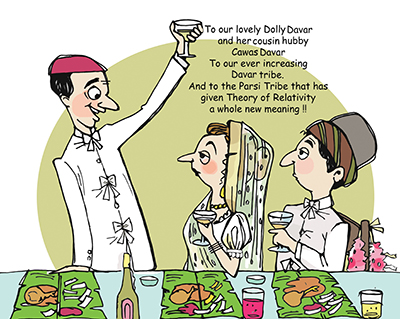
Illustration by Farzana Cooper
Severe genetic inbreeding often resulted in the dull witted and the moronic. Its effects were generally felt in the third generation. We can vouch firsthand about the veracity of this statement. Whenever our paternal grandmother called us sadantar chakram (totally crazy), we drew her kind attention to her marriage.
Sometimes the allocated cousin was switched by mutual consent. In a particular joint priestly family of scholarly disposition, there was a penchant for naming all first born sons Firoze. Moti was fixed with Darabsha’s son, Firoze, but desired his cousin with the same name, whose father was Nusserwanji. She animatedly discussed with her girlfriends how to manage the switch from Fi-Dar to Fi-Nus. Moti was the only daughter of wealthy parents and suffered from chronic dysentery. Fi-Dar was an incurable romantic who had fallen in love with the sister of Bollywood screen siren Madhubala from Kabul (when she landed at the Bombay Central Station, the crowd just froze looking at this legendary beauty). Her sister of course was not as pretty and Fi-Dar was a handsome lad who learnt Urdu to write letters to his object of affection. So he was glad to pass on the rich Moti to Fi-Nus, who had his eyes on his aunt-cum-mother-in-law’s wealth, her daughter’s dysentery notwithstanding.
However, Fi-Dar’s romance was cut short by his Pathan father-in-law-to-be, unless he converted to Islam. The reckless youth did think of doing so but chickened out and was married to his neighbor, one Gool, on the same day that Fi-Nus married Moti with great fanfare. Gool was a robust-looking sourpuss who tamed her wayward husband and bore him three lovely children. Moti had to unfortunately spend more time with the gastroenterologist than the gynecologist. Fi-Nus treated her well, but enjoyed the wealth to have numerous girlfriends. Once he was in Goa with one of his girlfriends and was shocked to see Gool sitting in the corridor of the hotel just outside his room and fervently praying from a largish Khordeh Avesta; which made him complain bitterly to his cousin as to why the latter’s wife had to go all the way to Goa if she only wanted to pray.
Hindus were aghast that Parsis married their first cousins whom the former regarded on par with siblings. One Jamnadas accused of abusing his co-worker, Sorabjee, with the sister word, defended himself by saying that Sorabjee was indeed married to his sister; whereupon the Parsi retorted by saying that every Parsi was a distant cousin of the other, and had no choice but to marry cousins, as the alternative of marrying a juddin was worse than incest.
In Lashkari Vad, a bombshell bimbette called Piloo was coveted by her three cousins ever since she wore a sari for the first time (a ceremony to mark a girl’s coming of age) but she rejected the overtures of all three, and married the neighbor’s only bespectacled son, Adar. Her three cousins were so shocked that they remained bachelors; causing their mother to complain bitterly that this was a classic case of gher na chhokra ghanti chaaté né paroshi né aato! (literally, children of the house were left to lick the flour mill while the neighbor enjoyed the flour). Adar must have relished his chapattis.
Berjis Desai, author of Oh! Those Parsis and The Bawaji, occasionally practices law.