"Ironically, the man who built Jehangir Art Gallery (JAG) Sir Cowasji Jehangir was not a collector of modern art,” said his grandson and present chairman Adi Jehangir. Cowasji’s collection comprised Mughal miniatures and Chola antiques, "not contemporary art.”
In 1952 besides the Artist Centre which was used more by artists as a place for painting rather than exhibiting, the Taj Art Gallery which was "very expensive” and occasionally had exhibitions, and the Sir Cowasji Jehangir Hall where exhibitions were held only if "prominent artists from abroad came,” there were no full-fledged art galleries in Bombay, states Adi. Artists used to exhibit their work at a room in the Chetna Restaurant on Rampart Row which served as "an ad hoc gallery.” In the limited space available artists would exhibit three or four paintings at a time. The notion of an art gallery devoted to art where a large number of paintings could be displayed was a novel idea.
Cowasji was the first Indian president of the Bombay Art Society and his associates in the group including nuclear scientist Dr Homi Bhabha and artist K. K. Hebbar urged him "to do something” for artists, states Adi. Cowasji first thought of setting up a gallery near the Cooperage grounds but people felt "it was too far to go,” Adi states with a laugh. When the Prince of Wales Museum grounds were suggested Cowasji was agreeable. "Give the land and I will bear the entire cost but the management of the gallery must be independent” even though the property vested with the Museum, Adi recalled his grandfather’s generous words.
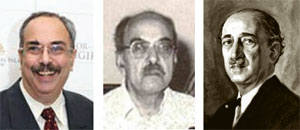
"It was sometime in 1948 that the trustees of the Prince of Wales Museum of Western India (POWM) felt the need for an art gallery in the city,” stated Sabyasachi Mukherjee, director of the prestigious Museum in the Art for Jehangir publication issued on the occasion of the jubilee. The 120-page publication printed by JAK Printers catalogs the works of the 47 artists who donated their paintings in part or fully to JAG for auctioning. "The idea was to acknowledge artistic endeavors of local artists as well as craftsmen of the country. Negotiations in connection with the establishment of an art gallery for Bombay were carried on between the Government and the trustees of the Museum. The result was that the trustees agreed to the construction of an art gallery on the Museum grounds. However, there were financial constraints which prevented the trustees from proceeding further.
"In 1949, Sir Cowasji Jehangir, second baronet, the well-known connoisseur of art and millionaire citizen of Bombay, and also a trustee of the Museum, offered a munificent donation of six lakh rupees to the trustees for the construction of the art gallery, under certain conditions. The trustees gratefully accepted the donation and also agreed to name the gallery as the JAG.” The Gallery was named in memory of Cowasji’s second son who had predeceased him.
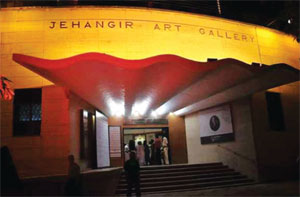
The gallery was designed by Durga Shankar Bajpai and G. M. Bhuta, states The Times of India (TOI) of October 7, 2012. "A fine example of early modernist notions of inward looking art galleries, the JAG is in need to both expand and improve its facilities to be an exhibition venue of the 21st century,” stated JAG in the Art for Jehangir publication.
Cowasji was "a true lover of Indian art,” stated the fourth and present baronet, Sir Cowasji Jehangir (Jehangir Jehangir) Adi’s brother. The 60th anniversary of JAG "coincides with the 50th death anniversary of its founder — a man who lived a rich, full and rewarding life,” he adds. After Cowasji, his son Hirji headed JAG, followed by Adi.
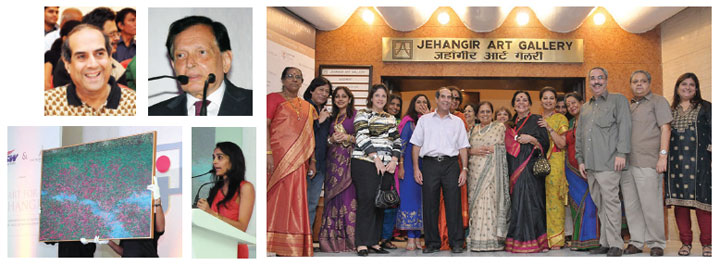
The art auction held at the Taj Mahal Palace hotel on October 17 garnered Rs 1.4 crores, notes Adi. The Taj Group of Hotels sponsored the event. Karthiayani G. Menon, the JAG’s secretary for 45 years, roped in the artists who generously consented to contribute their paintings for the auction. The artworks included creations by the late Jehangir Sabavala, the late Shiavax Chavda and Gieve Patel.
Noted auctioneer Mallika Advani, who did not charge for her services, told the gathering that the JAG was a prime example of public and private bodies working together to promote art. "There is no other place like it,” she observed. The JAG accepts donations and has an 80(G) certification from the income tax department whereby donors can write off a portion of the donation against taxes, notes Adi.
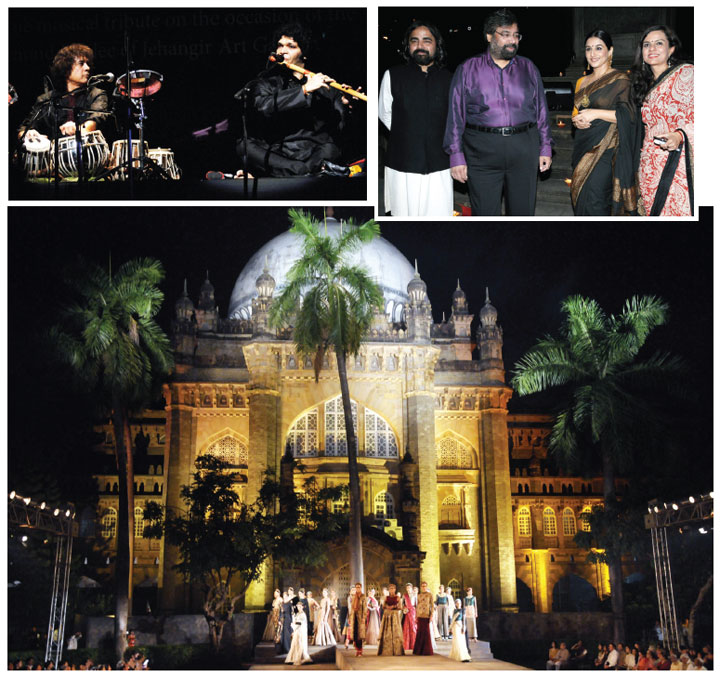
Industrialist and member of Parliament Kamal Morarka donated Rs 1.4 crores for renovating the main auditorium hall to the left of the entrance, says Adi. Designer Sabyasachi Mukherjee held a fashion show on the evening of October 28 on the lawns of the POWM. Mukherjee told the Daily News and Analysis (DNA) newspaper (October 20, 2012), "The evening will be a sensory overload in terms of beautiful sounds, textures and color to match the seriousness of art.” JSW (Jindal Steel Works) contributed finance for the event. A day earlier, courtesy Tata Sons, a musical recital by Zakir Hussain accompanied by Ganesh Rajgopalan, Sridhar Parthasarthy, Navin Sharma, Joy Singh and Rakesh Chaurasia was held at the Jamshed Bhabha auditorium of the National Centre for the Performing Arts at Nariman Point.
On the occasion of the anniversary auction, the JAG’s website was officially launched by noted medical practitioner Dr Farokh Udwadia. Terming the occasion "a happy and memorable day,” Udwadia showered praise on JAG which provided a "stepping stone” to many great artists. He recalled many years ago purchasing a painting of a horse by the late M. F. Husain which was on sale at JAG for Rs 10,000. When Udwadia told his wife, Veera, that he wished to purchase the canvas, she responded "You want to put all your money (savings) in a painting?” The late Kali Pundole however told Udwadia "Buy it. Six months later I will buy it back for double the amount.”
The website, sponsored by Adi and Jehangir, will enable JAG to archive all the exhibitions. Artists will also be enabled to connect with buyers throughout the world as the contact details of the painters will be posted on the site. The website is managed by Mio Design.
Even till 1957-58 JAG was "not fully booked,” recalls Adi. Rather than let the space remain vacant a portion on the first floor was rented out to Chemould Art Gallery run by Khorshed and the late Kekoo Gandhy and a section of the terrace was rented as a photo gallery. Today JAG is fully booked till 2015 and is handing out forms for 2018 onwards, Adi reveals. The rented space has been returned, with the Hirji Art Gallery occupying the space where Chemould was and a photo gallery on the terrace since April this year. Adi’s father Hirji was "an important collector” of modern art. During the 2012 monsoons the terrace gallery was closed but Adi says permission will be sought from the Bombay Municipal Corporation to erect a canopy thus enabling the gallery to remain open all year. "‘Upgrade, modernize and expand’ is our working motto,” Sapna Kar curator of the jubilee plans told TOI (October 7).
The popular Samovar coffee shop on the ground floor of JAG will continue "for the time being... for some years,” assures Adi.
Adi notes that today many big name artists opt to display their works at private galleries which assist painters to sell their artworks. Marketing is something artists are not able, or are disinclined, to do, observes Adi. At JAG, the hall is rented by the artist who has to do the publicity, marketing and selling. The JAG charges Rs 6,000 to Rs 7,000 per day for renting out the large exhibition hall to the right of the entrance. To facilitate artists who cannot afford the full hall or do not have enough pieces to exhibit, the space can be divided into three parts on a pro rata charge basis. Private galleries do not charge a rent but most take a commission on the sale of paintings. Should a private gallery book the hall at JAG the charge is Rs 20,000, says Adi.
"There is a new trend,” observed Adi, where paintings are presold at sponsoring galleries and later exhibited at JAG so that a larger number of the public can view the artworks. The late noted painter Jehangir Sabavala who was related to Adi’s family for example sold most of his recent paintings at the Sakshi Art Gallery but still wanted them to be subsequently displayed at JAG.
"We are told the Indian art market will cross Rs 3,500 crores by 2015,” noted Adi in Art for Jehangir. "Words such as ‘deal’ and ‘investment’ are commonplace references to art. But what seems to have been reduced to a mere whisper is the simple, pure love of art.
"But I believe that unadulterated love for, and of Indian art, still exists at JAG… At JAG all artists are welcome… whether they are from Assam or Aurangabad, Kashmir or Kerala. Ours is a not-for-profit organization. There are no commissions to pay, no fears to overcome… at JAG, no artist — big or small — ever feels intimidated or overawed. Neither does the common man or simple art lover, who may not be able to buy a work of art, but wants to soak in its inherent beauty. That indeed is the DNA of Jehangir, which continues to this day since the last six decades.”