The last leg of the flight to London was
fraught with misadventures, including getting
lost over the English Channel
Rusi Sorabji
Ninety-one years ago on March 21, Navroz day, Aspy Engineer, a young Parsi lad of 17 years, three months and six days, arrived in England from Karachi, flying his own plane, a tiny Gypsy Moth, accompanied by his friend Ram Nath Chawla. Engineer was to take part in the Aga Khan Race which offered a prize of pound sterling 500 to any Indian flying solo between England and India in the fastest time, provided the flight be completed within 30 days. This serialized account pertains only to how the two adventurous friends made it to England. Engineer then flew back to India solo to win the first prize. In the third instalment the flyers battled a storm while crossing the Mediterranean into Europe.
With profound thanks to all at the Royal Air Force base (at Malta) we (flying companion Ram Nath Chawla and I) were once again over the sea heading towards Sicily with an accurate compass and flight map. Soon majestic Mt Etna hoved into view and we were landing on a military airfield at Catania in Benito Mussolini’s Italy. The Italians wanted to check our aircraft. They were insistent and we could not say no for we wished to remain there for three days and did not wish to antagonize them, being, as it were, in their hands. They reset the carburetor finding the mixture too rich. On the day of our departure we found the Italians still fiddling with our plane. I soon realized that our Zenith carburetor had been completely dismantled and a drawing made of it. Once I was able to return the carburetor jets to their correct setting and had the engine going, we set off for Naples.
"Crossing the narrow straits of Messina we reached Reggia and flew on towards Naples. Soon the second majestic volcano, the historic Mt Vesuvius appeared in view still belching forth fumes and lava on March 15, 1930.
"Upon landing at Naples we were required to pay duty on the full value of the plane. No explanations were acceptable. We were marched off to town to sign a sheaf of papers. Staying overnight at Naples, we hopped into Rome where we received the ‘good’ news that our next stop, Pisa airport, was waterlogged. Here again belief in our motto, ‘what can’t be cured must be endured,’ kept our spirits high. On venturing into town we were confronted with columns of army personnel marching everywhere, blocking the streets and historical places of tourist interest. The acrid smell of car fumes and aroma of very black coffee from the numerous cafes pervaded all Italian towns. Next morning we made a soggy landing in Pisa in the shadow of the about-to-topple-over Leaning Tower.
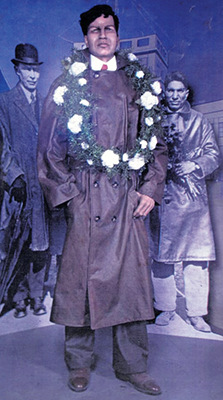
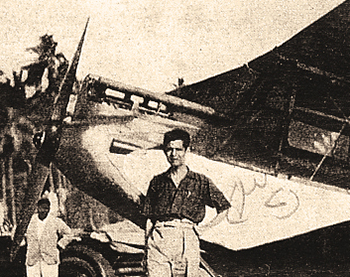
Top: Aspy Engineer with his plane;
above: his statue at Croydon airport, England
"Luckily, we were able to refuel immediately and depart for Marseilles, France without having to disturb any Italian officials during their afternoon siesta. We progressed slowly, engrossed in the incredibly beautiful scenery of the Italian and French Riviera. With a favorable back wind, as the sun went down, we landed in Marseilles. Next morning Chawla stayed in town searching for aviation maps to England and encashing bank drafts for French and English currency. I carried out the usual engine and aircraft checks for any repairs.
"Crossing the mountain ranges, we followed the Rhone Valley as far as we could then cut across to Lyon. On March 19 we set course for gay Paree. Though we did sight the Eifel Tower, we could not locate the Le Bourget airfield because of poor maps and fog. After much fruitless going around, saying a prayer we force landed in a field without any mishap other than a very irate farmer suddenly appearing from nowhere and lambasting us in the most profane language I have ever heard. The faster he spoke the less I understood. He was mad at us for landing in his field when there was an airstrip six fields away. All we could say in our frozen state was ‘Pardon Monsieur’ before taking off and landing at St Quentin, six fields away from the farmer, but 100 miles north-west of Paris. Despite the forced landing we consoled ourselves at being nearer to London, but in fact it was the root cause for the actual drama the next day.
"Staying at a comfortable inn near the airfield, we enjoyed an appetizing meal with good French bread and wine. It was the most relaxing night, falling asleep under the false assumption that we had indeed broken the back of the journey and now only a small stretch of water (the English Channel) had to be crossed.
"The next morning a Frenchman at the airfield verbally gave us the flight course for Blighty (England) because the maps we had collected were in French, and confusing. Surely, being so close, we could not miss the British Isles? It was no Malta!
"Leaving St Quentin for London at 11 a.m. on March 20, we set out for our final hop with the flight settings recommended by our French friend. We soon ran into bad, really bad weather and strong winds. Nearly frozen, we approached the coast presuming we were approaching Calais. Circling the town twice, we were satisfied that England lay only a few minutes away to the north. Actually, as we discovered later, the town we had circled was Ostend in Belgium and we were lost in the clouds somewhere over the North Sea. Our 10-minute crossing had turned alarming. All we could see was angry waves instead of the green fields of England; it was almost half an hour since we had sighted land.
"We soon realized we were flying far to the right over the North Sea. It seemed the compass had also imbibed too much French wine! This was when we saw a tramp streamer below and started a series of low dives circling the ship and with me gesticulating with my arms. Two sailors on deck waved back. I tried to indicate distress, but in vain. I made the letter ‘L’ for land with my hands. One sailor understood our predicament and pointed towards England making an ‘L’ with his arm and leg. Thanking them, we swung sharply to port and soon spied land.
"As the fuel gauge indicator was low, another forced landing had to be attempted in a field. Saying my prayers and crossing my fingers I jammed myself in the cockpit. Chawla brought the plane down safely. An enraged farmer arrived and shouted at us. Chawla was too exhausted and I was left to assuage the farmer’s ire as best as I could.
"The farmer seemed stumped with the ridiculous story of the last six hours but seeing our wet condition, his blood red face changed color and taking pity on our bedraggled state he invited us to his house and made arrangements for the next day as well. I learnt later he was a big cheese in the area. He immediately rang up Croydon airport informing the reception party there that we had decided to visit Thetford first and would be arriving at Croydon at 11 a.m. on the morning of March 21.
"The Press representatives who were at Croydon smelt something interesting and immediately left for Thetford to find out what sort of aviators we were who could actually altogether miss the British Isles on a simple crossing of the Channel. Giving them the address, mine host invited them to dinner. As the Press party would be late in arriving, our host graciously suggested that perhaps as we were hungry we would like a bite right away. Not needing a second invitation, we found that the roast beef and Yorkshire pudding with a large tankard of brown ale was just what the doctor had ordered. As we were finishing our hearty meal, the Press representatives arrived and listened to our adventures. After a quick dinner with our host they rushed back to London to file their story.
"On the morning of March 21, 1930 our host ensured that we left in time to arrive at Croydon punctually at 11 a.m. — this was the first time we were on time.
"On alighting we were garlanded by a member of the reception committee, the Mayor of London dressed in his striped pants, tail coat and top hat with his insignia of office prominently displayed. Pathe Film newsreel cameras were there.
"So at last we reached our destination for the start of my solo flight for the Aga Khan prize, thanks to good luck and guardian angels. The difficulties we encountered were a form of education to me and stood me in good stead during my return solo flight which went off without any major incident apart for looking for spark plugs, which J. R. D. Tata offered me in Egypt. But Chawla and I were the first Indians to dual fly between India and England.
"Col Shelmerdine kept his word and got the Legislative Council to grant us a special prize of Rs 10,000 which proved to be most welcome as our expenses were very heavy indeed. I was happy I had not let my dear father down and felt absolutely confident that I would win the Aga Khan prize as well make my mother’s prediction come true.”
Concluded