The British, The Bandits and The Bordermen: From the Diaries and Articles of K. F. Rustamji, edited by P. V. Rajgopal.
The senior police officer had earlier helped quell riots during the Quit India Movement in 1942, served as chief security officer to India’s first Prime Minister Jawaharlal Nehru for six years and was appointed as the chief of the Madhya Pradesh Police to deal with insurgents in the area. After his retirement from the BSF by which time it had a strength of 60,000 men he was made special secretary in the Ministry of Home Affairs and while in that position, in September 1974, the Indian cabinet set up the Rustamji Committee, under his chairmanship, to examine lacunae in security and law enforcement between the Indian Navy and the central and state police forces. The only Indian police officer to be decorated with the Padma Vibhushan, the nation’s second highest civilian award 12 years before his demise in 2003, he also enjoys the distinction of having the first engineering college in India established by a para military force named as the Rustamji Institute of Technology.
Besides Rustamji there were 48 "foreign friends" from India and the rest from the USA, Russia, France, Australia, UK, Sweden, Sri Lanka, Nepal and Bhutan who were presented an award for their valuable support at a time "when Bangalees stood up against the atrocities and genocide and contributed to the eventful emergence of sovereign Bangladesh through a nine-month war."
On the invitation of the Bangladesh Government, Toronto based businessman Cyrus Rustamji went to Dhaka to receive the posthumous award conferred on his father Khusro. At Parsiana’s request he gave a detailed account of the four days they spent as VIP guests of the government.
• • •
On December 13 we arrived in Dhaka along with some of the other award winners who were on our flight from Bombay. From India the group was fairly evenly divided between government and military officials, and eminent personalities from the film industry, arts and journalists. These included Anandji Virji Shah (part of the famous music director team of Kalyanji Anandji), Pritish Nandy, Rinki Roy Bhattacharya (daughter of film director Bimal Roy) and Brig (Retd) H. S. Nagra, son of the late Maj Gen G. C. Nagra, the first Indian General to lead his troops into Dhaka in December 1971. We were pleased to meet the Parsi actress Nargis Rabadi, better known in Bollywood as Shammi, and her son who were also part of our group.
On our way to the Pan Pacific Sonargaon Hotel, our bus was escorted by a convoy of police vehicles as protests were planned in Dhaka that day. There were a number of billboards as well as signs across major bridges and intersections welcoming the ‘Friends of the Liberation War.’
Later in the day we met some of the award winners and their representatives. These included Ambassador Jagdish Sharma who saw action in the 1971 War as a young officer in the Indian Army; Townsend Swayze, retired from the US State Department; Somporn Coggin, wife of the late Dan Coggin, veteran journalist from Time Magazine; Shamshad Husain, son of the late M. F. Husain; Sudeb Dey, nephew of singer Manna Dey; Chitra Devi, wife of the late Sepoy Ansuya Prasad posthumously awarded the Maha Vir Chakra for gallantry during Operation Cactus Lilly.
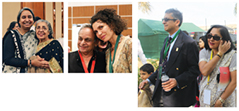
On December 14 we made an early morning start for the Mirpur Martyred Intellectuals Memorial. We were quite amazed with the number of people who had already gathered to lay a wreath for the martyrs of December 14, 1971 when a large number of intellectuals, university students and professors were brutally killed. The tragedy is that these events took place just two days before the surrender at Dhaka that resulted in the largest number of prisoners of war since World War II. Even though the crowds were very large and quite vocal we never felt unsafe or uncomfortable at any time. The Prime Minister Sheikh Hasina, daughter of Bangabandhu Sheikh Mujibur Rahman was the first to present a wreath and there was a brief ceremony and a period of silence to honor the dead.
Following this we were taken for a river cruise embarking from the Postogola Cantonment jetty. On board the vessel we met up with a group of retired army officers and their wives also visiting Dhaka as guests of the Bangladesh government. Many of these officers were retired generals visiting Bangladesh for the first time since 1971 when they were captains or majors. A retired Indian Army general can be easily identified by his tweed jacket or navy blazer, a cravat or regimental tie, with a smart hat. One of the great opportunities we had on this trip was the chance to speak with these retired officers. We got to hear their stories and could sense their feeling of pride on a job well done.
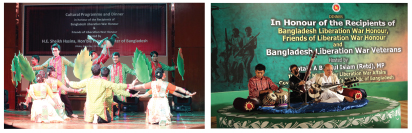
Post lunch there was a cultural program that included songs by Sudeb Dey. By special request we were treated to a spirited recital by Anandji of the song Yari Hai Iman Mere Yaar Meri Zindagi from the film Zanjeer. That evening, dinner was hosted by the Foreign Minister Dr Depu
Moni. The guests were shown a video documentary An Evening of Remembrance and as a living reminder of the tragedy, we had in our midst family members of some of the martyred intellectuals.
My wife Namrita and I were touched by the sincerity of the hospitality shown towards us. Dr Moni complimented Namrita on the Parsi gara she was wearing and on our last day presented her a sari.
The next day, December 15, we left early in the morning for the Bongabandhu International Conference Centre and the award ceremony for the "Friends of Liberation War Honour." We were greeted by Sheikh Hasina and citations were read out by the cabinet secretary for all the award winners. A group photo followed.
In the afternoon we were taken for a very moving tour of the house of the late Sheikh Mujibur where he and a number of his family were brutally assassinated in 1975. The spot where the Father of Bangladesh was gunned down is now preserved under a sheet of glass. Bullet holes and blood stains still remain.
That evening we were invited to a dinner hosted by the Prime Minister and we got a chance to speak one-on-one with her. Our five-year-old son Zubin was thrilled that Sheikh Hasina shook his hands! We presented her with a picture of Sheikh Mujibur taken with my father in 1972.
On the morning of December 16 we left the hotel at 5 a.m. for the National Martyrs Monument in Savar where the Prime Minister led the wreath laying ceremony. At 10 a.m. we were taken to the National Parade Square for the annual Victory Day Parade. Following the Parade a small group of us were invited for a private tea at the residence of the Finance Minister Abul Maal Abdul Muhith. He remembered meeting my father. We also met Sahriyar Kabir, a filmmaker who presented me with a copy of a film that includes an interview he recorded with my father. Later in the evening we were taken to the Liberation War Museum in Segunbagicha.
Our last dinner was hosted by Capt A. B. Tajul Islam, the State Minister for Liberation War Affairs at the Army Golf Club. This being our final event we bade good- bye to our hosts and fellow invitees.
The Bangladesh operations had a very special place in my father’s heart and he often spoke about the friendships that he had made and the work that had been done by many of his BSF colleagues and later on by the Indian Army to ensure the liberation of Bangladesh. He was pleased that the Indian Army left Bangladesh after January 1972 and let the Bangladesh people handle their own affairs. He was very close in particular with Tajuddin Ahmad who was the first Prime Minister of Bangladesh and was deeply dismayed when Sheikh Mujibur and later Tajuddin were both assassinated in 1975. There were many senior government officials who made it a point to speak to me about their appreciation for the help given to them by the government and people of India.
My father’s role in the Bangladesh operations is well documented. He would frequently refer to the warm hospitality, the great food (important to all good Parsis), and the friendships that he had made in Dhaka in 1972. We found the same warmth and sincere hospitality 40 years later. We left Bangladesh with a feeling of optimism about the future of the country. Joy Bangla!