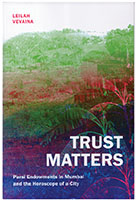
Trust Matters: Parsi Endowments in Mumbai and the Horoscope of a City by Leilah Vevaina. Published in 2023 by Duke University Press, 905 W. Main St, Ste 19-B, Durham, NO 27701, USA; website: dukepress.edu; email: orders@dukepress.edu. Pp: xii + 201. Price: $ 26.95.
One of the more significant projects made possible through Parsi charity of the 19th and early 20th centuries was the building of Parsi social housing. Both individual charity and charitable trusts provided for the construction of 40 baugs and dharamshalas from the 1830s to the 1930s. The building of residential colonies reserved for Parsis constituted the largest social housing charitable enterprise among the Parsis since their settlement in Bombay. Today, Bombay’s Parsi community continues to be one of the largest private landowners in the city due to its network of public charitable trusts.
Leilah Vevaina: conjunction of religion and capital
In Trust Matters, Leilah Vevaina, an assistant professor of anthropology at the Chinese University of Hong Kong, explores this conjunction of religion and capital and shows that communal trusts are the legal infrastructure behind formal religious giving in the community. The public charitable trust has tremendous influence on communal life, and by approaching the city of Bombay through this distinct financial and legal construct, the author offers an innovative and culturally rich exploration of property and religion among the Parsis. As Vevaina tells us her research, while focused on the charitable trust as a legal form, is perhaps more accurately a study about the trust as a "technology of property relations” for Parsis living in Bombay.
Vevaina’s research lies in the intersection of urban property and religious life. Field research for this fascinating ethnography (the scientific description of people and cultures) was conducted in Bombay from 2009 to 2018 in multiple phases and entailed extensive and repeated visits to trust offices and interviews with residents, lawyers, accountants and numerous lay Parsis. She argues that while Parsi colonies do have segregationist settlement patterns with their legal restriction to Parsi residents only, what was groundbreaking was their establishment in perpetuity through the use of trust agreements. This exclusive use was meant to perpetuate and nurture minority life in Bombay.
Vevaina follows the trust as "it traverses the timescape and municipal regulatory constraints” of the city. She shows us how Parsi property transformed into real estate during the colonial period and then discusses some critical personalities who founded the trust landscape in the city. Khan Bahadur Muncherji Cowasji Murzban was an engineer and architect, well connected with philanthropic families like the Camas and the Allblesses. He would approach the government for permission to establish what he saw as a needed institution and then finance it through the backing of his wealthy contacts. Later, the Bombay Parsi Punchayet (BPP) entered the charity housing game in 1910 when Sir Cowasji Jehangir, First Baronet, established the Hughes Road Colony now known as Khareghat Colony in South Bombay. The other institution which changed the nature of Parsi settlement was the Parsi Central Association, founded in 1919, which helped construct the Dadar Parsi Colony.
Vevaina tells us how Jerbai Wadia, the widow of the industrialist and mill owner N. N. Wadia endowed five enormous properties and accompanying funds in the name of her husband and sons, rather than have her children directly inherit the assets. The five estates were dedicated as Parsi housing colonies in the 1920s and 1930s through separate trust agreements. While the main concern was to encourage Parsis from Gujarat to settle in Bombay to better their prospects, another reason was the controversial conversion to Christianity of her two sons, Sir Ness and Sir Cusrow. Endowing the assets allowed Jerbai to prevent her sons from inheriting the estates directly from her as per succession rules.
The author explores how contemporary Parsi family and marriage practices intersect with trust bureaucracy and organizational practice. Vevaina also shows, through the analysis of landmark Parsi legal cases over beneficiary access to trust-managed sacred places, the degree to which a secular court will interfere in religious trust matters. The cases discussed are Petit vs Jeejeebhoy, Kanga vs BPP (the priests’ ban case), and the Goolrookh Gupta case.
The book also discusses the relationship between trusts and Zoroastrian mortuary ritual practice. Vevaina examines the role of mortuary infrastructure and its relation to critical disputes in the community over the form and content of death rituals and the people who are allowed to participate in them.
The trust allowed the community to mark its minority spaces and preserve community codes through access to these spaces. The author argues that the underlying purpose of the trust is the fulfillment of a particular intention to be carried out over time, but embedded in the practice of endowment itself are values of what constitutes proper relations with these assets. She argues that the trust is a constitutional document as it structures a social, legal and fiduciary relation among its settlor, trustees and beneficiaries. "The trust document is the first instance of hinging an obligation to property,” she observes.
This is an academic work and one which primarily targets the academic community, but it can also be read with profit and pleasure by the general reader who is willing to persevere. Vevaina presents a fascinating array of Parsi processes and practices in Bombay across legal, spiritual and material spaces to explain the workings of the trusts that operate throughout the city. In Trust Matters the professor brings into focus a legal and financial entity that every Parsi in Bombay takes for granted. We must thank Vevaina for throwing much needed light on a commonplace we know so little about. BAKHTIAR DADABHOY
Dadabhoy is a Secunderabad based author