Threads Of Continuity – Zoroastrian Life and Culture by Shernaz Cama. Published in 2016 by the Parzor Foundation, F-17, Hauz Khas Enclave, New Delhi 110016, email:
parzorfoundation@gmail.com,
shernazcama@hotmail.com; website:
www.unescoparzor.com. Pp: 520. Price: Rs 2,500.
This large, beautifully produced hardcover book on glossy paper has something to say about almost every aspect of Zoroastrian life and culture. From the birth and life of Zarathushtra himself to the arrival of Zarathushtis from Iran to India to the activities of present day Zarathushtis in India, Iran and throughout the world — it’s all there, with beautiful photographs and illustrations. There are 11 chapters written by Dr Shernaz Cama, director of the UNESCO Parzor Project and associate professor at Lady Shri Ram College, Delhi University, who was curator of the exhibition by the same name at the Indira Gandhi National Centre for the Arts in Delhi from March to May 2016. In addition, the compendium is made up of articles contributed by 46 other authors, both Zarathushtis and non-Zarathushtis from all over the world. The book is extremely well annotated, with end-notes to almost every chapter and article and there is an extensive bibliography at the end along with a detailed index.
Although all chapters and contributed articles reflect a commendable effort to present vast material in compact, readable form, certain chapters and articles are particularly well done and informative.
.JPG)
Dr Shernaz Cama Photo: Jasmine D. Driver
I found Cama’s chapter on Zarathushtra and Zoroastrianism particularly commendable and welcome, because wherever possible she makes it clear what is the original, and what are the distortions, by citing chapter and verse from Zoroastrian scriptures to back up the authentic. And in true scholarly tradition, where backup was not possible, she presents the many commonly held views and beliefs with phrases like "it is said that…”, "it is believed that…” and "legend has it that…”, etc.
The confounding of myth and fact has plagued almost all religions, and has been one of the root causes of wars throughout history. Cama has done a marvellous job of distinguishing myth from fact in Zoroastrianism. It was J. P. Bernbach who famously wrote: "A myth is a pack of lies being sought to be passed off as truth, in order to drive home some moral lesson to unthinking masses.” Throughout her book, Cama and some of her guest authors relate extremely interesting and enjoyable myths in Zarathushti culture, but in most cases it is clear as to what is myth and what is fact, what is "story” and what is "hi-story.”
Of course different people will find different parts of the book interesting, but most readers are likely to regard Cama’s other chapter "The Story Of The Parsis In India” as one of their favorites. Not only is the chapter replete with the facts of Parsi history, but it also contains a number of beautiful color pictures of the things, places and people who made and are today making that history.
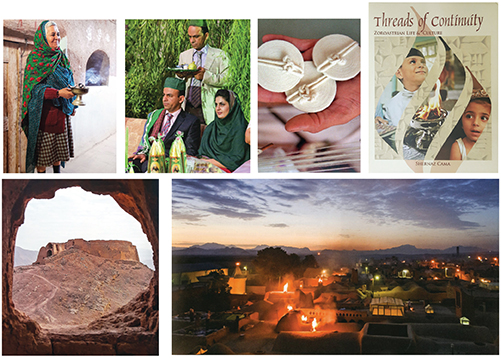
1st row from left: Zoroastrianlady, Yazd; an Iranian wedding; kustis; book cover;
2nd row: a defunct dakhma in Iran; fires lit in Iran to bid farewell to the fravashis on New Year
Top: family home of the only Parsi family in Dahod;
Kaoosji Talukhdar’s children
"The Story of the Parsis in India” starts off with a startling revelation: "It is common knowledge that Sassanian princes married the daughters of Indian kings. Zoroastrians came to India on the land route earlier than the Sanjan landing…” This left me wondering about the proclamations by Parsi evangelists about our "Aryan ancestry,” "racial purity,” and "bund pasbani.”
Among the articles by other authors, I found the one by Anton Zykov "Zoroastrian Funeral Practices: Transition In Conduct” very topical and thought-provoking. Early in the article, Zykov writes: "The paper intends to cast light on the history of the nasusalars, with particular attention focused on the current situation of the Parsi community.” He goes on to say that his "article comes at a time when the anthropology of death in the Parsi community has become not just a matter of academic discussion, but a subject of a major dispute about the future of the community.”
Another interesting article is the interview of Mobed Mehraban Firouzgary of Iran, by Vanshika Singh. Firouzgary is regarded in Iran as mobed-e mobedan (priest of priests), but in the interview he requests with humility not to use that title for him. When he was young, it was his parents’ wish that he should become a Zarathushti priest, and he was sent to India. But he says he was refused admission to the M. F. Cama Athornan Institute, and "my 22-year-long stay in India was filled with hardship in earning my living so as to study up to my BE in electronics…” Of course Firouzgary eventually became a Zarathushti priest, and was at the forefront of the reform that brought Iranian Zarathushti women into the priesthood as mobedyars.
Marzban Giara’s article "Statues Come Alive: Parsis in the Making Of Bombay” should make any Parsi proud of his lineage. But at the same time it should make him introspect why the achievements of the personages Giara writes about are hardly matched by their descendants. There are photographs of statues of many of the greats of Bombay, along with interesting notes on them, and on the statues that were sculpted — Sir Jamsetji Jejeebhoy, Sir Cowasjee Jehangir, Sir Pherozeshah Mehta, Sir Dinshaw Petit, Sir Sorabji Pochkhanawalla, and many others. Several Parsi ladies of yore whose statues grace the streets or buildings of Bombay also figure in Giara’s article — Lady Sakarbai Petit, Lady Meherbai Tata and others.
This is a book worth buying. It is not likely that any reader will go through this book, cover to cover, in one sitting or in any number of sittings. This is because the book is so comprehensive in its coverage of Zoroastrian philosophy, history and culture. No single person is likely to be so keenly interested in all these aspects of Zoroastrianism.
But any reader who has even just skimmed through the book is likely to close the book in a pensive mood, and say to himself: "What a glorious past!” Soon thereafter, reflective readers are likely to get into a more sombre mood, and ask themselves with considerable concern: "But what will be the future of this community?” It is this very real concern about the future that has gripped the thinking people in the community, and it is this concern that has motivated UNESCO to set up the Parzor Project under which this book has been published.
In fact, if one is forced to mention a shortcoming of the book, it would be that it has very little about the demographics of the community, and the attitudinal, social and economic factors that may be affecting the demographics, the cohesiveness, and the condition and usage of community properties.
Dr JAMSHED A. MODI