In "A story of two funerals” (Readers’ Forum, Parsiana, June 21, 2017) Dr Syrus Irani once again advocates the ‘chemical’ hydrolysis method of disposing a Zarathushti ruvan (corpse) by using sodium hydroxide (NaOH) and potassium hydroxide (KOH). The matter is quite important and worthy of consideration. It is no use simply debating the issue through the Readers’ Forum column of Parsiana. Under any circumstances our traditional khurshed nagirashni system must be maintained in the dakhmas. Electric crematorium is not an option. Nor is an aramgah.
One should interview scholars of our religion starting with your independent researcher Farrokh Vajifdar. One may also speak to Dastur (Dr) Firoze Kotwal, Ervad (Dr) Ramiyar Karanjia, Ervad Marzban Hathiram, Noshir Dadrawala and others like research scientist Ervad (Dr) Jehan Bagli.
The thoughts and opinions gathered may be shared with the Bombay Parsi Punchayet. Once a decision is taken to pursue the idea and implement it, the modus operandi and the economics can be buttoned up. Thereafter, there won’t be any Dhun Barias to take photographs and videos of our dakhmas to humiliate our Mazdayasni Zarathushti community and ridicule our pristine system of khurshed nagirashni. Nothing is impossible.
DARA WADIA
dfwadia@hotmail.com
After reading Berjis Desai’s excellent article "A story of two funerals” (Bawa Musings, Parsiana, May 7, 2017) where he writes that in the not too distant future there will be an electric crematorium in dakhmas, I absolutely agree with his views because solar panels are a form of slow burning crematorium which do not work well in the monsoons. Instead of that why don’t we have an aramgah as there is ample space in Doongerwadi to have one, as in Delhi? We need a change badly. Why are Bombay Parsis forced to go into a dakhma instead of using this beautiful place in a different way? People who prefer dakhmenashini can go into a dakhma, if they wish to, but others can be buried in a cemetery among flowers and birds chirping among trees.
Today people are turning towards cremation thanks to the A. H. Wadia Trust, Dinshaw Tamboly, Jamsheed Kanga and Homi Khusrokhan for creating the Prayer Hall at Worli. This is called ‘change’ where progress is a rule of life!
THRITY MISTRY
Browsing through some old documents, I came across a slim, 66-page booklet, Dokhmu Ke Daatvanu (to consign in the dakhmas or to bury), authored by my late father, Ervad Siavax Maneckji Bhadha, panthaky of the Belgaum agiary in the year 1938. What drew my attention are the few remarks/endorsements made by personalities from around the world who visited the Towers of Silence. A few of these are appended below, purely for academic interest:
Monier Williams, University of Oxford, had written in 1876, "My second visit has confirmed me in my opinion that the Parsi method of disposing of their dead is as perfect as anything can be in a sanitary point of view….. Nothing during my travels throughout India from Kashmere to Cape Comorin has interested me more than my two visits to the Parsi Towers of Silence.”
J. Gibbs, member of the executive council of the Governor General, wrote in March 1879, "In reply to your question as to whether the Towers of Silence were a nuisance to my late house, I may say that during the nine years I lived there, none of us ever experienced the least annoyance from having the Towers so near, and I do not remember ever seeing any of the birds using the trees on my side of the valley. They could not have been less objectionable had the Towers been 10 miles away.”
In the same month and year, Henry S. Olcott, founder president of the Theosophical Society, reported, "A committee sent by the Theosophical Society of New York to report upon the philosophical and religious ideas of Oriental people, has enjoyed the pleasure of a visit to the Bombay Towers of Silence and the instructive explanations of the secretary of the Punchayet. We cheerfully state that these latter have removed whatever prejudices may have existed in our minds against the Parsi method of sepulture, and it will be a gratification to us to make these conclusions known to several branches of our Society in America, Europe and Asia.”
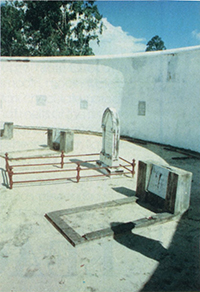
Graves in dakhma in Colombo, Sri Lanka
In September 1896, the second president of the Theosophical Society, Dr Annie Besant, observed, "The mode of disposing of dead bodies is one which does no injury to the living and restores the corpse quickly to the elements, of which it is composed. The place is beautifully kept.”
As remarked the veteran American humorist Mark Twain, "One marvels to see here a perfect system for protection of the living from contagion derivable from (the) dead. I mean one marvels to see this proof that modern science is behind the ancient in this so important matter.”
Declared Val C. Princep in Imperial India, "I must confess the whole thing fascinates me much and I should, when dead like to be so picked myself feeling that I should at least be doing some creatures some good after death.”
Zenaid A. Rogozen wrote in The Story of the National series - Media: "The dakhma brings us to a contemplation of the most extraordinary refinement of logical consistency ever achieved by human brains.”
Attested Dr Rudolf Pock, Austrian Plague Commission, "I find that the Parsi system of the disposal of the dead is the best from a hygienic point.”
Likewise corroborated Louis L. Seaman, of New York, USA, "Certainly a novel, and to my mind a far superior method for the disposal of the dead, than that in vogue in many parts of the western countries.”
If only we could restore and resurrect this amazing concept to its pristine glory!
Cmde MEDIOMA BHADA (Retd)
mrbhada@gmail.com