Patients suffering from dementia should be
handled tenderly and tactfully, recommends Dr Dolly Dastoor
Text: Parinaz M. Gandhi Photos: Jasmine D. Driver
"Less than 10% of people who experience lapses of memory develop dementia,” reassured Dr Dolly Dastoor, assistant professor of psychiatry at the prestigious McGill University in Montreal, Canada. She was addressing a gathering, predominantly of senior citizens, that had assembled to hear her talk on "Alzheimer’s: Managing an Aging Mind,” under the auspices of the Women’s Entrepreneurs (WE) Wing of the World Zarathushti Chamber of Commerce (WZCC) at the Indian Merchants’ Chamber on January 19, 2019.
Occasional inability to recall where one has placed the keys or parked the car or why one has entered a room is a common human experience, noted the speaker who has been working in this field for over four decades and chairs the Education Committee at the McGill Centre of Research and Studies in Aging. Memory recall is dependent on how attentively the brain has encoded the information. Whilst listening to her talk, if an individual is thinking about one’s return journey or dinner plans, retention would be impacted, she cited an example.
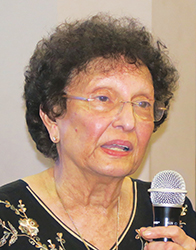
Dr Dolly Dastoor
Alois Alzheimer’s patient Auguste Deter in 1902, first described
case of Alzheimer’s disease Photo: wikipedia
Although the terms dementia and Alzheimer’s tend to be used interchangeably, Dastoor specified that dementia is a generic term whilst Alzheimer’s accounts for 64% of all dementia. She defined dementia as a syndrome or group of symptoms resulting from a structural loss or death of nerve cells in the brain. Dementia impairs cognitive, functional and behavioral abilities, has an insidious onset and is marked by progressive decline. Cognitive impairment affects language and executive functions as also the ability to work with hands (apraxia) and ability to recognize objects (agnosia) as when mistaking a waste paper basket for a toilet. This results in functional loss in activities of daily living.
The loss of language abilities in Alzheimer’s patients progresses in the opposite direction when compared to the development of a child. A baby starts with making sounds, saying single words and then sentences. The reverse is the case in Alzheimer’s where the patient has difficulty in framing sentences, slows down to speaking single words and eventually says nothing. In the case of fecal and urinary control too, the decline in Alzheimer’s patients reversely corresponds to a child gaining control. Likewise, the sucking and hand clasp reflex of an infant are seen in advanced cases of Alzheimer’s where towards the end the patient tends to put everything in the mouth.
"The top 10 warning signs” of dementia that one should look out for are: memory loss that affects day-to-day functioning; difficulty in performing familiar tasks like writing a cheque or not knowing where to turn at a crossroad; problems with language that lead to difficulty in reading, writing or speaking; disorientation of time and place; poor or decreased judgment which leads to inappropriate dressing in different seasons; problems with abstract thinking where the person cannot visualize without the object being placed before him/her; misplacing things more frequently; changes in mood and behavior, showing signs of aggression, anger, anxiety; changes in personality with the person freely mouthing abuses; loss of initiative, with ‘no’ being the most common form of response.
Besides Alzheimer’s, there are 60 other forms of dementia, the other common ones being vascular dementia where the brain is affected by blood clots or a paralytic stroke. In such cases, further deterioration can be prevented through proper blood flow. In front-temporal dementia, a person acts in an embarrassing way or says lewd things that would not be considered polite. Alcoholic dementia resulting from a high content of alcohol remaining in the body for a longer time leads to memory loss although the short-term memory is not affected. Lewy body (abnormal aggregates of protein that develop inside nerve cells of the brain) dementia is characterized by hallucinations and perception problems. Familial dementia that is due to genetic factors may start as early as 30 or 40 years of age.
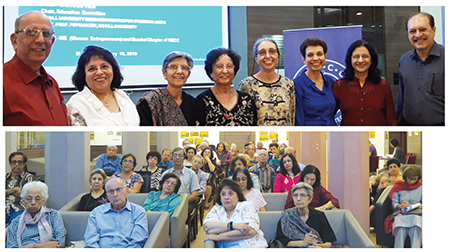
WZCC organizers (from l) Adi Siganporia, Behroze Daruwalla, Homai Mehta, Dastoor,
Percis Dubash, Villie Daruvala, Dolly Dhamodiwalla, Aspi Antia; a section of the audience
Comparison of healthy brain (left) with that of Alzheimer’s patient’s showing extreme
shrinkage of cerebral cortex and hippocampus and severe enlargement of ventricles Photos: wikipedia
"Bhéja (brain) cutlets are common for Parsis.” Those who make bhéja cutlets have seen the brain of an animal, she pointed out. Her PowerPoint presentation showed different areas of the brain that are vital to memory: hippocampus (temporarily holds information vital for decision making and reasoning), frontal lobes (process short-term memory), amygdala (associated with emotions, whether sad or happy, although hurt and insult are remembered longer), thalamus (controls consciousness and alertness, as when a mother instantly wakes up on hearing her baby cry).
"Memory is a dance of chemical and electrical activity in the brain,” she summed up before proceeding to explain a memory model with working/short-term and long-term memory; memory systems that are explicit and implicit; and memory storage as sensory, primary and secondary. Memory falters with age when the activity in the hippocampus and frontal lobes slows down due to loss of connection (synapses) between nerve cells. As per current knowledge, after the age of 30 years, four to eight percent of the brain cells are lost every 10 years. After 60 years of age, the loss is 15%; after 80, it is 30% and after 100, it rises to 50%. Usually 60 to 80% of the brain cells are lost by the time Alzheimer’s is diagnosed. Such loss does not uniformly apply to all people.
Risk factors that may lead to Alzheimer’s are genetic, hormonal, Down’s syndrome, hypertension, head trauma, lower level of education and environment. Conversely, protective factors could be higher education, estrogen for brain cell growth, exercise, anti-inflammatory drugs or hypertensive drugs, anti-oxidants like vitamins E, B, C, good diet, cholesterol lowering drugs, red wine, social support and network, spirituality.
The global count of dementia patients has more than doubled in the last two decades. Whilst there were 20 million cases of dementia in 2000, it had risen to 46.8 million in 2015, with 4.1 million being in India. Within India, 2.3 million were women and 1.8 million were men. The global cost of dementia which was USD 604 billion in 2010 had risen to 818 billion in 2018 and was expected to rise to one trillion by 2021. "We have no medication to cure this disease,” she pointed out. The common supportive medication Aricept, Exelon and ReminylER being approved in 1997, 2000 and 2001 respectively, are only able to delay the downslide, there being no cure. After 2001 there have been no new drugs approved indicating the need for extensive research.
When elaborating on management of behavioral problems, Dastoor regretted that in India, frequently the illness is not diagnosed in the early stages and there is nothing like a support group for the family. A caregiver can experience burnout, as the disease progresses from early stage, through middle stage and last stage by which time a patient has lost the capacity for recognizable speech, has difficulty in swallowing food and may not recognize one’s own face or that of a spouse. Rather than see caregivers experience depression or stress, she recommended 10 ways to reduce stress: learn about the disease; be realistic about the disease; be realistic about oneself; accept one’s feelings; share feelings with others; be positive; look for humor; take care of oneself; get help; plan for the future.
There were several helpful strategies she recommended for those in charge of dementia patients, whether they exhibit physical or verbal, aggressive or non-aggressive behavior. "Try and connect, not correct,” should be the caregiver’s approach. When the patients show signs of restlessness, distract them, calm them with music or touch or the fragrance of their favorite perfume, or the viewing of a family video. When they perform repeated actions, these could be ignored. When they display suspicion, don’t take anything personally or try to argue and reason. Rather than hide such a patient’s condition, neighbors and acquaintances should be kept informed. Whilst minimal pharmacology would help, dementia patients need focused, person centered care with dignity and respect as human beings in a conducive, home-like environment. The tone and rhythm of voice of the caregiver should be soothing to give the patient a feeling of comfort and safety. If patients are inclined to wander, reminders like shoes and hats should be kept out of sight.
The intervention techniques she suggested were soft music, art therapy, reality orientation with date and day of the week positioned prominently, cognitive activities like simple addition and recognition of alphabets, reminiscence therapy, encouraging them to talk about old times, movement therapy like the soothing movement of a rocking chair, simple exercises so that they don’t become stiff, touch therapy to keep them connected with other humans.
Dastoor felt this disease is "very, very pertinent to our aging community that tends to live longer.” Further, with women outliving men, there could be a dearth of caretakers. Community leaders need to think creatively, out-of-the-box, to set up programs and/or supervised residences for middle-class people with cognitive impairments who are residing alone, she urged.
Memory aids
There are four important guidelines to preserve memory, she recommended: lifestyle, cognitive activities, positive attitude, use of efficient strategies. "Aging is inevitable, memory loss is not,” she stressed. Under lifestyle she included maintaining good health and body weight through physical exercise of 30 minutes, at least three times a week, or walking in the company of someone. A diet, low in saturated fats and high in fruits and vegetables with some pulses (the traditional logic of eating kathor every alternate day) and a palmful of dryfruits like walnuts and almonds should help. A good night’s sleep is also essential for "this sleep deprived generation,” to help the body to recuperate and the brain to make good judgments. The expression "let me sleep over it” permits the brain to search for different solutions. Managing stress through social contact and leisure activities is important to ensure the body does not produce the hormone cortisol which shrinks the hippocampus.
Equally important are cognitive activities like solving crossword puzzles, Sudoku and other teasers. Learn one new activity a year, she recommended, instead of indulging in passive activity like watching television which should be seen with someone so that you are mentally alert.
A positive attitude, willing to adapt and accept "goes a long way to live a fruitful, good life.” Under efficient strategies Dastoor covered internal and external aids. Internal would include mnemonics, adding something to the information to make it more meaningful, organizing information that needs to be remembered and breaking the information into smaller parts. External aids encompassed agendas, cues, filing systems, written lists or even the smartphone.
As she reiterated, "Growing old is natural; feeling old is optional.”
WE welcome
The aging community in Bombay does not have commensurate facilities, observed Behroze Daruwalla, the global head of WE in her introductory remarks. Giving credit to Dastoor for "helping me through the journey when my mother was suffering,” Daruwalla added, "We have intellectual treasures in our community.” Take advantage by becoming members and attending programs organized by WZCC, she recommended. Of the 15 WZCC chapters, the latest being launched in Toronto, only three are in India. "I think we are a bit lethargic,” stated Homai Mehta who heads the Bombay wing of WE.
The nearly 90-minute talk by Dastoor was followed by a short round of question-answers after which Villie Daruvala, vice chairperson of WE-Bombay, thanked Dastoor and others who had facilitated the conduct of an informative session.