Died: Dr Frene Noshir Ginwala, 90, freedom fighter and first Speaker of Parliament of free South Africa; on January 12, 2023 in Johannesburg, South Africa after suffering a stroke.
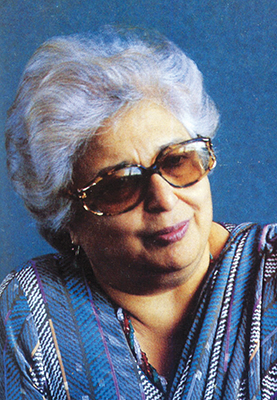
The President of South Africa, Cyril Ramphosa, announced a seven-day mourning period for Ginwala and directed that the national flag be flown at half-mast throughout the country. An official memorial service was held on January 24 at which her co-workers in the many bodies of which she was a part paid her the highest of tributes.
For 20 years, from 1971 to 1990, Ginwala served as a member of the Cabinet of the African National Congress (ANC) government-in-exile, and as its principal speechwriter, spokesperson and ambassador. A prolific writer and truth teller, at every step she was both political strategist and organizational worker, understanding the forces of power, as well as of hard campaigning. The apartheid racist government was always apprehensive of her moves and speeches. Their view of Ginwala was rightly described by Mac Maharaj, ANC comrade and Cabinet minister in free South Africa, as "a pinless grenade in a sari!”
When the ANC was unbanned in South Africa in 1990, Ginwala returned home to South Africa where she served the party in various capacities. She became a member of the Task Force to establish the ANC Women’s League. She was a member of the National Executive Committee (NEC), the ANC’s highest party organ, as well as a member of the National Working Committee (NWC), its highest executive body. In 1994, she was elected as a member of parliament for Kwa-Zulu Natal.
In her numerous achievements there are two key positions that reflected her extraordinary abilities and the level of trust that her country reposed in her. The first was her appointment in 1991 to Nelson Mandela’s office, working on a daily basis on the national strategy and decision-making processes. The second was her election in 1994 as the founding Speaker of South Africa’s first democratic Parliament. In this capacity for 10 years she oversaw the epic dismantling of the evil legal structures of a hundred years of racist apartheid. She was a part of the drafting of the new Constitution. And then shepherded the swift and systematic entrenchment of the detailed legal foundations of the democratic, non-racial, non-sexist future South Africa that the ANC had promised decades earlier in its charter.
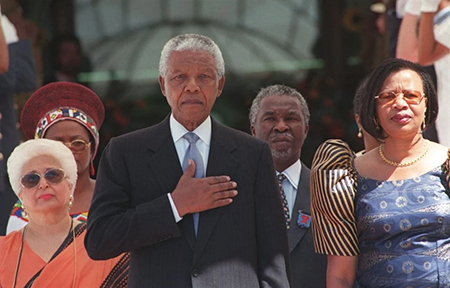
Frene Ginwala (top and above, l) at the swearing in of President Nelson Mandela in 1994
Within a few months of taking over as Speaker, Ginwala and the Rules Committee that she chaired "scrapped the formal dress code, established a crèche for women parliamentary workers and members, and opened up previously closed parliamentary committees to the Press and public,” noted an article by Pippa Green reprinted as a cover story in Parsiana (see "The Hon’ble Speaker,” Parsiana, June 1995).
Her family went to India during World War II and she spent four years schooling there as it was too dangerous to return. She qualified at the University of London for a bachelor of law degree and was enrolled as a barrister at the Inner Temple. She returned to South Africa after graduating and moved to Durban. She became irretrievably involved with the ANC in 1960 when the Sharpeville Massacre erupted. The Apartheid Government shot at a peaceful rally, resulting in the deaths of 69 persons. The Pan African Congress (PAC) and the ANC were both immediately banned and the Boer Government moved to arrest all their leaders. Ginwala headed the task of spiriting Oliver Tambo of the ANC and Dr Yusuf Dadoo of the Natal Indian Congress out of South Africa. They were taken first to Mozambique and then under the critical diplomatic cover and material help of the Indian Government to the safety of Tanzania (then still Tanganyika).
There, Ginwala continued to run the underground railroad for others coming out, including in the following year (1961) Mandela on his short trip out to Addis Ababa and Algiers and back. She became part of establishing and strengthening the ANC’s operations abroad for the overthrow of the Apartheid regime and the freedom of all South Africans.
While in Tanganyika, Ginwala also edited the ANC voice Spearhead. During this time she was injured in a motor car accident, and travelled to London for further medical treatment. She continued her political and journalistic work in London over several years, till February 1970, when President Julius Nyerere of Tanzania, called her to Dar-es-Salaam to become the editor of the newly nationalized English-language Government newspaper, The Standard, shortly renamed the Daily News.
The appointment was a significant one and an indicator of Ginwala’s standing in the politics of the African continent when the Apartheid Government was at the peak of its power, the Cold War was at its height with Africa a major battleground for the competing ideologies, and Tanzania just committing itself to a Socialist society. That Nyerere put the voice of Tanzania and the country’s reputation in Ginwala’s hands on a daily basis is a tribute to her understanding of all these local, continental and international tensions.
In August 1971, on a difference of editorial policy, Ginwala resigned and returned to London where she resumed her ANC and other anti-apartheid work, and for a while returned to Oxford University, where she was awarded her doctorate on Indian South Africans.
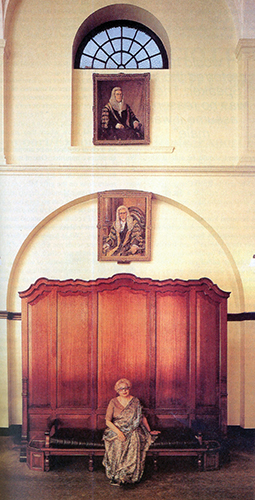
Ginwala in the former House of Assembly Photo: David Goldblatt
Among her many other positions and contributions within and beyond South Africa, Ginwala represented her country as a member of the informal advisory group to the United Nations High Commission for Refugees and was co-chairperson of the Commonwealth Parliamentary Association, South Africa branch. She also served as the chancellor of the University of Kwa-Zulu Natal. In 2003, Ginwala was awarded the internationally prestigious North-South Prize by the Council of Europe. In 2012, India awarded her the Bharatiya Pravasi Samman Award.
She was available to guide every anti-apartheid activity. Her responses to collective bodies as to individuals were the same — unforgiving of euphemisms that covered up oppression or indignity, uncompromising on her politics of justice, fearless beyond compare. She was in the ANC Military and was a planner of attacks, including famously on the Government’s oil reservoirs (SASOL) in South Africa. She was a constant target for years. And the ANC had reason to be concerned about her safety. Anti-apartheid activist Ruth First had been blown up with a post-parcel bomb. Lawyer and activist Albie Sachs had barely survived a car bomb. Behind all Ginwala’s work was a massive intelligence, applied with scalpel precision to the matter before her, whether of national liberation or injustice to individuals.
From the time she was in exile, Ginwala challenged patriarchy and sexism. While in Dar-es-Salaam in 1971 she halted the notorious forced marriages of Persian girls by Zanzibar Government personages. Later, she served as deputy head of the ANC Commission for the Emancipation of Women, and as national convenor of the Women’s Coalition. She was a founding member of the Women’s National Coalition that focused on two key demands: the inclusion of women in all decision-making about the shape of the post-apartheid state and constitution, and an end to violence against women.
In the 1985 Women’s Decade Conference in Nairobi, I watched Ginwala at sessions, as part of the ANC delegation, working, lobbying, speaking and coordinating with women for South Africa, the Palestinian Liberation Organization and all women who were in unjust conditions, imbibing as much as I could. In the following year 1986, in the summer after freshman year, I was volunteering with the Anti-Apartheid Movement in London, and Ginwala called me over to ANC House and had me take notes at a high-level meeting on sports and sanctions against apartheid South Africa. She also put me and others to painting banners for the protest march that followed! She was special in her love for those she saw as the young foot-soldiers of freedom and justice. In 1995, Ginwala was one of the heads of the South African delegation to the UN Fourth World Conference on Women at Beijing, and was feted and honored as such.
When she was appointed editor of the Standard, a Tanzanian staff member observed how Ginwala and a collection of brightly dressed ladies no one had seen before, filed into the editor’s office carrying baskets, files, books and delicious smelling food. One of the other Tanzanian reporters called them "The Parsee Bombers.”
Wherever Frene lived she was quickly a part of Parsi circles. Phiroze Dastur, present president of the Nairobi Parsee Zoroastrian Anjuman remembered the time when Parsis met every Sunday for the usual generous (and sumptuous) Parsi lunch followed by hours of card playing. Ginwala who was a fabulous cook was a regular, taking her turns as host. Dastur assessed her inevitable presence as her way of releasing for the day the quite extraordinary tension of her political commitments. She also relaxed, Dastur recalls, with detective novels.
Ginwala was a role model and mentor to hundreds of thousands of the African continent’s political workers and young people as she was to two generations in our family. Our family knew the indefatigable activist for six decades. All of us, parents and us siblings, were fortunate always to enjoy her (even while holding her in near awe), to ask her things, and to learn from her, and spend opportunistic time with her. Whenever she appeared, from wherever, she brought presents for my sister, my brother and me — Liberation literature, posters of the struggle, whether in Africa or South America, coffee mugs, books on Tambo or Mandela, ANC publications, painting puzzles, fancy chocolates. Democracy and good taste were never incompatible for Ginwala.
Whether before presidents, enemies, allies or us, Ginwala was always herself. And it was a quintessential Parsi self. She had the gift of the Good Mind and lived the life of Good Purpose. She was a person of unyielding ideals, highest integrity, meticulous work and a lot of humor.