Self-awareness with conservation of nature
and heritage would earn respect for the community
Parinaz Gandhi
"All of us want to learn how we could make better choices when faced with difficult situations, and how we could maintain happiness and serenity in a world gone awry.” Answers to these queries were sought in the discussion on "Zarathushtra’s Gathas and the art of living,” the first session following the keynote speakers on the opening day of the 18th North American Zoroastrian Congress (18NAZC) in Houston on December 29, 2024.

Seeking inspiration from the Gathic text, believed to be the only work directly attributable to the Prophet, moderator Dr Keki Dadachanji reminded, "Ahura Mazda has given humans the freedom of choice. All choices have consequences. Those that promote the well-being of Mazda’s creations are right choices. Those which frustrate Asha (righteousness) are wrong choices. Mazda has not given commandments to do this or not do that.”
Holding a doctorate in operations research, Dadachanji was senior manager at M&M/Mars before he transitioned to education, taking courses in spirituality, philosophy, literature and world cinema at the Osher Lifelong Learning Institute at Rutgers University. He leads the Gatha Study Group at the Zoroastrian Association of Greater New York. "The only (spiritual) path that takes us to what we seek is the path of Asha. All other paths are blind alleys. There is order in the universe. Just as there are laws of science and motion that govern the physical world, the Law of Asha and the Law of Consequences are applicable to the spiritual world. There is unity of life; we are all connected, an indivisible whole. Asha does not divide or segment life. Asha does not bear ill will to anybody. Harming any part is going to harm the whole world,” he reminded.
"Vohu Mana (good mind) is not ordinary reasoning or intellect. It is inborn wisdom. If all have Vohu Mana, why can’t we see right from wrong? This is because our natural tendencies are clouded by fear, anger, hatred, lust. If we free ourselves of these, Vohu Mana will show us the right way always.” Since "thoughts are extremely difficult to control,” he suggested, "We can start by refining speech — never saying anything to hurt others. Even subtle ways like silence, gossip, jokes, ignoring, talking down, interrupting, holding a grudge instead of forgiving can be hurtful. Being kind and compassionate brings peace, love and joy.”
Realizing that a steadily deteriorating environment due to irresponsible humans is the greatest threat, out of respect for Armaiti (the female divinity representing harmony, devotion, and the sacred earth) "we can recycle waste or minimize the use of plastic but that won’t solve the problem. Searching for what I could do personally, 20 years ago I became a vegetarian.” Whether it would result in saving rainforests or minimizing cruelty to animals he was not sure but he derived solace from the Bhagvad Gita that says, "Your duty is to do that which is right. The result is not in your hands.” He advocated the "need to simplify our lives; buying, consuming only that which we truly need. What good is a beautiful house if there is no decent planet to put it on? Do something every day to benefit someone other than yourself. We have to change our own habits and then persuade others. Why get frustrated? At the Chinvat Peretu (day of reckoning) the Lord will not ask if we succeeded but if we tried.”
A firm believer that "everyone should understand what they are praying; there is value in reciting prayers in the original language; sound has a particular effect,” he invited the views of four youngsters with him on the panel. Involved with community activities, they referred to their exposure to the five Gathas and the strength they have derived from these texts to pursue meaningful activities.
Above, from l: Dr Keki Dadachanji, Natasha Dungor, Mahtab Dastur, Farzin Avari, Afshan Irani
Farzin Avari served as co-chair of the Zoroastrian Youth of North America (ZYNA) for three years and is now the assistant secretary of the Federation of Zoroastrian Associations of North America (FEZANA). As an educator she understands the importance of empowering youth leaders to create more inclusive and supportive spaces within their community. A freshman at Rice University, Mahtab Dastur studying social policy and medicine, has served as Zoroastrian Association of Houston Youth Group president, co-chair of the ZYNA Religion and Culture Committee and was social media chair for the 18NAZC. She is passionate about caring for the environment, empowering the youth and fostering communication. A 12th grade student, Natasha Dungor plans to study medicine and business analytics to pursue a career in healthcare. Co-chair of the Youth And Young Adults Program Committee at the 18NAZC, she is an accomplished dancer and dance instructor. Afshan Irani has a bachelor of science in biomedical engineering and works as product manager for the Scientific Data Analytics team in Boston. Earlier a camp mentor for the Zoroastrian Association of North Texas he had earned The Good Life badge through Scouts of America and is currently a member of the Zoroastrian Association of Greater Boston Area.
The values they have imbibed from the Gathas were spreading happiness to others, the importance of collective advancement, thinking critically and passionately, spiritual regeneration, leading a virtuous life with good thoughts, words and deeds, striving towards perfection, expressing gratitude. To the youngsters, the message of Zarathushtra is "still relevant in today’s life.”
Pride in heritage
There were two other concurrent breakout sessions on the first day that Parsiana was unable to attend: A panel discussion on "Preserving the Flame: The role of museums and cultural organizations;” and a talk on "Breaking the Chains of Bias: Reclaiming Zoroastrian Unity in North America through Conflict Resolution” by Ferzin Patel.
Meant to "promote ongoing pride in our rich cultural heritage,” at the first session the panelists sought to increase an understanding and appreciation of the methods adopted by museums and cultural institutions to preserve and protect historical treasures and invaluable objects and their interesting narratives for future generations.
Top: Banoo Irani Parpia with exhibits from the Parpia Collection
at the Museum of Fine Arts, Houston;
above, from l: Amy Poster, Bradley Bailey, Jennifer Kapral
Bradley Bailey, curator of Asian Art at the Museum of Fine Arts, Houston (MFAH) referred to the recent exhibition at MFAH, "Living with the Gods: Art, Beliefs and Peoples,” (see "Showcasing spirituality,” Parsiana, February 21-March 6, 2025) that featured the Zoroastrian religion along with other faiths with a display of artifacts used in worship and celebrations, as also their clothing and textiles. Amy Poster, consulting curator of Asian Art at MFAH highlighted the contributions of legendary Parsi art collectors, gallerists and artists.
One such collector is the session moderator Banoo Irani Parpia, granddaughter of the legendary Khan Bahadur Ardeshir Irani who produced and directed India’s first talkie film Alam Ara. Banoo and her husband Jeevak Parpia who share an interest in Indian textiles have had numerous exhibitions from their comprehensive collection, including at Cornell University from where they both received their PhDs, as also at MFAH. As subsequently learnt from Houston pillar Aban Rustomji, "the entire Parpia collection will now reside at MFAH and in July there will be an exhibition ‘Indian Textiles from the Parpia Collection.’ There is a lot of community engagement.”
Ultimately Jennifer Kapral, senior director of Education & Outreach, referred to "the mission of this preeminent cultural organization to navigate shared futures for Asia and the world across policy, arts and culture, and education for the benefit of all.”
Unity, not uniformity
A psychotherapist with over 25 years of experience in mental and behavioral health, Patel has been a board member of the Zoroastrian Association of Greater New York and a trustee of the Dar-E-Mehr in Pomona. Carried here is a summary of her presentation shared with Parsiana:
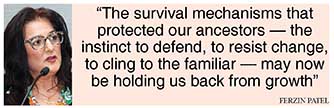
"At community gatherings when we hear something that doesn’t align with our worldview we feel our defences rise. When our beliefs are challenged, it can feel like a threat to who we are, to everything we’ve known and held dear. The survival mechanisms that protected our ancestors — the instinct to defend, to resist change, to cling to the familiar — may now be holding us back from growth.
"While many of the first generation immigrants coming to North America practiced a sort of protectionist, insular philosophy, the succeeding generations are proud to spread out, they have informed themselves about Zarathushti traditions, theology and doctrine, are ready to participate fully in the mainstream and have learnt to integrate.
"Harmony doesn’t mean we all think alike; it means we learn to create beauty from our different notes. Unity doesn’t require uniformity, it calls for understanding. Peace isn’t just the absence of conflict; it’s the presence of justice and mutual respect. When we truly listen, not just to the words but to the underlying emotions, thoughts, unspoken sentiments, we break down walls of misunderstanding and build bridges of trust.”
Knowing that conflict can cloud judgment and hinder logical reasoning, create division and unhealthy relationships, leave lingering resentment and a sense of injustice, she advocated understanding the root of conflict as coming from within us. These could be personal triggers and past experiences, unmet fundamental needs, hidden fears and vulnerabilities, unconscious patterns and conditioning, one’s ego that seeks validation and insists on defending its position at all costs.
Advocating Conscious Conflict Resolution, she recommended that instead of breaking down the beliefs of others, we transform ourselves through self-awareness, emotional intelligence and shifting perspective from control to connection with collaborative problem-solving. "The resurgence we seek is about creating a community where different generations can truly hear each other, where diverse perspectives are seen as assets rather than threats. The path forward isn’t about erasing our differences, it’s about learning to navigate them with wisdom and grace.”
Other sessions of the Congress will be covered in forthcoming issues of Parsiana.