A mother’s journalistic endeavors and social welfare activities inspired the family
Meher Tarapore
My mother Banoo Tarapore is 91 years old. She has, among other things, been one of the early group of female journalists and columnists in India, scripted a couple of Films Division documentaries, hosted her own radio show, spent over 10 years of her life volunteering at the National Association for the Blind’s (NAB) Mata Lachmi Nursery for the Blind, and been the recipient of the Rustom Merwanji Alpaiwalla Memorial Award for her outstanding contribution to education, training, placement, rehabilitation, and administration of blind welfare activities. Yet, today, she feels most proud of the fact that many years ago, she actually cooked meals for us for a complete week! Never having made a cup of tea in her entire life, the kitchen held more terrors for her than interviewing the Sheikh of Kuwait!
Banoo Tarapore: always volunteered
In the early days of her marriage, my mother and her mother-in-law Allan had struck a pact. My grandmother would take charge of the kitchen, and my mother would read to her every afternoon. Thus began afternoons of Jamasp-ni-Jiloo, and other Parsi comedies and tragedies, and of course hours of Parsi romantic serials where delicate, pale Jeroo trembled in Noshir’s manly arms!
Soon my mother tried her own hand at writing, and found that not only was she good at it, but it was something she really wanted to do. With my dad Sorab’s encouragement, she signed up for a journalism course at the K. C. College. Armed with a diploma in journalism, she made the rounds of umpteen magazines and newspapers. But in the early 1960s, although there were a few female journalists and columnists, the profession was still very much dominated by men. Women were mainly relegated to writing ‘puff’ pieces.
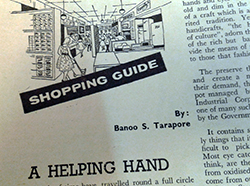
Banoo finally managed to get a job as a columnist on an obscure magazine called Consumer, where she had to scour the city for unusual ‘finds’ and interview the owners of these objects. If you had an unusual table, or the perfect desk lamp, or a gorgeous purse, or made delicious hand-dipped chocolates, Banoo would be knocking at your door. And your treasure would be showcased in the "Shopping Guide” feature. She also doubled as the ‘agony aunt,’ doling advice in each issue. (And asking friends to come up with interesting ‘problems’ for her column.)
Femina was the first Indian ‘women’s’ magazine that was trying to break boundaries. Editor Vimla Patil gave my mother a job to write a regular humorous column on the trials and tribulations of motherhood — naturally causing my teenage sister Soonoo and me untold embarrassment. Every silly thing we did or said was promptly reported to amuse her readers.
Soon followed the kind of work Banoo was really interested in. Serious articles commissioned or published by prestigious publications like Hindustan Times, The Illustrated Weekly of India, Femina, The Sunday Standard among others as well as short stories and middles as well. And she proudly scripted two documentaries (those boring documentaries we were forced to sit through when we went to the movies) for Films Division India. One was about the Sharavati Project, and the other documented the Sheikh of Kuwait’s visit to India.
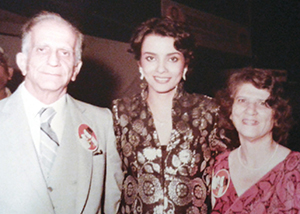
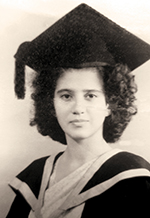
Above: Sorab and Banoo Tarapore with Persis Khambatta (center); r: Banoo at her graduation
My mother interviewed quite a few prominent people, but one stands out in my mind: Dr Christian Barnard. He had come to India to give a lecture about his first human-to-human heart transplant surgery, a truly ground-breaking event in medicine! My mother had taken me with her to listen to the lecture (I was always reluctantly dragged to any special event!) and then afterwards we were taken backstage to meet him. I was really way too young to know why he was so important, but this very, very important man took time to talk to me – a child, and ask me all about myself! I think that is a true sign of greatness!
Soon Banoo met up with Paula Mistry, a program manager at the All India Radio, and scripted shows, as well as narrated them for the radio. She hosted a radio show called "The Women’s Forum” where she interviewed local celebrities on important issues of the day — one being the "Keep Bombay Clean” program initiated by Begum Ali Yavar Jung, wife of the then governor of Maharashtra. Banoo adapted well-known classics like Robert Louis Stevenson’s Dr Jekyll and Mr Hyde, Charles Dickens’ The Pickwick Papers and others for a children’s radio show, and when they were short of a child actor, I was naturally roped in. I played the caterpillar in Lewis Carroll’s Alice in Wonderland once, and Indira Gandhi another time, for which I was paid the princely sum of five rupees!
But to me, her most exciting assignment of all was scripting and compering a fashion show held on a luxury liner docked in Bombay. I seriously hoped mum would get a few designer clothes in my size instead of cash, but…
Banoo always volunteered wherever she could. She volunteered at our school, at community events and also to read to the blind. And when she was in her 50s, my mother volunteered at Mata Lachmi Nursery and made an immense difference in the lives of many blind children. While there were quite a few schools for the blind at the time, this was the only boarding nursery school for blind tiny tots. People brought in children as little as a few months old, mostly from the slums — children who had no future in a country stricken with poverty. My mother along with a wonderful group of other volunteers and workers turned the place around, and made it a thriving, happy model visited by people from all over the world. Banoo did not allow the children to believe they were disabled. She arranged swimming lessons, participation in small concerts. She had a swing set and a jungle-gym with monkey bars installed in the yard, had a company donate tricycles, and soon the nursery was full of noise and fun as the children learned to maneuver through every obstacle and challenge in their way — in play and in life.
She sent out newsletters and wrote personally to blind organizations all over the world, and representatives from different countries visited the nursery, and exchanged ideas and techniques. A few couples from western countries came and adopted these blind babies. She was invited to read a paper about the nursery at a world conference in Aruba.
In her 60s, Banoo joined the editorial board of Blind Welfare, a monthly magazine published by the Association, and injected it with fresh perspectives. She wrote a book called Out of the Night published by NAB focusing on the accomplishments of blind Indians. The intense effort these individuals made to succeed in their fields in spite of their disability truly touched me.
These young people did not have a very easy life. Getting around in Bombay is difficult enough when you are sighted, but these students had to make their way to college, work (most had to work part-time), and then for tutoring in various subjects. They all lived in the suburbs, and spent most of their day on trains and buses getting from place to place. They were quite exhausted by the time they came to our home. Mum would give them tea and biscuits, and then out came the Shakespeare — Macbeth, Hamlet, Othello. Within about 15 minutes, my mother’s voice would be accompanied by gentle rhythmic snores. Her students would be peacefully asleep…
About 10 years ago, a middle-aged blind man knocked on my parents’ door. It was one of her students – come back after about 35 years to thank her, and proudly show her photographs of his blind wife and three sighted children. To my mother, that was the best recognition of all!
Banoo has never been a very religious person, but very few can match the immense pride she feels in being a Parsi. She loves the community wholeheartedly, and is very reluctant to accept anything negative about it. I told her about our new place of worship in Poona where everybody is welcome, and she was very pleased: "Now my grandchildren no longer need to feel excluded or unwanted within our community. They can attend our special occasions, prayers, funerals and jashans, and truly feel they are a part of our family and community as well.”
I asked her this morning what she’d like to say about the Parsi community. With a wide smile, she answered, "I love it. Very much. That’s all.” She loves the fact that we are a progressive community, encouraging women to excel in a country which has always tried to hold women back. She loves the fact that young Parsis are bringing fresh and forward-thinking ideas to revive and rejuvenate the community. She loves the fact that Parsis are known for their honesty and trustworthiness. She is very proud that our tiny community has produced the very best industrialists, doctors, lawyers, businessmen, musicians, educators, writers, architects, aviators, sportsmen, and soldiers. But most of all, she is proud of Parsi philanthropy and generosity. And she has given generously — both her time and her money wherever required. And taught my sister and me to do the same.