Finding fulfillment in their academic studies connected with
the Zoroastrian religion and history, three scholars encourage the
community to read relevant texts
Text: Parinaz M. Gandhi Photos: Jasmine D. Driver
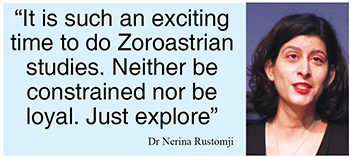
Members of the community — be they conservative or liberal, laypersons or priests, North Americans or Indians or Iranians — "are hungry for good information… That is what drives us, as academics, to try and fill the gaps,” commented Dr Yuhan Sohrab-Dinshaw Vevaina. "This is the golden age of Zoroastrian studies, academic expansion,” declared Dr Jamsheed Choksy. "It is such an exciting time to do Zoroastrian studies. Neither be constrained nor be loyal. Just explore,” reiterated Dr Nerina Rustomji. The possibilities for further engagement with Zoroastrian scholarship and history were impressed on the audience attending The Khorshed F. Jungalwala Memorial Lecture at the 12th World Zoroastrian Congress in New York on July 2, 2022.
Distinguished Professor at Indiana University, Bloomington, Choksy is an authority on Iran (Persia), the Middle East, Central Asia, South Asia, Zoroastrianism, Manichaeism and Islam, and of religious minorities in the Middle East and Central and South Asia. Holding a fellowship of several distinguished institutes, including the American Academy of Arts and Sciences, he was nominated by the US President and confirmed by the US Senate as a member of the council overseeing the National Endowment for the Humanities.
From l: Ferzin Patel, Dr Yuhan Vevaina, Dr Nerina Rustomji, Dr Jamsheed Choksy
Having taught at Harvard, Stanford and the University of Toronto, Vevaina is the Bahari Associate Professor of Sasanian Studies and a Fellow of Wolfson College at the University of Oxford, England. He is co-editor of The Wiley Blackwell Companion to Zoroastrianism, the largest single volume reference work on Zoroastrianism at almost 700 pages. Specializing in the interpretation of the Gathas in the Sasanian and early Islamic centuries, he has completed a two-volume project on the ninth book of the Denkard, the largest surviving Pahlavi text.
The conversation was moderated by Rustomji who is associate professor and chair of the History Department at St John’s University in Queens, New York. She is a historian of the Middle East and specializes in the intellectual and cultural formation of Islamic societies. She guided the conversation wherein the two scholars highlighted the vital role of historical and religious education for community members and provided ideas on how to foster Zoroastrian studies. Their comments provided an expansive vision of "continuity, contingency and context.”
The session was made possible with contributions from The Khorshed F. Jungalwala Fund at the Federation of Zoroastrian Associations of North America (FEZANA). As Ferzeen Patel mentioned in her introductory remarks, her mother Khorshed, true to her name, could "illuminate with her wisdom and spark. Her essence was radiant illumination. She inspired us to be better human beings, more humane. She was a lawyer by training and an accomplished musician. "The queen of dining table conversation, she would exude peace, share ideas and perspectives.” Well known for building bridges between Zoroastrian associations, she represented the Zoroastrian Association of Greater Boston Area and FEZANA at congresses. A world body for the Zarathushti community was her vision. She had even served as chairperson of the FEZANA Journal publications committee.
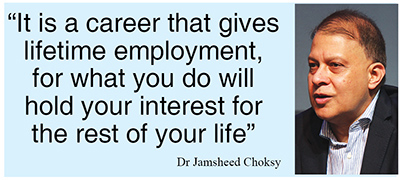
When asked what inspired Choksy and Vevaina to pursue their chosen path, they indicated it was serendipity. Both of them, having earned their PhDs from Harvard University, alluded to their roots and Bombay where they were born. Choksy acknowledged the support of his extended family in Sri Lanka, India and Pakistan and those who have supported his career for over four decades. Initially, a biology major student, in the US which is the hallmark of liberal education, he "stumbled into monumental courses at Columbia University,” learning about the history of the Middle East, the Persian empire… He chose to undertake "a fascinating journey which is intellectually rewarding. It is a career that gives lifetime employment, for what you do will hold your interest for the rest of your life.”
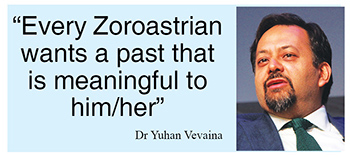
Vevaina grew up visiting fire temples and hearing tales of ancient Iran from his grandmother. He was 12 when his family migrated to the US. When in high school, "Mom dragged us to an event in Harvard where James Russell and Prods Oktor Skjaervo were the speakers.” He was struck by how much they knew as compared to the majority of community members. When pursuing international relations and Chinese studies at the University in Oxford, he recalled a friend enquiring about his religion to which he gave the clichéd response that it represents good thoughts, words and deeds. When asked ‘what else?’ He had no answer. This made him start looking for books. He remembered reading about Zoroastrianism in China in the Columbia History of the World. "That got me hooked… I contacted people at Harvard…” The mentors there inspired him to undertake his own research.
"Incredible authorities and magical guides can animate you. There is incredible wealth. There is Zoroastrian investment in higher education. You can find answers on your own,” stated Rustomji. In America, until the 1800s, school children were taught English from a primer where the letter ‘X’ did not stand for xylophone but Xerxes, she revealed.
"People feel alienated from the past because they feel it does not speak to them, relate to them. (But) there is always something there that will enrich you. The more you study, the richer you will be,” stressed Vevaina. "Learning will not strip you of your values. Nothing is ever lost… As academics, the only thing we can do is write books; we can’t make you buy them or read them. We need to move away from the constant trope of loss, decay and decrepitude and make use of resources available to make a present and future we would like,” he added.
"Our duty as scholars is to engage the broader world. This engagement is your past, present and future. Cherish it; enjoy it. Learn from it. It connects you with others. It is different. Study it and don’t waste time on endless recurring debates… Look at the US and Canada, how many communities and associations have grown,” observed Choksy. Through intellectual exchanges, by finding more manuscripts or inscriptions, the corpus of written texts, archeological facts keep growing, shedding more light on little known areas. Iranian Muslim scholars are doing phenomenal work, archeological work…. "There is a global interest in Yazd… The Associated Press ran a piece about this Congress. They are interested and concerned,” stated Choksy.
As compared to 1991 when he earned his PhD following which only five academic positions were available, there are many positions now available in different universities, observed Choksy. There are many valuable resources that the community can draw on: from Encyclopaedia Iranica where he serves as consulting editor to books on navjote available online. "For mindful information I look at Parsiana and the FEZANA Journal,” he remarked.
"How do we do more with what we have?” wondered Vevaina referring to the academics’ quest "to fill gaps in the 3,500-year-old religious history which is enjoyable and yet a challenge.” He referred to "a long-standing frustration when people disagree with everything. There would be no problem as long as it is done in a civil way.” Keenly interested in the Gathas, he soon realized that "the translations are so widely different that it bothered me. It is not just a textual problem. How do we choose to interpret it? (It appeared) so far away from the original text...
"What did the Zoroastrian tradition have to say about ritual and meaning — about the Avestan rituals? The Visperad rituals? The Dinkard? The Pahlavi translation of the Gathas? Edward West’s translation of the Sacred Books of the East?” asked Vevaina before continuing, "There were fundamentally divergent, impoverished interpretations of Zoroastrian tradition… It allows us to see how tradition was an ever changing, evolving concept.”
While many continue "to read old stuff from the late 19th to the early 20th century, there is so much more material that has come up. There is a missed opportunity. From the Persian Revayats to the colonial period. We don’t have the material. We don’t have the manpower to study,” regretted Vevaina. He was more concerned that we are not tapping the "wonderful human resources: there is an incredible array of knowledge with the priests; the experiences of the founding fathers/mothers in North America need to be recorded by well-trained sociologists/anthropologists. We can learn so much from each other.”
Commending FEZANA’s oral history project, the youth outreach, children’s classes… Vevaina noted that scholarly material should be artfully presented to children. "We need a back-loaded, dynamic, usable past. Every Zoroastrian wants a past that is meaningful to him/her. We should have the humility to say my assumptions will be challenged by something I am not familiar with; constantly challenged by the incredible diversity of Zoroastrian experience.”
Reports on other sessions at the 12WZC will be carried in forthcoming issues of Parsiana.