Over 550 delegates from the US and Canada attended the 15th North American Zoroastrian Congress in Houston
Parinaz M. Gandhi
"We are at the threshold of a momentous time in our history whereby our very survival is at stake. We must seize this opportunity to bind the ties that once united us. Combine the old with the new and come up with ideas that allow us to co-exist,” declared co-chair Roshan Sethna in her opening speech at the 15th North American Zarathushti Congress (NAZC) held in Houston from December 29-31, 2010.
Over 550 delegates from the US and Canada attended the three-day event which had chosen for its theme: "Preserve the Past, Protect the Present, and Perfect the Future.” As summed up co-chair, Jasmine Mistry: "With a diverse group of speakers, performers, and participants between the ages of two and 85, we were certainly able to convey this theme via a grand opening ceremony, a jashan conducted by 19 priests, informative and well-balanced sessions, and a wide range of entertainment for all ages.”
(Above and alongside): Niaz Kasravi and participants of The Silk Road; (Below): venue of the Congress and organizers (from left) Roshan Sethna, Jasmine Mistry, Arnavaz Sethna, and Sarosh Collector
The hosts of the Congress, the Zoroastrian Association of Houston (ZAH), received considerable encouragement from the mayor of the city Annise Parker who through her proclamation announced December 29-31, 2010 as "Zoroastrian Days.” Her accompanying message carried in their attractive spiral bound Congress brochure noted, "America has stood as a beacon of religious freedom for citizens around the world and the Zoroastrian community in Houston has worked to sustain this great tradition… The city of Houston salutes and commends the organizers and participants of this important event and extends best wishes to all for a successful Congress.” Houston council member Al Hoang too was "pleased to welcome the… Congress… and commend your important role in our community.”
As reminded Bomi Patel, president of the Federation of Zoroastrian Associations of North America (FEZANA), "The Congress is an ideal event for our community members to meet and celebrate our identity and heritage… I am delighted to see so many of our fellow Zarathushtis making an effort to come to this Congress from all over North America and other parts of the world.” To Daraius Bharucha, chairperson of the FEZANA Congress Committee, the theme selected was "both apt and timely in the context of the North American diaspora and the triumphs and successes we have experienced as a community as well as the challenges we face, going into the future… The organizing committee has put together an outstanding program with speakers who are luminaries in their field, learned scholars and erudite experts. This together with a host of events and participatory forums will not only serve to entertain those of us who are in attendance but will also enlighten and educate us on our common understanding of the Zoroastrian faith.”
The Intercontinental Hotel, the venue of the Congress, and the array of facilities and hospitality offered by the 35-year-old ZAH were courtesy, the support of their platinum sponsors MKM Engineers Inc and PIKA Inc; gold sponsors Babbages Inc, Tata Sons and the Zoroastrian Charity Funds of Hong Kong, Canton and Macao; silver sponsors CDA Advisors Inc and Kershaw K. Khumbatta PC; advertisers and numerous generous donors.
One of the highlights of this Congress was the addition of a "mini-Congress” run by Vehishta Kaikobad for children aged five to 12 in the hope that this will persuade the younger attendees to attend future Congresses and become active members of their communities. To Kaikobad also went the credit for conceiving the nearly two-hour opening ceremony that captivated the audience with a performance of The Silk Road where a cast of 56 adults and children showcased the dominant role played by the Parthian and Sassanian dynasties of ancient Iran in shaping a unique network of trade routes.
2010 North American Zarathushti Community Awards winners with FEZANA officials (from left): Navroze Gandhi, Farrokh Namdaran, Bomi Patel, Ervad Soli Dastur, Dinyar Patel, Kayhan Irani and Noshir Langrana
Closing the lingering divides
We all agree that our religion must be preserved and protected; and perfection is a goal we must all strive for, stated Dr Niaz Kasravi, senior manager for law enforcement accountability at the National Association for the Advancement of Coloured People, in her keynote address. To reach that goal we must overcome the internal challenges that we face by moving beyond intolerance, closing the lingering divides and involving the younger generation. We must work outside our community towards ensuring the greater good of others because our philosophy, our faith and our forefathers mandate and demand it. If we do this, we will be true Zoroastrians because being Zoroastrian is defined not by how and where and with whom we pray or congregate; it is defined by how we choose to live our lives by the choices we make, she added.
The post lunch slot on the first day saw three concurrent sessions: Dr Niloufer Ichaporia King and Jehangir Mehta speaking on culinary art; Daniel Sheffield on "Contesting Calendars, Connecting Communities: Collective Memory in Early Modern Zoroastrianism;” and Eric Engineer moderating a discussion on Youth Career Connect.
From left (top row): Bomi Patel, Daraius Bharucha, Niloufer Ichaporia King, Jehangir Mehta, Daniel Sheffield, Jamsheed Choksy; (second row): Jim Engineer, Rashna Writer, Saroja Voruganti, Shirin Abadi, Eric Engineer and Farrokh Mistree
The enduring connection between Parsis and food was referred to by Ichaporia King in her interview with Nerina Rustomji. Author of the James Beard award winning My Bombay Kitchen featuring traditional and modern Parsi home cooking, Ichaporia King alluded to her quest for fresh ingredients and the farmers’ markets in USA that helped her adapt Parsi cuisine to a new milieu (see "Imaginative with ingredients,” pg 204). Chef Mehta who is the owner of Graffiti and Mehtaphor restaurants in New York was wary of modern technology giving us plentiful food supply and the consequent wasteful habits. We need to relearn the virtues of living in balance and harmony with nature, he stressed.
An author of three books and presently a doctoral student in Iranian and Persian studies at Harvard University, Sheffield recommended that as the Zarathushti calendar is associated with the solar system, the process of intercalation should evolve such that all individuals commit themselves to a single calendar beginning with the vernal equinox.
Young Mitra Khambatta who was the winner of the ZAH Shahnameh essay contest spoke of the lessons she learnt from Firdausi’s magnificent text and the need to continue to educate Zarathushti youth on this epic.
The networking opportunity for the under-40 youth was coordinated by Engineer who is a senior associate at Sevin Rosen Funds, a venture capital firm in Dallas and youth director of the global World Zarathushti Chamber of Commerce (WZCC). To enhance career prospects and social cohesion the session recommended a mentorship program through the WZCC, online networking among professionals, pro-bono legal services, electronic library of Sunday-school resources to educate children in our faith and an online recipe book featuring healthy community dishes.
Shahnameh storytelling by Kaemerz Dotiwalla at the mini-Congress
Inter-generational involvement
The prospects for Zoroastrians in modern Iran appear ominous for those who remain there despite valiant efforts by eminent Zarathushtis such as Dr Farang Mehr, now living in the West, to alleviate their suffering, summed up Dr Jamsheed Choksy when delivering the Khorshed Jungalwala Lecture on the morning of the second day. Professor of Central Eurasian Studies, History and India Studies Program at the Indiana University, in the course of his speech Choksy reviewed the political, legal, economic, religious, educational and social conditions of Zoroastrians in modern Iran, and identified trends in their quality of life under the present theocratic regime that came into power.
After the coffee break there were two concurrent sessions: Jim Engineer led a panel discussion on "Inter-Generational Dialog,” whilst social researcher Meher Marker Noshirwani elaborated on the Parzor Project’s efforts to record the oral history of the Parsis in India and Pakistan and to document their culture, and Dr Homi Dhalla spoke on "My contribution to Zarathushti Culture and Interfaith Movement.” Founder president of the World Zarathushti Cultural Foundation, Dhalla referred to the organization’s endeavors to facilitate excavations in Sanjan, conservation of Bahrot caves, setting up of the Zoroastrian Information Center in Udvada and the Sir Jamsetjee Jejeebhoy Memorial Museum at Navsari. The spoken language in Parsi homes must be Gujarati, he stressed.
Jim Engineer, an independent public relations consultant, one of the five directors of NextGenNow and co-chair of the WZCC — Chicago chapter, moderated the session which saw participation from enthusiasts like Jimmy Antia and Cyrus Rivetna and veterans like Lovji Cama, Kaikhosrov Irani, Rustom Kevala and Hosi Mehta. Attended by nearly 200 delegates of varying ages, the session focused on standardizing religious education, increased interfaith and intrafaith dialog and understanding, generating harmony and unity over divisiveness, open acceptance and inclusiveness of out-married Zarathushtis and the intriguing exchange of ideas between generations.
The lunch break was used to announce the winners of the 2010 North American Zarathushti Community Awards sponsored by FEZANA. The Shirin Dastoor Outstanding Young Zarathushti Award went to Dinyar Patel, Dinshaw Joshi Excellence in Performing Arts, Painting or Literature Award to Kayhan Irani, Excellence in Business or Profession Award to Dr Noshir Langrana, Jamshed Pavri Humanitarian Service Award to Farrokh Namdaran, and the Rohinton Rivetna Outstanding Zarathushti Award to Ervard (Dr) Soli Dastur.
Nineteen priests who participated in the inaugural jashan at the Congress
The post-lunch session on the second day gave platform to four speakers: Bomi Patel gave an overview of FEZANA as a nongovernmental organization in the United Nations Department of Public Transformation. This umbrella organization for 26 member associations and smaller groups in the USA and Canada has its quarterly publication, FEZANA Journal for which a new policy is being framed to make it an online publication whilst continuing with the print version.
Dr Nerina Rustomji who is an assistant professor in the Department of History at St John’s University, New York spoke on the dire need for a historian in each family. "We often understand our past as a story of ancient dynasties but we forget it is personal histories that bring meaning to the way we live our lives,” she conveyed.
Mobed Fariborz Shahzadi of California recommended a 36-point program to strengthen the "Iranian Zarathushti identity in the western world.” When speaking on "Parsi identity… lost?” Sarosh Manekshaw, who conducts religious education classes in Houston, lamented that Parsi identity is now lost in North America due to acceptance of conversion, calendar controversies, etc.
After the coffee break Dinyar Patel who is doing his PhD at Harvard University dwelt on the causes of the rapidly dwindling Zoroastrian population in India and the diaspora. According to his findings, the figure for the worldwide Zoroastrian community would be 15,000-24,000 in Iran (current estimates), 5,000 in United Kingdom (2004 estimates), 3,000 in Australia and New Zealand (2004 estimates), 15,500 in North America (2004 estimates), 1,766 in Pakistan (2010 figures), 69,601 in India (2001 figures) and 2,500 elsewhere (2010 crude estimate), giving a total of 1,12,367-1,21,367. Simultaneously Dr Saroja Voruganti who is a staff scientist in the Department of Genetics at the Southwest Foundation for Biomedical Research presented the results of recent studies of Parsis in India which showed an increased incidence of diabetes, strokes, hypertension and cardiac problems in the community. She is conducting research to determine if these patterns also occur among the Parsis in Texas but needs a wider sample, since presently her volunteers number merely 100. Dr Shirin Abadi, a pharmacotherapeutic specialist working at the British Columbia Cancer Agency and teaching medicine at the University of British Columbia showed with statistics how 40 percent of women in North America and 45 percent of men are affected by cancer, major factors being smoking, excessive alcohol consumption, mental stress, inadequate exercise, obesity, poor diet, genetics, and failure to take medical tests in a timely manner.
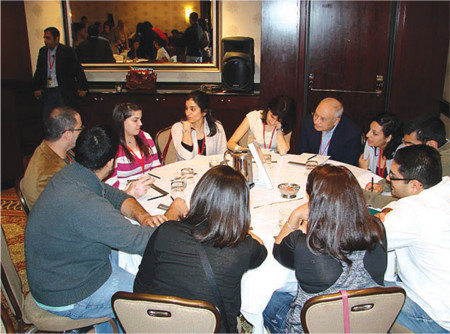
Youth Career Connect session at the Congress
Distinguishable diaspora
The main speaker on the final day was Dr Rashna Writer, senior teaching Fellow in the Department of Study of Religions, School of Oriental and African Studies, London University who addressed the audience on "Zoroastrians in the Diaspora: The Challenge to Remain Distinguishable be it in Lydia, India or USA.” Differentiating the terms "distinct” and "distinguishable” she stressed that the members of the second diaspora should remain "well defined.” Included in her recommendations for the community was the need to establish a representative body that speaks to, and on behalf of, Zoroastrians the world over.
Post coffee break, Dr Pallan Ichaporia whose passion is anthropological research into Zoroastrian archeological sites spoke on "Zoroastrian Treasures and Diaspora in Ancient China.” He stated that after the fall of the Sassanian empire thousands of Zoroastrians migrated eastward into China as evidenced from the major Zoroastrian settlements dating back to the 7th-9th centuries CE. The disappearance of Zoroastrian influence around 1280 CE, Ichaporia felt, held some cautionary lessons of what can happen through assimilation in a hospitable society like North America or extermination in inhospitable modern-day Islamic countries.
When Ichaporia’s talk was in progress, Zeeba Kayani was conducting a session on "Towers of Success” wherein young achievers shared their life experiences. The Youth chair at the NAZC, Kayani works for The University of Texas Health Science Center at Houston for the Developmental Pediatrics Department and is responsible for organizing the first Autism Center in Houston. The four other panelists who participated in this session were Nina Godiwalla, founder and CEO (chief executive officer) of Mindworks which trains business professionals in stress management; Cyrus Mistry, lead product manager at the Google headquarters in California, currently in charge of the Chrome Operating System; Zal Bilimoria, founder and CEO of Snip.ly, an early stage web startup based in San Francisco; and Abadi. The youth discussed how their Zoroastrian upbringing helped them steer an ethical path through the corporate jungle and the motivating factors that led them to select their chosen careers.
Holding the fort at the final post-lunch session was Dr Farrokh Mistree, director of the School of Aerospace and Mechanical Engineering at the University of Oklahoma, who briefly recapped what all the speakers had said and urged the North American community to face two critical challenges: The goal of increasing our numbers (and politico-economic power) is in direct conflict with the concept of "ethnic purity.” This issue must be addressed head-on, in developing the definition of identity that is uniquely distinguishable. The second issue is to develop a core philosophy and doctrine which is sufficiently inclusive to allow diversity of practice.
The dynamic organizing team working conjointly with Jasmine Mistry and Roshan Sethna included treasurers, Sarosh Collector and Kershaw Khumbatta; secretary, Arnavaz Sethna; operations, Pervin Sagar; program, Rustom Engineer, Morvarid Behziz, Collector, Behroze Daruwalla, Kaemerz Dotiwalla, Vehishta Kaikobad, Farrokh Mistree, Yasmin Pavri, Meheryar Rivetna and Aban Rustomji; fundraising, Jimmy Kumana, Persis Behramsha and Yasmin Medhora; publications, Ken Bhappu and Percy Master; publicity, Mani Surkari; booths and exhibits, Meher Rustomji, Villi Bhappu, Daruwalla and Jasmin Katrak; youth Zeeba Kayani, Kashmira Behramsha, Khushchehr Italia, Tina Mehta and Justin Mody; medical Dilnavaz Subawalla; registration, Roshan Engineer, Cyra Kanga, Manek Nariman, Hoshang Sethna and Sweta Sethna; entertainment, Kamalrukh Gandhi, Arzan Gonda, Nozer Buchia, Persis Buchia, Lyla Daroga, Vehishta Kaikobad, Fiona Setna and Farzana Sidhwa; audio/visual, Aderbad Tamboli, Khushrav Nariman, Percy Behramsha, Khursheed Dastur, Danesh Desai, Neville Divecha, Yezdi Engineer, Sheroy Haveliwala, Percy Katrak, Master, Kayomerz Sidhwa and Kaizad Sunavala.
This write-up was prepared with inputs from Mani Surkari, Rustom Kevala and Jimmy Kumana.
The next issue of Parsiana will carry a detailed report on the other activities that preceded the Congress and the entertainment on view.