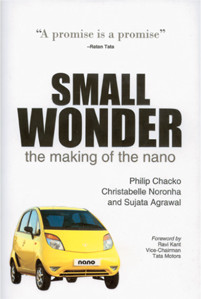
Small Wonder – the making of the nano by Philip Chacko, Christabelle Noronha and Sujata Agrawal. Published in 2010 by westland ltd, Venkat Towers, 165, P. H. Road, Maduravoyal, Madras 600095. Pp: 149. Price: Rs 295.
"For every member of the Nano team, working on the project was a once-in-a-lifetime opportunity, where they got the chance to interact at a personal level with Ratan Tata (the 73-year-old chairman of the 98-company, 395,000 employee Tata Group) and observe him at close quarters. They would hang onto his every word and gesture, and they were only too eager to do what he wanted them to. It was an amazing display of team dynamics and an exceptional example of how a group of people can be motivated to reach for the stars, to reveal capabilities they may not have known they possessed,” writes Ravi Kant, vice chairman, Tata Motors in his foreword to the book Small Wonder – the making of the nano. "I am fortunate to have been associated with the Nano story and I consider it an honor to write this foreword,” he adds. The book is apparently the first official behind-the-scenes account of the men behind the machine.
The unveiling of the Nano on January 10, 2008 at the Delhi Auto Expo catapulted the one lakh rupee ($2,500) family vehicle to international fame as the world’s cheapest car. But while the ‘family-of-four- on- a-scooter’ story (the trigger behind Tata’s vision/dream of giving millions of his countrymen a safer means of mobility) and the affordability angle in a developing country captured the world’s attention, few cared to probe what lay beyond the major driving forces, who were Tata himself, Kant (then Tata Motors’ managing director), Girish Wagh who headed the Nano development program, Prakash Telang, the company’s managing director for India operations and a host of other top brass.
But at its peak, the Nano project had more than 500 people, mostly young, on its team. "The most involved member of this team, the most zealous about realizing its objective, was Ratan Tata…who is said to have the softest of corners for Tata Motors, the Tata enterprise closest to his heart,” the authors Philip Chacko, Christabelle Noronha and Sujata Agrawal state. Their book seeks to delve deeper, profiling the human story of the employees involved with the project, their sacrifices on the family front, the burning of midnight oil and calories in the development of the small car — "a homegrown winner crafted on a workbench of challenges.”
At the book launch (from left) Ravi Kant with authors Sujata Agrawal, Philip Chacko and Christabelle Noronha
Conceived, designed, and built amidst the cussed milieu of contemporary India, the Nano has traversed a rocky road — from Tata’s casual comment in 2003 at the Geneva Motor Show about his company making a one-lakh rupee ‘people’s car’ to its launch six years later. "A promise is a promise,” Tata’s words at the unveiling find their way to the book’s cover. The story records for posterity every roadblock Tata and his team had to overcome along the way — the skepticism often amounting to ridicule about a full-fledged car ever being made at a price "roughly equivalent to the price of a DVD player in a luxury car from the West,” the innovative and ‘frugal engineering’ concepts that made the Nano a game changer, the struggle to connect with the customer in a cruel gas-guzzling market which demands in a Rs 100,000 price tag what others get for several times that amount!
Yet these were the ‘expected’ bumps along the route. Far more serious were the unexpected speed breakers — the Singur to Sanand saga, where the company was caught in the crossfire between the Left Front-ruled government of West Bengal and its political opponents, the Trinamool Congress led by firebrand Mamata Banerjee. First came the flooding caused by unusually heavy rains inundating the low-lying factory site. The bigger problem was the continuing political agitation over almost two years on the land acquisition issue, the vested interests that stirred up and fuelled violence in and around Singur, with crude bombs, land mines and mobs of agitators beseiging Tata Motors’ employees as well as those of Shapoorji Pallonji and Company, the infrastructure developers for the project. Staring at what seemed to be a situation without solution, an emotional Tata eventually announced in Calcutta on October 3, 2008 that Tata Motors would pull out of Singur.
With various state governments vying with each other in offering alternative sites, a decision was taken in an amazingly quick period of four days to accept chief minister of Gujarat Narendra Modi’s offer of 1,100 acres of land at Sanand, "a two-hour drive from Ahmedabad and separated by a million miles in temperament and political culture from Singur.” What followed was the gargantuan task of dismantling an entire, brand new, almost-commissioned plant and tons of machinery, packing the crates with great care and transporting them in more than 3,000 trailer-trucks through West Bengal, Jharkhand, Bihar, Uttar Pradesh and Rajasthan to Nano’s new abode at Sanand — a total distance of 2,100 km!
Ratan Tata (mike in hand) with Ravi Kant (to his left) and top executives of the Nano team at the launch
"In a trice one project became three projects — from Singur to Sanand to the interim manufacturing at Pantnagar (in Uttarakhand) and Poona (in Maharash-tra) — and they had to be executed by the same team with the same number of people,” the book details the spirit-sapping travails of the company’s staff and workers, as well as those of the vendors and suppliers compelled by circumstance to move with them. "We have built three factories in two-and-a-half years. Nothing like this has happened in the history of Tata Motors,” the authors quote a member of the planning team. "Singur became a sacrificial victim and Tata Motors — after 18 months of unceasing endeavor, Rs 15 billion of expenditure, and countless instances of undeserving distress — was left to carry the cross,” the book records. The Nano was officially launched at the Parsi Gymkhana at Marine Drive on March 23, 2009.
Small Wonder is a no-frills book, in keeping with the aam aadmi (the ordinary man) character of the car. The pictures are simple and straightforward and are grouped together over eight pages. There is a degree of repetition in the chapters, but the details of the reworking, rejecting, redesigning will interest the mechanically-minded. The engine-at-the-back and the boot-in-front, four-door subcompact has a 624cc, 35 bhp engine giving a top speed of 105 kmph. The economical, lightweight sheet-metal body, the nifty designing of the instrumentation panel and interiors to save on costs yet provide spaciousness, the ample crumple-zone and intrusion-resistant doors, etc have received wide attention and acclaim. At 101 gm/km, the Nano has the lowest carbon dioxide emission for cars in India. It is Bharat Stages II and III compliant and Bharat Stage IV ready. The fuel efficiency rate of 23.6 km/liter ensures that the car has a low carbon footprint, ideal in reality for India’s heavily polluted, overcrowded cities and towns where a parking slot in a housing complex probably costs more than the car does!
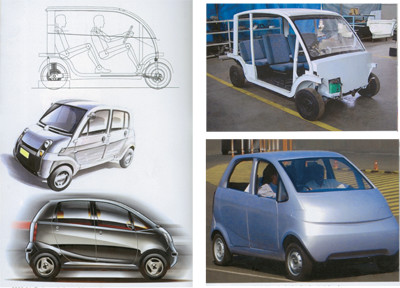
The early stages of the car’s design
Yet the hatchback has faced flak on several counts, with (in the words of a senior executive) "people out there just waiting to pounce.” For Ratan Tata, the Nano has been a leap of faith. For the company and its employees, the learning was priceless. Tata Motors is India’s largest automobile company, the market leader in commercial vehicles and in the top three in passenger cars in the country. Several worldwide acquisitions have made it the world’s fourth largest manufacturer of medium/heavy commercial vehicles and the second largest bus manufacturer! Recent takeovers include the iconic brands Jaguar and Land Rover (JLR) in the United Kingdom. JLR introduced its premium range of automobiles in India in 2009. The multi-product, multi-location, multi-business Tata Group, which has survived many a body blow, had total revenue of $ 67.4 billion (Rs 319,534 crore) in 2009-10, as per its website.
But the story does not end with this book. "The Nano is part of the continuum (the continuing evolution of the product), a contribution by Ratan Tata to an emerging India eager to burst into the international arena,” writes Kant. Tata Motors has subsequently announced the development of electric and hybrid tractions. The Tata Nano EV (electric vehicle) as well as the Indica Vista EV were displayed at the Geneva Motor Show in 2010. The Nano Europa, an advanced version with a more powerful engine, power steering, airbags, ABS (anti-lock braking system), etc, is not far in the distance. Tata Motors is also exploring the development of hydrogen-fuelled internal combustion engines in collaboration with India’s space agency ISRO (Indian Space Research Organisation), the book states.
"In today’s world, companies have to keep running to stay in the same place… Being confined to the Indian market was not what Ratan Tata had in mind when he defined a strategy for Tata Motors. His view: if you have to be competitive in India, you have to be competitive in the world…That is how global companies think and work,” the authors state. "The synergies between the low cost approach that characterizes most Tata vehicles and the high-tech nature of the JLR operations could be enormous in making Tata Motors a genuinely global brand,” they conclude. HILLA P. GUZDER