Sorab Wadia enjoys
the challenges of
multiple disciplines of
the performing arts
Firdaus Gandavia
Sorab Wadia has always straddled the world of the performing arts — pianist, tenor and actor. The son of Coomi of the Paranjoti Academy Chorus fame and the late Nariman, a jeweler, he modestly explains, "Everything led to something else, choral music and piano in India led to piano in my initial foreign student days and then to opera during my second masters which in turn resulted in a career in acting.”
Above, front row, center: Sorab Wadia played a Sikh in the musical version of Bend it Like Beckham
At present, he is playing the Sultan on the North American tour of the hit Broadway show Aladdin. It is a big honor to be in such a professional and lavish production, he notes. They have already performed 200 (probably 250 by the time this goes to print) shows all over North America to packed houses of 2,000-3,000 people. The show is sold out more than 95% of the time, he says. When one is on the stage, the glorious choreography, brilliant cast, phenomenal dancers and unbelievable ovation from the audience is mind boggling and an aphrodisiac, Sorab related. "But people forget that acting is a job like any other. And a very difficult one, at times: you travel every Monday, you perform eight shows — every day of the week Tuesday to Sunday — matinees on the weekend. Often you have to wake up early on Mondays to catch a flight to the next destination and make yet another hotel room and theater your home for the week.”
Roger Brunyate, his professor at Peabody Institute of the John’s Hopkins University at Baltimore, Maryland in the USA where Sorab was a student, had said he would like to see what Sorab would be doing in 10 years’ time. Being multi-talented and multifaceted is a double-edged sword and comes with difficult choices as one finally has to make a decision which career option to follow. But there has never been any doubt in Sorab’s mind. "Even when I am taking part in an opera, acting and communication come first. When I am on stage, I will unconsciously sacrifice the beauty of the singing voice for communication of thought or plot or emotion or character.”
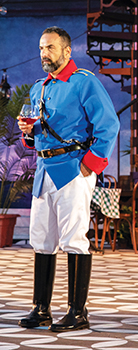
Wadia in Shakespeare’s Much Ado About Nothing
Photo: Philip Hamer Photography for St Louis Shakespeare Festival
Wadia (center) singing with Apollo’s Fire, the Grammy-winning baroque orchestra
Sorab has performed two demanding solo plays, a one-man stage version of Afghan-American novelist Khaled Hosseini’s The Kite Runner which sporadically ran for 11 years and Canadian writer and actress Evelyne de la Chenelière’s Bashir Lazhar about the journey of an Algerian, French-speaking refugee in Montreal. Both required totally different performance styles. "In The Kite Runner, I had to portray the different characters the protagonist speaks to and as a result have a three-way conversation with myself. However, when Bashir speaks one only hears his voice. The audience never hears the persons he is addressing and, as a result, is forced to intuit the answers from the tone of your voice and the expression on your face.”
In the USA, because of his "ethnic” heritage, he tends to get cast as Persian, Middle Eastern, North African or occasionally South Asian. "For the Americans, sometimes, I am considered too pale to play the role of a South Asian. They have a stereotypical view of the dark skinned Dravidian look; on the other hand, both Gurinder Chadha in the musical version of Bend it like Beckham and Mira Nair in Monsoon Wedding had no problems in casting me as a Sikh.”
Should one play around with and revamp an original "sacred” text, like a Greek tragedy or a play by Shakespeare or Moliere? He is ambivalent: sometimes they work and sometimes they don’t. He has done traditional versions of Shakespeare’s Much Ado About Nothing, The Tempest, The Merchant of Venice in Bombay and in the USA. However, the play he really enjoyed doing was an inventive production of The Merchant of Venice. It was performed outdoors in the Jewish Ghetto in Venice to commemorate the 500th anniversary of the Ghetto’s establishment. This was the first time ever that the play had been performed in the Ghetto, and Sorab takes great pride in knowing that he is almost certainly the first actor ever to portray the iconic character in the very place where he would have probably lived and worked 400 years ago. The director, Karin Coonrod, believes that "Shakespeare exploded genres; so do we,” and broke up the role of Shylock into five people of different sexes and ages to show that it was not just one person who was being "othered” but that discrimination has been felt by many different peoples over the centuries. The five Shylocks would occasionally come together as four actors behind one and at other times, all five would speak together.
Sorab is particularly attracted to villains and other "baddie” roles and would love to play Iago, Lady Macbeth and Angelo in Measure for Measure "as ‘evil’ characters give you license to explore darker areas of human nature and do things I never would in my life!”
Sorab fondly remembers his early childhood days in Bombay when every evening he studied the piano, first with his mother Coomi and then with Farida Dubash before he went abroad to study, first to Trinity College, London and then to the Peabody Institute. "I received a great foundation at Peabody and I really enjoyed studying there. I was taught by some of the best pianists in the world, including Yoheved Kaplinsky, who is one of the most sought after teachers in the world today. I particularly valued the institution because it let you explore other aspects of music. It was not the most famous music school in America at that time, and even today it trails behind the Juilliard School in New York and the Curtis Institute of Music in Philadelphia, but these schools tend to be much more focused on one thing whereas Peabody liked us to stretch ourselves in different directions. This is why I was encouraged to do both the piano and opera.” Singing with his mother in the Paranjoti Academy Chorus of which she has been the conductor for over 50 years, he made his debut in 1976 as a boy soprano; choral singing created an overwhelming passion to study opera. The director of opera at Peabody recognized his talent and as a result Sorab played important roles: Pangloss, in Leonard Bernstein’s operetta Candide, the vicar in Benjamin Britten‘s Albert Herring. He has performed in operas all over the world: Maurice Ravel’s L’enfant et les sortileges in Chiara, Italy; Richard Strauss’s Ariadne auf Naxos; Lèo Delibes’s Lakmé and Jacques Offenbach’s Tales of Hoffmann at the International Vocal Arts Festival at Tel Aviv, Israel, and the world premiere of Augusta Read Thomas’s Ligeia in Evian, France — under the baton of Mstislav Rostropovich where he played an unusual role for an actor who also has to play the piano on stage; the music was written specifically keeping him in mind.
However, it was the piano which initially propelled him into the world of music. He has played with orchestras in Bombay and abroad and it is contemporary music he likes to perform. He has played music by Toru Takemitsu, an avant-garde Japanese composer, Luciano Berio, an Italian composer who is famous for his experimental work and his pioneering work with electronic music and Lukas Foss, a contemporary German-American composer. "I love that sort of music because it is challenging and I’ve always liked new projects whether it is acting or singing or even opera. When you are creating a role for the first time, I love the thought that you are doing something new and that others will follow you.”
Sorab loves the philosophies and beliefs of the Zoroastrian religion. He finds it a beautiful, tolerant, gentle faith and would love to study it more deeply. "I wish most of us did not merely say the prayers by rote but also comprehended the meaning, philosophy and tenets of the faith.” He is drawn to the chanting of the prayers as "They have a musicality to them that I adore listening to. And when multiple priests are chanting together it creates a gorgeous tapestry of aleatoric music, which I find mesmerizing, and profoundly comforting.”
He abhors meaningless fights and controversies. The reason why people flock to see Aladdin is because the show is filled with laughter, joy and hope and these are needed in today’s world.” This does not imply that he is suggesting a life of pure entertainment, of song and dance. "Even in Disney’s Aladdin, there are poignant moments which lead to enlightenment.”
And where is home? Being a peripatetic performer for the last 30 years he has always said that home is where his laptop is. However, in recent years, home has come to mean Cusrow Baug. "My flat is not quite ready but when I open my door, sit in my chair, look out of the window and listen to the bird songs, smell the perfumed smoke from the agiary, there is a profound sense of peace and letting go. And if that is not home, what is?”