Died: Ali Akbar Jafarey, 99, eminent scholar of the Gathas and liberal founder director of the Zarathushtrian Assembly that educated and initiated all those drawn to the Zoroastrian faith; on October 6, 2020 in Southern California.
"Dr Jafarey was a true Ashavan, and a lover of Zarathushtra and his divine message. His knowledge of the Gathas and his passion to teach others was instrumental in spreading the Zoroastrian religion all around the world. He was enlightenment personified and a father and friend to everyone he met. His life’s mission was to spread Zarathushtra’s message and he did that to his last breath,” announced the California Zoroastrian Center (CZC) that organized a memorial service in his honor on October 18.
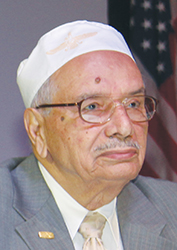
"We were two of the five founders of the CZC, the first dar-e-meher in Southern California and we were also the two founders of the Zarathushtrian Assembly, an organization whose sole purpose is to educate people on the tenets of Zoroastrianism,” recalled Dariush Irani, a retired aerospace engineer in Southern California, referring to their "shared belief in the universality of Zoroastrianism, the power of the Gathas and the desire to educate our community (that)…was expanding in very large numbers… Baba (as Jafarey was respectfully addressed by those who knew him well) would provide the ideas, the knowledge and education, and I would help with the practicalities of making his mission a reality by providing the planning and structure. I was his friend and supporter, and in turn he was my friend and teacher.” Together they travelled across the US, Canada, India and to places like Brazil, Venezuela and Mexico.
Describing their first meeting in the late 1970s in Poona as "happenstance,” when both of them were visiting Poona at the same time, Irani from the US and Jafarey from Iran, they were introduced to each other by a friend of Dariush’s late father Kaikhosro. The visiting scholar from Iran impressed Dariush as being "humble and self-effacing despite being an encyclopedia of our beloved faith.” Two of Baba’s most important principles "I have carried with me are that ‘Truth must have the absolute freedom of inquiry,’ and ‘Bigotry and exclusion are like a cancer that enfeebles the mind of an individual and must never take root.”
Having participated in the conceptualization of the Zarathushtrian Assembly and contributed articles on the Zoroastrian faith in its Spenta magazine, Adi Davar, retired executive of World Bank, and founder and former president of the Zoroastrian Association of Metropolitan Washington Incorporated, recalled Jafarey’s belief that "any person who understood the basic principles of our faith and wanted to live by them should be allowed to do so…To that end, he gave them courses at the Zarathushtrian Assembly or arranged for those who could not take them, to get that knowledge by putting them in touch with knowledgeable North American Zoroastrians. And most importantly, before initiating them into the faith he personally gave most of them a rigorous test to gauge the depth of their knowledge of Zoroastrianism and commitment to lead a Zoroastrian life. He declined to initiate anyone who did not pass that test.”
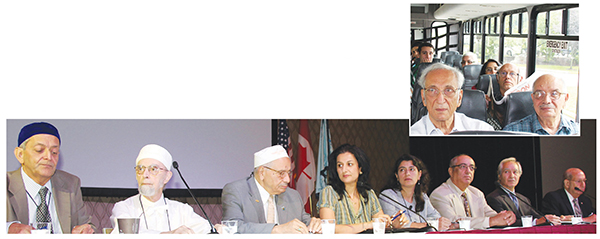
Top: Ali Jafarey; inset (front row, r): with Dariush Irani beside him;
above (third from l): at a panel discussion during the XVI North American Zoroastrian Congress in 2012
Photos: Jasmine D. Driver
"In the passing away of Ali Jafarey, the North American Zoroastrian community and the world at large lost a scholar of the Gathas. His study and understanding of the ancient Zoroastrian text paved the way for imparting this knowledge to thousands around the world,” remarked Arzan Wadia, president of the Federation of Zoroastrian Associations of North America (FEZANA). "His writings, both in book form and on the internet, allowed for people to learn about religion in a structured and organized manner. (He) leaves behind a large vacuum for the thousands who embraced the faith at his calling, and continue to practice it today,” added Wadia.
Viewing him as "a friend and a very valuable contributor” to the FEZANA Journal, its editor Dolly Dastoor respected him as "a teacher who transformed the practice of Zoroastrianism by providing an opportunity for anyone who embraced the Gathas to choose their faith. But first and foremost he was a humble and kind gentleman connected with others through his humanity and honesty and commitment to equality.”
Describing Jafarey’s passing as a "big loss for the Zoroastrian community and for the World Zoroastrian Organisation (WZO),” chairman Sammy Bhiwandiwalla referred to his "profound and righteous influence on issues of tolerance and acceptance among Zoroastrians in the western diaspora.” Other Zoroastrian scholars and WZO committee members from across the globe also respected Jafarey’s contributions: Describing the "gracious and generous” scholar of Zoroastrianism as an "iconic Zarathushti,” Ervad (Dr) Jehan Bagli of Ontario remarked, "His knowledge of languages of the various countries in Asia Minor was absolutely outstanding.” Fariborz Rahnamoon of Canada considered Jafarey "ahead of our times by decades. He in his very calm way was instrumental in spreading the Gathas of Zarathushtra to the world in spite of the opposition and name-calling from all quarters… He worked hard to bring the Gathas to the forefront from the otherwise five-day end-of-year muktad prayers category.”
When advised to accept new converts covertly and discreetly, Jafarey as a man of integrity refused to do that, recounted jurist and author Dina McIntyre of USA. She recalled his rationale, "‘How could anyone inflict on a new initiate the status of a covert Zoroastrian as though he were not good enough to be openly acknowledged?’ He was well aware that the religion as it was practiced throughout Avestan and Sasanian times was a universal one which anyone could join and that when Zarathushtra first started teaching his envisionment, there were no born Zoroastrians.” She gave credit to him and Irani for persisting with the Zarathushtrian Assembly that they founded in 1990 despite the vicious attacks and false accusations that were leveled against them for their liberal stand.
With the Assembly now having chapters in the US, the UK, Europe, Mexico and South America, McIntyre added, "One of the things I admire the most about him is that he did not allow the attacks against him to embitter or defeat him... For the last decade or more of his life, after all that persecution, he sailed out into the sunlit waters of approval, affection and respect.”
Author of nearly 30 books and booklets in Persian and English on the Zarathushtrian religion and Iranian culture, Jafarey had taught at various universities and institutions in Iran and Pakistan. Founder trustee of the Cyrus Society, Jafarey’s fields of specialization included Indo-Iranian history, geography, culture, religion, linguistics and literature. With his knowledge of 13 ancient and modern languages, he was able to offer rare insights into Zarathushtra’s teachings. He was a frequent contributor to Parsiana too and had last submitted an article for the special issue that we had published ahead of the 10th World Zoroastrian Congress in 2013. Copies of Spenta were printed and sent to Parsiana subscribers at the Assembly’s expense for a number of years.
Besides USA and Canada, condolence messages poured in from neo Zoroastrians in Iraq, Kurdistan, Brazil who recognized that "Baba welcomed everyone on the path of Asha.” To Awat Darya who considered him her "spiritual father… The memory of Baba will remain immortal in my mind and inspire me to advance in order to spread the Zoroastrian message in Kurdistan and the world.”
If the Zoroastrian high priests in India could approve the late life initiation of business barons Neville and Nusli Wadia who were Christians but chose to return to the religion of their forebears, deeming it reversion and not conversion, why could not born Muslims revert to their ancient Zoroastrian religion? Jafarey had enquired of the traditional Parsis. "Had there been no conversion, each of the founders would have been the sole follower of his own religion,” he had remarked (see "Awaken to this doctrine,” Parsiana, March 21, 2008). To him, Anghra Mainyu is not an evil force but to be viewed as a retardant spirit, countering the progressive Spenta Mainyu. "Don’t suppress the wrongful but try and win them over,” he advocated.
"At the age of 14, I read books on modern science. It made me lose my faith in Islam and akin religions. Then, through a Parsi friend, Eruch Bulsara, I became a disciple of Dr Maneck B. Pithawalla, principal of the B. V. S. Parsi High School (in Karachi) and later of Dastur (Dr) Maneckji N. Dhalla. That gave me my religion of ‘choice,’” Jafarey had recounted in "Welcomer to all” (Parsiana, November 7, 2007). To him, "The divine doctrine of Zarathushtra Spitama is thought-provoking, rational, progressive, ever-fresh and ever-modern with a scientific basis.” Having decided to pursue "Daena vanghuhi Mazdayasni Zarathushtri, the good consciousness of venerating super-intellect (God) and the Zoroastrian religion,” he had his navjote done in Tehran.
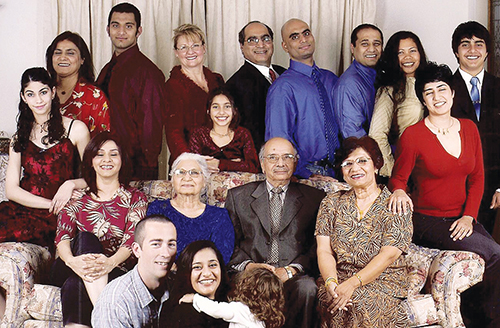
Amy and Ali Jafarey (seated center on sofa) with family
Ali and his wife Amy had taken up residence in Tehran when they found there were not adequate educational opportunities for their daughters in Saudi Arabia where he was then employed as a translator/anthropologist in the Arabian Research Division of Aramco. In Tehran, his birth place, he established a translation bureau, joined the Ministry of Culture and Arts, and founded the joint Iran-Pakistan Institute of Persian Studies in Islamabad. Engaging with the Zoroastrian community, he had started his Gatha and Message of Zarathushtra classes convened by the Zoroastrian Association, the Zoroastrian Women’s Organization, the Zoroastrian Youth Organization and the Ancient Iranian Cultural Society in Tehran. When the Shah was overthrown, Jafarey fled Iran and via Afghanistan reached Karachi where he was hosted by Parsi friends until the US granted him refugee status.
Very popular among his legion of admirers was the "Daily Prayer” he shared on email until he was hospitalized a few months prior to his demise. He believed, "We have to first learn the fundamentals of the religion, practise it and then teach another person. We have forgotten how to be missionaries.”
The religious reformer is survived by his children Nahid, Nasrin, Nozar and Naghmeh.