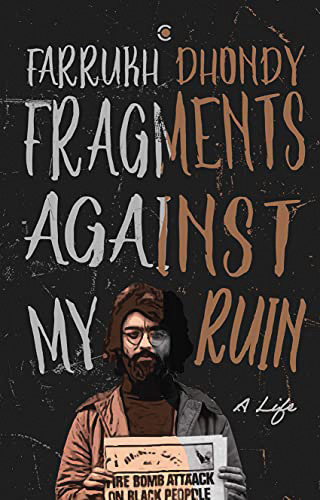
Fragments Against My Ruin: A Life by Farrukh Dhondy. Published in 2021 by Context, an imprint of Westland Publications Private Limited, 1st Floor, A Block, East Wing, Plot No. 40, SP Info City, Dr MGR Salai, Perungudi, Kandanchavadi, Madras 600096. Pp: 306. Price: Rs 699.
The account of Farrukh Dhondy’s (pictured) interesting and eventful life reads more like fiction than an autobiography. In Fragments Against My Ruin: A life, we learn about the litterateur’s association with the Black Panther Movement demanding rights 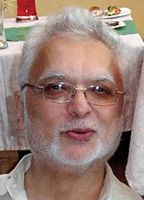 for people of color; with the British Broadcasting Corporation (BBC) as a script writer and the free-to-air British television network Channel 4 as a commissioning editor; his encounters with a variety of celebrities — the Beatles rock band, television talk show host Oprah Winfrey and poet Alan Ginsberg; his friendship with serial killer Charles Sobhraj, Nobel laureate for literature Sir Vidia Naipaul and Trinidadian historian, journalist and Marxist Cyril Lionel Robert James; and his film ventures with Bollywood film director Subhash Ghai and internationally acclaimed filmmaker Mira Nair. And, of course, he is a journalist, prolific novelist, playwright and a poet.
The autobiography gives us a picture of his childhood and youth starting in the quiet city of Poona to his college days in Cambridge, and his time in London. It gives us a glimpse into the multifaceted character and the event-filled life he has led, as a political activist, school teacher, writer as well as the husband/partner of several women.
Farrukh’s father Lt Gen Jamshed Dhondy was an officer with the British Indian Army and the family had a peripatetic existence from one Cantonment to another till Farrukh and his sister, Zareen, were sent to Poona to stay with their aunts. His encounters with sex at the early age of six as well as his fear of contracting venereal disease when he was "pre-pubescent” and never had any sexual encounters with women are recounted in a charmingly innocent and amusing manner.
One sees his remarkable sense of humor when he describes his first day at the Nowrosjee Wadia College (N. M. Wadia College) — which he innocently attended in short trousers. He humorously describes an incident when the interviewer for a Tata scholarship forced him to visit the lavatory to ensure that he would "use the flush.” At Cambridge, he passed his second year exams with advanced physics and chose to spend his last year studying English. His career as a writer began fortuitously when he made friends with a photographer, Andrew Whittuck, who needed someone to write short articles to accompany his photographs. It is through Whittuck that he met and interviewed members of the Pink Floyd band, the Beatles and Ginsburg. He frequently contributed to Indian magazines, newspapers and some of his articles were even published in the erstwhile BBC weekly, The Listener. A chance meeting with a professor of English gave him a place as well as a scholarship to do a master’s degree in arts at the University of Leicester.
 While he was at the N. M. Wadia College, he met the beautiful writer and activist Mala Sen, whose father was the chief of the Southern Command, headquartered in Poona. "Passing through stages of attraction, infatuation and obsession,” he fell in love with her. She reciprocated his affection and through devious means reached London to be with him.
Farrukh left London to study contemporary literature at the University of Leicester. Two events there made Farrukh the champion of the underdog and set him off on a path which finally resulted in his becoming a member of the Black Panthers. The first was the rejection he faced from all "white” landlords when he tried to rent a room. The second and more defining incident was the dismissal of five of his Punjabi friends over a physical fight with an English supervisor who accused one of them of going to the toilet too often. The Indian Workers’ Association as well as the union were both ineffective. Sen and Farrukh encouraged the workers to strike and within an hour-and-a-half not only did the management accede to their demands for re-instatement but also to a general increase in salary of two percent. There was no looking back once they had started on the path of combatting racism and the resulting injustice which always remained a very important part of their life and work.
When they returned to London, Farrukh took up a job as a teacher. He describes the initial indiscipline he faced from his students which was only quelled when the leader of the unruly mob told the class that their teacher was a member of the Black Panther movement and hence not to be troubled. Sen and he joined the central core committee of the movement and Farrukh narrates several incidents where they fought against the injustice of racism. He never loses his sense of humor, even in moments of great danger. When a firebomb was thrown through the ground floor window of his house, Farrukh describes the funny side of the situation — his escape from the blazing fire in boxer shorts and a heroic leap from the second floor onto a bed of glass and flames. He castigates the police who neither bothered to interview him nor charge anyone for the crime (even though the fire brigades affirmed that this was a case of arson). He has only praise for his fellow British teachers. They brought him all the articles of clothing he required and one of them even offered him his home till Farrukh found alternative accommodation.
Farrukh acknowledges four people whom he met and who played a vital part in his career: Martin Pick of Macmillan who wanted to publish his stories; Peter Ansorge who commissioned Farrukh to write for the BBC; Charles Hanson who asked him to write for the Black Theatre Co-operative he ran; and finally Jeremy Isaacs who offered him the role of commissioning editor on Channel 4. During these years, he met/interviewed a host of interesting characters: Winfrey, author Salman Rushdie, Martin Luther King’s wife Coretta Scott, politician Rajiv Gandhi, the British pop singer Cat Stevens, Prince Edward, Earl of Wessex and filmmaker Anand Patwardhan. During a conversation, Julie Christie, the famous Hollywood actress, commented that Farrukh did not understand Indian politics to which he retorted, "You teach me Indian politics, and I’ll teach you acting.” When Charles, Prince of Wales questioned him about the diminishing population of Zoroastrians, Farrukh quipped, "May be something to do with our sexual inclinations?”
Farrukh describes with great warmth and affection his relationship with Naipaul. Though it started off on the wrong foot, they later became extremely close friends. He was invited several times to Naipaul’s Dairy Cottage in Wiltshire and on his birthday Dhondy presented him with a "fluffy little white-and-black” kitten on whom Naipaul lavished extraordinary love and spoilt him rotten.
Sobhraj contacted Farrukh when he wanted his assistance in finding a publisher for his memoirs. This started a strange relationship and on one occasion Sobhraj wanted to use Farrukh as a front for his shady armament deals. He refused. When Farrukh published a novel, The Bikini Murders based on Sobhraj’s life, Sobhraj threatened to sue him for defamation. Farrukh replied that would be tantamount to accepting the fact that he had actually committed these murders. Farrukh ends the episode with the laconic comment, "They didn’t sue.”
Farrukh wrote several film scripts for many of which he received no credit: Midnight Breaks, Immaculate Conception, Train to Pakistan, Jinnah. He even ghostwrote the script of Bandit Queen based on the life of bandit queen Phoolan Devi. Writer Arundhati Roy managed to have a court summons issued for "traducing Phoolan Devi’s rights.” Roy also convinced Devi to file a case against the distribution of the film. It is only when the resourceful Farrukh gave Devi’s husband a cheque for £ 40,000 that she dropped the proceedings. Farrukh’s relationship with Ghai and the description of his erratic and unusual and eccentric ways of scripting and directing a film are startling and amusing.
Farrukh’s private life has been as eventful as his public one. After his marriage with Sen ended, not only has there been a stream of partners but also multiple children with each of them: Shireen and Jahan were the daughters of Piki; Tamineh and Danyal, the children of Loretta; and Tir, the daughter of Bernadette. If the children had an important part to play in the autobiography, Farrukh would have needed to include a list of dramatis personae.
At one point in the book, the author informs his readers of author George Orwell’s reasons for writing: "Sheer egoism, aesthetic enthusiasm, historical impulse and political purpose.” How much more compelling and less pompous are his reasons for the same. "Perhaps the real reason one writes is the reason spiders spin webs. It’s what comes naturally — a spider can’t help it and can’t stop, and it’s a trap for sustenance.”
FIRDAUS GANDAVIA
Gandavia holds a doctorate in English literature and is a retired chartered accountant. He is a compulsive reader of fiction.