A fall from a horse confined the writer to a wheelchair for the rest of her life
Having maintained a graphic diary since the unfortunate riding accident that left her paralyzed chest down, Shanoor Forbes shared her story of grit and gumption in a detailed account of her ordeal titled Excerpts from the diary of a tetra in November 1996. In this she recounted how, with the support of family, friends and medical treatment abroad, she overcame all odds to lead a full life, albeit in a wheelchair. Forbes passed away on July 30, 2017, nearly three decades after the accident. We reproduce here edited excerpts from her narrative of the early days of her nightmare. A copy of Forbes’ Excerpts was given to Parsiana by family friend and relative Rati Wadia.
Shanoor and Sarosh Forbes; below with son Reshad
I fell on February 28, 1988. I was 44 years old at the time. It was like any other morning ride — pleasurable as all my riding had been since I was a little girl, up until this moment. However, this time when I took the toss from my horse I thought to myself, "This is the beginning of the end.”
"I am only one, but still I am one. I cannot do everything, but still I can do something; and because I cannot do everything, I will not refuse to do the something that I can do.” These words of Helen Keller (author, activist and lecturer, she was the first deaf-blind person to earn a Bachelor of Arts degree) have been an inspiration to me, after my riding accident at Mahalaxmi Race Course in Bombay. I was thrown from my horse Romanique when she tripped. I fell straight on my head and snapped my spinal cord at the C6/7 level and was immediately paralyzed.
 The minute I fell on my head, which was protected by my riding hat, I recollect being on the ground in a crouched position — not able to move. There was no pain at all and the only thing I felt myself doing was fighting for breath, my whole body concentrating instinctively on that one fierce activity — breathing hard, in, out, in, out, and not being able to do that easily seemed strange. Nor could I move from that crouched position.
My friend Minnie Dastur, who was riding with me at the time, and other joggers and walkers on the track quickly summoned an ambulance which is always standing by at the race course. The driver and his assistant pulled me on the stretcher without protecting my neck or head as is customarily done. In India there are no properly trained ambulance personnel like the paramedics abroad who are always on the ready when called to treat accident victims. I can never be sure, but my fractured vertebrae could have been further damaged and greater injury done to my spinal cord due to the movement of shifting and lifting me without proper support to my neck and back. I was then taken to a hospital near the race course where, after taking X-rays of my whole body, they said my neck seemed to be broken and summoned my husband Sarosh and son Reshad (aged 20 at the time), my mother Freny Mehta and other close family members, informing them of my poorly state. (My daughter Simonil, aged 21 at the time, was studying in America and had to be informed over the phone.) My myelogram (radiographic examination to detect pathology of the spinal cord) and CAT scan also had to be taken but the hospital lacked the facilities, so they took me off to another bigger hospital which had the equipment. Being a Sunday, these departments were closed! So I had to remain in agony and without treatment with my broken neck. My close family members and many friends constantly came to visit me and gave me much support and encouragement.
My mother sat by my side night and day, shooing away visitors when she felt I needed my sleep more than conversation! Being her only child, she and I have always had an almost symbiotically close relationship and it doesn’t bear thinking what agonies she must have suffered, uncertain whether I would survive or not. But her outwardly calm exterior certainly kept my spirits up. My timid, sweet mother-in-law Dolly, with whom I had a pricelessly superb friendship, seemed withdrawn and in shock, unable to speak or do anything much when she was around me. We just had an unspoken communication which forged a bond between us in those terrible days. Being a gregarious person, despite all my agony and pain, both mental and physical, I remember feeling very cheered and happy that so many people were concerned and helping me in every way they could.
The next day after my myelogram the consulting surgeon was of the opinion that a major and critical operation of the vertebrae would be necessary, since the fractured portion was in bits and pieces, the shards of which had severed my spinal cord. This news filled us first with dismay and then fear. So, on being advised by many well-wishers that the conditions for the proper treatment of this immense problem were totally lacking in India, Sarosh made a snap decision to fly me to England where I could be operated on.
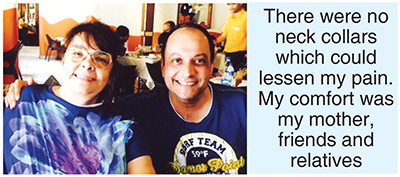
We did not possess the large amounts of money that would be required, so there began an immediate search for funds: loans, grants and liquidation of any stocks, shares and capital owned by us, in the shortest possible time. This would not have been possible without the help of our very kind family members and friends who went around with Sarosh, who was near breaking down himself with what had happened to me, and who like my vertebrae had been smashed in a split second. Sarosh’s friend, Dr Manek Bharucha, who lived in England set the ball rolling. Phone calls were made back and forth liaising with friends and doctors all over the world. It was eventually arranged to fly a neurosurgeon from England to Bombay and for me to go to England on a stretcher along with the doctor, Sarosh and Reshad. All these arrangements had the deadline of a week and till then I lay with a broken neck and in agonizing pain at every turn of my head. There were no neck collars which could lessen my pain. My comfort was my mother, friends and relatives who were constantly at my side together with private nurses feeding me, changing me, turning me and giving me courage. I was totally paralyzed and in complete depression.
The doctors then decided to do a tracheotomy to my throat since I seemed to have a little bit of difficulty in breathing and talking and it was after this operation that my real nightmare began. The procedure was performed in a faulty manner and I was put in the intensive care unit (ICU) which was full of moaning and groaning patients who were seriously ill. The physiotherapist who came routinely on her rounds seemed to compensate for her lack of knowledge by terrorizing her patients. She forced me to breathe in and out on a breathing apparatus she had inserted in my mouth which caused choking and when I pleaded with her to stop and remove the tube, she snapped at me in anger and forced it down. I heard my private nurse, who was a gentle and kindly woman, urging her to stop since I was obviously choking. But she snapped at the nurse telling her to mind her own business.
Just then I saw one of my aunts, Nergis Mehta, who is a doctor, come in and exclaim that I was out of breath and turning blue. In her opinion these exercises ought to be halted immediately. To this the young physiotherapist angrily retorted that my aunt had no business being in the room and asked her to leave immediately. By now I was in a state of panic and turning and twisting my head this way and that, regardless of the sharp, shooting pains this caused. Finally, with a superhuman effort I feebly lifted my arms and somehow managed to push out the tubes that were forcibly held in my mouth. Ah! the relief of being able to immediately and freely breathe again! The physiotherapist left in a huff. I was so terrified she’d reappear the next day to once again "do her duty” as she put it, that later in the day I begged another of my aunts, Feroza Seervai, a formidable lady, to explain to the authorities and instruct them not to allow this physiotherapist to come anywhere near me! She never bothered me again, and another compassionate and competent physiotherapist treated me for breathing exercises the following day.
A couple of days later, the cut on my throat started bleeding and when this was pointed out to the hospital doctors and nurses they brushed it aside as being of little consequence. However, the bleeding would not stop and finally with great difficulty a house surgeon was located by one of my family members. He breezily stopped by for a while and said it was not an urgent enough matter to inform the surgeon who had operated, but he did try to stop the bleeding by pressing down on the spot where the blood was gushing, counting the seconds on his stop-watch, saying this was the "three-minute technique” of applying a so-called tourniquet on the area which was bleeding, and in 90% of cases it usually worked. However, he did mention that just sometimes this technique did not work and a clot may form instead. The technique did not work, as slowly the blood started to flow internally down into my gullet, where it finally clotted. The consequences of this, we were to later realize, nearly cost me my life.
Perhaps it may have been best if it had, for life then felt horrible. It was a nightmare. I was like a newborn infant — utterly helpless and at the mercy of others, having to be looked after 24 hours a day. What kept me going in those early days of shock, fear and horror was the tremendous surge of love and compassion emanating from both friends and relatives. There was a round-the-clock vigil by my bedside. People sacrificed their work, daily routine, personal commitments and rushed around from morning till night helping us get things organized in the brief period before our departure for England.
Being the realist that I am, I knew I’d survive — in a wheelchair. An extrovert by nature, I come alive in the company of people and wither away when left to my own devices. Even in the miserable state that I was, I appreciated having so many of those I loved, always around me.