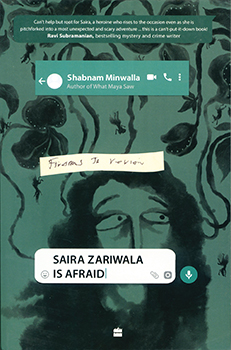
Saira Zariwala is Afraid by Shabnam Minwalla. Published in 2021 by HarperCollins Children’s Books, an imprint of HarperCollins Publishers, A-75, Sector 57, Noida, 201301; website: www.harpercollins.co.in. Pp: 352. Price: Rs 299.
Shabnam Minwalla’s (pictured) Saira Zariwala is Afraid is a fast paced novel full of suspense. She certainly knows how to keep the reader engaged by creating a sinister world, yet an everyday world we are familiar with.
 The need for young people to own and use a cell phone is ubiquitous. One little realizes the danger that this could result in. Saira Zariwala feels deprived as she is one of the two girls in her class of 36 who does not possess a cell phone. Her joy knows no bounds when, on her 15th birthday, her parents — more her father, as her mother still has some reservations — present her with an iPhone. Saira’s impatience to get a SIM card and be connected is acute, as she desperately wants to get on to Instagram and WhatsApp to chat with her friends and to be added to the groups.
Her father takes extra trouble to choose a SIM with an appropriate number for her, but his good intentions misfire. When she accesses her app and finds a volley of messages, she is upset that they inexplicably are not for her, but for Akaash, the previous owner of the SIM number. The first message is "Akaash, where are you?” followed by a barrage of questions from frantic friends and Priya Maami as Akaash seems to have disappeared, leaving no trace. Saira’s curiosity is further aroused by the fact that several people are asking Akaash about their lucky colors and there are references to the mysterious La Bruja. Compared to the messages for Akaash, the messages for her are uninteresting and banal — requests for her homework, a missing Hindi essay and lost shoes.
Minwalla does an excellent job of creating a lugubrious and disturbing atmosphere. Though Saira’s mother thinks that Smriti Bhavan is "atmospheric,” Saira does find the house frighteningly eerie as the stairwell is murky with cobwebs, the lights on the stairs are temperamental, the rooms are marginally crooked and during the nights she imagines she hears "the groans of aging, arthritic beams and columns.”
The protagonist, Saira, is the narrator, chief detective and investigator of the mystery as she tries to unearth what has actually happened to Akaash. But can she be trusted or is she an unreliable narrator? At the age of five, she had a fall from the top of a tall slide. This has instilled in her a fear of heights; she still suffers from trauma when she has climbed several floors and looks back; she has panic attacks and eats sweets to fight her phobias. Further, she is a very imaginative girl. She has been told that a resident’s brother had died several years ago and she imagines a very young boy riding a red bicycle taking a sharp turn and falling down the staircase. She also seems to be psychic as she is haunted by the image of a little girl who mysteriously fell to her death from a highrise apartment block. Parallel to the main plot, there is also a sub-plot of a science project: inventing a gadget during the Diwali holidays. Minwalla effectively brings both these strands together at the end of the novel.
Minwalla creates several credible and interesting characters and endows them with their own personality. There is the elder brother, Tarik, who is scruffy and protective of Saira, even though she does not like his interfering ways. Kartik, who is part of her science project, is a geek and very serious. Then there is Tia, her oldest friend, who is forthright and short tempered, the ideal Watson to Saira’s Sherlock. And finally there is a rather nasty, selfish, sneering and permanently complaining "friend,” Tamara, who does not miss a single opportunity to insult Saira and play on her insecurities.
 The novel is a tightly plotted page-turner and consequently holds the reader’s interest. However, the number of characters, especially Akaash’s friends, could have been reduced. The canvas is a bit too large and keeping track of so many characters could occasionally be a problem. This would also have resulted in a shorter novel. In spite of it having such a riveting plot, I wonder how many young adults will persevere through 350 pages especially considering their addiction to their cell phones.
However, the novel is not just a mystery story for young adults. It has a serious underlying theme of the dangers which indiscriminate use of social media could result in. This is evident from the cover where the author’s name and the title have been displayed in the form of WhatsApp messages. Minwalla stresses how much danger Saira puts herself in by using social media. Saira puts up a profile picture (after much agonizing) on WhatsApp in her school uniform which makes her an easy target to track down. For want of any sensational details, she mentions on her Instagram account that she will be staying late at school. Both these innocuous actions have far reaching and sinister implications.
It would be wonderful if this novel were read not just by young adults, but also by their parents who could be made aware of the dangers and pitfalls of social media and how information can be misused. F. G.