The town that once housed over 200 Parsis today has none
Dinyar Jalnawalla
Imagine life in Jalna in the late 19th century, just after the first War of Independence in 1857. At that time it formed part of Hyderabad state as a tehsil (subdistrict) of Aurangabad district, under the Nizam’s rule. Today it is located in the Marathwada region of Maharashtra. An agiary was established in 1842 by Meherwanji Khurshedji Jalnawalla, and the M/s Pestonji Meherwanji (PM) firm’s office was located on what is now Bezonji Road, where the family also resided. There were around 200 Parsis living in Jalna at that time, my father Navroze had once told me.
While Pestonji conducted business in Jalna and other locations within the Nizam state, his elder brother Dinshawji stayed at the Bombay office on Princess Street during the latter part of the 19th century. There, he handled drawing and discounting bills of exchange and marketed cotton bales at the textile mills. The Bombay office, under the name M/s Dinshawji Pestonji, continued to operate until 1985.
During an outbreak of plague, the Jalnawalla family moved to the PM Bungalow near Azad Maidan. This property, extending over 26 acres, was purchased in 1869 for Rs 2,400 (USD 28). It had seven bungalows and five wells. The land had previously been owned by the British Regiment stationed at Jalna.
Clockwise from top: dakhma; agiary remains;
plaque on the founding of the agiary
Photos: Hemant Chaturvedi
L-r, top row: Bezonji Jalnawalla; Jalnawalla cousins; Bezonji with his cousins and business partners;
2nd row: male and female Jalnawalla family members at the Ghanewadi reservoir
Transportation was mainly by tongas, horse-drawn carriages. The wealthier families often owned two-horse tongas. The Jalnawalla family operated a courier business, transporting letters and parcels in tongas. The horses would be changed for fresh ones after traversing several miles. The letters would be delivered to Khamgaon, where there was a railway station, and from there they would arrive in Bombay within two days.
The Nizam State Railway began operating in 1904, and Bezonji Jalnawalla, my grandfather’s cousin and the doyen of the family, was appointed to the Railway Board by the then Nizam.
The Jalnawalla family was large, with about 25 members living together at any given time. They shared a large kitchen. When meals were ready, a butler would strike a gong to indicate that all cousins and relatives should assemble together to eat in the common dining room which could accommodate 50 people. The men of the house would sit first according to seniority followed by the women, again by order of seniority. The children had a separate table in an adjoining room. No one voiced their separate food preferences; whatever was served was eaten with gratitude.
After dinner, they played cards or board games; on moonlit nights they enjoyed walks. The PM Bungalow had a long walking track. Occasionally the Nariman family, owners of a department store in Jalna, would join them for dinner and games. The men played tennis at the Civil Club, which was established on land donated by Bezonji. My grandfather contributed a billiards table to the Club in 1930 at a cost of Rs 1,000.
The daughters were sent to St Anne’s School in Secunderabad while the boys were educated in Jal Master’s School in Devlali. Only my father was sent to Boys’ Town in Nasik.
Marriages among Parsis from Jalna, Aurangabad and Hyderabad were common; for example, three members of the Davar family from Aurangabad married into the Jalnawalla family.
Women were not allowed to shop in public, to shield them from lustful eyes. So shopkeepers would come to their homes. Even at weddings, food would be packed and sent to the bungalow for the ladies.
The women in the family spent much of their time in the common kitchen, known as the bawarchi khana. This was run by the domestic helpers. It also served as their canteen where daily food items were prepared. The staff included two Christian cooks and one Muslim cook to prepare Hyderabadi cuisine and fetch groceries from the bazar. There were about 15 domestic helpers (coming from the Kannada area) to serve about 40 relatives who stayed at the bungalow during the summer holidays. The bawarchi khana also served as an afternoon resting place for the domestic help.
Between 1860 and 1900, opium trading was legal and even encouraged by the British government. The Nizam of Hyderabad used opium daily, and my grand uncle, Phirozsha Moos, who was his chief excise commissioner, even tasted it for the Nizam. The Jalnawalla family also had a wholesale liquor distribution business for the entire Nizam state, partnering with the Bhiwandiwala and Chinoy families from Secunderabad.
However, in the 1890s, the older women in the family protested against the opium and liquor business, leading to its closure. The money the family had made from government contracts was then invested in cotton ginning and pressing factories. By the 1930s, the family owned 17 cotton ginning and pressing factories, 6,400 acres of land, and 300 houses, records for which are still available at the Jalna office.
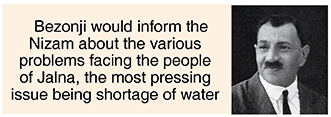
Bezonji, often met Nizam Usman Ali Pasha, returning each time with gifts of three to four gold coins (Ashrafis). During these visits, Bezonji would inform the Nizam about the various problems facing the people of Jalna, the most pressing issue being shortage of water.
The Nizam asked Bezonji to build a reservoir at Ghanewadi. With his engineering diploma, Bezonji was well equipped to plan its construction and execute the project. However, the Ghanewadi project caused concern in the PM family because they knew that Bezonji intended to pay the laborers much more than the minimum wages prevalent at the time, which could lead to a significant financial burden. Despite the advice of his younger brothers, Bezonji remained committed to the project, driven by a desire to help the people of Jalna. The Ghanewadi project was executed smoothly, but the finance minister of the Nizam state objected to the amount paid to the laborers, resulting in a shortfall of two lakh rupees (USD 2,342) which Bezonji paid out of his own pocket. Bezonji also owned two cotton ginning and pressing factories, which he was compelled to surrender to PM, in settlement of his debts to the family firm.
Later, Bezonji realized that without a filtering system the water in the reservoir would not be potable. He had lived in England in 1912-1913 and had seen the filter beds there. Soon after the completion of Ghanewadi Lake, filter beds were installed. These were, I was told, the best in the Nizam State.
The Ghanewadi reservoir provided water for 35,000 people, which was the population of Jalna in 1926. Some of Bezonji’s friends in the Nizam’s government jokingly wondered whether the lake would have enough water for the entire city. Bezonji took on the challenge and it was said that he transported gallons of water in train wagons to show that there was ample water to satisfy the thirst of many in Hyderabad city as well.
Another notable aspect was the technology used for transporting water from the Ghanewadi Lake to the filter beds. This system relied on gravity to move the water. It was efficient and saved a significant amount of money that would otherwise have to be spent on electricity to pump the water downstream.
Top (l) and above: Jalnawalla Bungalow, then and now;
top (r): common kitchen at the Bungalow
The construction of the Ghanewadi reservoir and his other public charitable works led to Bezonji’s financial ruin in the 1940s, though his capable and learned son Rustomji recouped all the losses later. Bezonji’s personal assets were taken over by the family firm. The firm’s records show that until his death in 1949, Bezonji donated discreetly up to nine lakh rupees (USD 10,540) to various public causes and charities which was a very large sum of money in those days.
Bezonji was a member of the Freemason Lodge in Secunderabad, which included many prominent members of Hyderabad society. He believed that the Lodge taught him a way of life where charitable giving was done without seeking recognition. This is the key difference between the Freemason Lodge and other social organizations.
A memorable incident involving Bezonji illustrates the community’s respect for the family. While traveling by train to Secunderabad, Bezonji was garlanded by factory managers at every station as a mark of honor reserved for members of the family. Noticing the reverence shown, the collector of Aurangabad wanted to know why Bezonji was being thus garlanded. Moved at learning that Bezonji had funded numerous students through their graduation, at the next station the collector personally sought out Bezonji to extend his greetings and seek his blessings. This was a testament to the profound impact the PM family’s contributions had to education and community welfare.
As part of their social responsibility, the Jalnawalla family funded the education of several students and provided free medical aid to those in need. They kept their charitable efforts private, believing that "your left hand shouldn’t know what your right hand was giving.” My uncle, Rustomji, made a notable contribution by funding the science stream at JES College, Jalna. My father established a Marathi primary school named Navroze Prathmic Shala. Despite his persistent efforts to secure government grants to sustain the school, he ultimately faced disappointment when the principal resigned, leading to the school’s untimely closure. However, along with his friends Drs Moses and Chopra, my father was instrumental in bringing St Mary’s School to Jalna, a legacy that would have a lasting impact.
My father who passed away in 2012, often compared modern life to the 1940s. He appreciated the simpler conditions of the past. Back then, there were no modern conveniences, except for radios, but houses were spacious, the air was clean, and people lived with a sense of discipline because of their belief in karma. My father would say, when you have respect for elders, the entire generation is blessed. One shouldn’t bring home the worries of the office or vice versa.
The agiary closed in 1992 as there were no mobeds available. The dilapidated building still stands. The agiary belonged entirely to our family and was always funded by our firm. There was no trust. At present I am looking after the land.
Panther encounter
Bezonji’s grandson Rustom Bharucha narrated an encounter his grandfather had with a panther which is mentioned in H. D. Darukhanawala’s Parsis and Sports:
"Bezonji Fardoonjee Jalnawalla is a shikari (hunter) of over 35 years’ experience during which period he has bagged nearly a 100 wild animals, including tigers and panthers.
"In May 1933 while out shooting near Jalna, a wounded panther rushed at a beater when Jalnawalla hit the beast in the face with his topee which was in his hand but the beast scratched his wrist and tore his hat, reared itself on its hind legs, and for about 15 seconds both man and beast grappled with each other. Unfortunately at that crucial moment Jalnawalla slipped and fell and the panther got on top of him. Keeping his presence of mind he thrust his left elbow into the beast’s mouth. The panther mauled him for a while and then left him, making for his companion. Jalnawalla immediately picked up his rifle when the panther again attacked him, but he shoved the barrel of the rifle into its mouth and held the beast at a distance of a yard when his companion succeeded in shooting the panther which measured over eight feet.”

Sixty-year-old practicing lawyer Dinyar Jalnawalla migrated to Poona in 1985 and completed his law degree in 1988. He did a postgraduate course in competition law from King’s College, London in 2014.