Two years ago the Calcutta Parsis debated on
who may be permitted to enter their fire temple
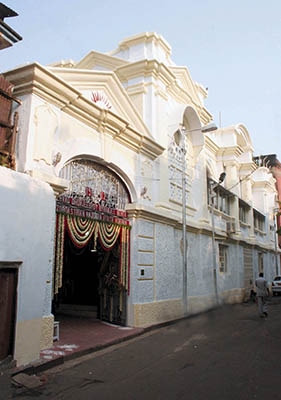
The issue of whether to admit children born to a Parsi mother and non-Parsi father into Calcutta’s Late Ervad Dhunjeebhoy Byramjee Mehta’s Zoroastrian Anjuman Atash Adaran was keenly debated at the fire temple’s annual general meeting (AGM) on August 23, 2015. Of those attending, the minutes show over 15 members spoke for and against admission at the two-and-a-half-hour meet which agiary trustee Noshir Tankariwala termed "a record” since the 12 or 13 years he has been a trustee. He thanked the gathering for "carrying out this debate or issue in a dignified manner with much decorum...It is very difficult for the trustees who have been entrusted to take such decisions...where the trust deed is very specific.” The two other trustees of the Adaran are  Yezdezard Dastoor and Jemi Bilimoria.
The matter eventually led to an Originating Summons being filed in the Calcutta High Court (HC) on December 19, 2016 by Prochy Mehta and her daughter Sanaya Mehta Vyas whose grandchildren/children were denied entry by the newly appointed panthaky of the agiary, Ervad Jimmy Taraporwalla (see "The concept of gender equality,” Parsiana, July 21, 2017).
In his affidavit in response Tankariwala stated, "the trustees have looked into the matter in considerable detail and have received the opinion that the trust deed is sacrosanct and cannot be altered. Therefore, the children of Parsi mothers married outside the community will not be allowed into the Adaran even if their navjotes have been done.”
Parsiana carries edited extracts from the minutes that reflect a cross section of the views expressed by some speakers.
Prochy Mehta
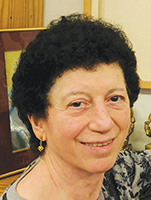
(Reading from a letter she wrote to the trustees) Demographically, we are 470 Parsis and 136 non-Parsi children and spouses... The count will be continuously changing as more and more children marry outside the community. The only way we can preserve our Parsiness, is by inclusion, not by exclusion. We must accept our women’s children as well as our men’s children, whoever they are married to, if their navjotes are done. We cannot be scared of change…
What are we afraid of? That we will lose our Parsiness? Parsis of Calcutta are quite different from the Parsis of Bombay or Surat or Nagpur or Jamshedpur. This we have seen quite clearly during the cricket pentangular tournament. So we want to maintain a Calcutta Parsi culture. How do we do that? They are our children, our grandchildren. We can bring the children up teaching them our way of life, our culture, our habit, our values. We must make them more like us. This can only be done if we follow the process of inclusion.
Yezdi Karai
Let us look at what three eminent Parsi jurists have had to say.
Fali Nariman, former additional solicitor general of India and senior advocate in the Supreme Court, who delivered a lecture in New Delhi, on January 9, 2000, on the occasion of the diamond jubilee celebration of the Delhi Parsi Anjuman had expressed his opinion about the rights of children of inter-married couples: "After all, customs are not eternal and ancient customs in a modern society are fast changing. Parsis settled overseas (and he used the examples of the United States and Canada) have shown the road very quietly and unobtrusively that the children of parents, one of whom is a non-Parsi, have been freely admitted into the religion and have fervently professed and practiced it.”
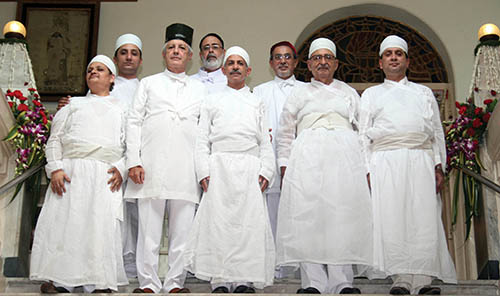
Top: Prochy Mehta; (above, from l) Ervads Behram Bhadha and Jimmy Taraporwalla,
Noshir Tankariwala, Yezdezard Dastoor, Ervad (Dr) Ramiyar Karanjia, Jemi Bilimoria,
Ervads Shorab Kotwal and Mehernosh Dastur at the 2011 Adaran centenary celebration
Mehta and Vyas families at Samara’s navjote
On December 2, 2000 Justice Sam Bharucha, the ex-Chief Justice of the Supreme Court of India, addressed a meeting of The Federation of the Parsi Zoroastrian Anjumans of India in Jamshedpur: "I must go on to add that the anjumans and punchayets should consider the admission into the faith by the performance of the navjote of a child born to a Parsi mother and a non-Parsi father, provided such child is a product of wedlock and the father is a consenting party.” He goes on to add that, "I know that a judgment delivered long back by the Bombay High Court would seem to be standing in the way, but if the anjumans and punchayets all resolve that this is the appropriate practice to adopt and the practice is challenged… it can, given, the circumstances, be overruled. Implicitly, it therefore says that nobody, absolutely nobody, has the right to say that the child, whose navjote has been done by ordained Parsi priests, cannot be admitted into the faith. You cannot prevent a Parsi from practising his faith, a Zoroastrian from practising his faith. All Parsis are Zoroastrians, but all Zoroastrians are not Parsis.”
On Human Rights Day in New Delhi in December 2003, Soli Sorabjee, former attorney general of India said that people must pledge to make human rights a living reality. Rights without remedies are useless. So, yes, we have a right to practice our religion. When we are prevented from doing it, we have a remedy. We should use that remedy.
Rohinton Nariman, (now a Supreme Court Justice) had earlier stated that he concurs with the views expressed by many Parsi legal luminaries that we should change with the times. And, in fact, he is the legal luminary who pointed out the applicability of Yasna 46.10, where Prophet Zarathushtra says that all men and women are equal.
I care as much about tradition as anybody else and I care as much about the community preserving those traditions, but traditions have to change with time…
At the same time let us acknowledge and respect the wishes of the community by doing an independent survey of what every member in this community wants…
We wouldn’t want somebody filing a law suit against the trust to say you have acted against the interest of the trust. The consequences are, that if we do nothing, something will be done and it will divide the community and in due course of time this trust becomes irrelevant, this agiary becomes irrelevant, because there will be another place of worship.
Aban Confectioner
We need to look at it in a very, very big manner, not something that can be decided by a few people and... immediately. If it deals with the adaran trust, does it deal with the CZCRCF (Calcutta Zoroastrian Community’s Religious and Charity Funds), Parsee Club, the Stree Mandal, with every place where the term Parsi Zoroastrian is used? We should not limit ourselves because this is going to be such a massive task that we need to look at it in its entirety and not just in one isolated place.
Numazar Mehta
Each and every one of us has a duty... When we think for ourselves, we guage that which is right and wrong and stand up for what is right and behave as per our conscience. Our conscience, not somebody else’s conscience, not some priest’s conscience, not some head’s...
Dastur (Dr) Maneckji Nusserwanji Dhalla had written, "After the Prophets depart their disciples turn everyone into blind followers of faith. Religiosity replaces religion, the intoxication of religion makes a man delirious. Social religious customs take the place of pure, ethical and devotional faith and turn it into tradition ridden religion, as a result of which men quibble and quarrel constantly... There is grace, dignity and wisdom in fashioning our lives according to the demands of this...century.”
Beroze Bilimoria
When our girls get married to non-Parsi boys they are very much aware of the dos and don’ts of the community. So they should abide by it until the change takes place. Incidentally, my daughter is also married to a non-Parsi.
Dickoo Nowroji
We are shrinking at such a rapid rate that this future has to be addressed and we are already late. The trustees, the priests, all our institutions have to take a strong look at this, or seriously we are dead. And if you wish to die you can. I had a very good friend, a Parsi, some of you may have known him, he used to say, ‘Dickoo, we Parsis have a death wish.’ I didn’t believe him then, but I believe him now, because I think most of us are not willing to look at the alternative, or what will happen if we don’t change now.
Frenaz Mogrelia
We have to be very clear that Parsi Zoroastrian and Zoroastrian are two entities. Now when you look for a change in a community, look at history. Historically, every religion that has gone through changes has not gone through changes in the existing religion. There has always been a parallel religion that has come out. For example, Protestantism was a protest against the Catholic religion. And, it is always the big and powerful people, when they get affected, that change happens. And that’s good, because we aam aadmi (common man) cannot make the change. So you need people who are well connected to make the change. So that’s good because change is what we want. But we also have to remember that we cannot force change on people who do not want the change. So what is the solution you are looking at? Changing the trust deeds of the existing trusts or why not widen your horizons and think of starting an alternate order where there is true equality, where you not only make changes (but) don’t stick to small and petty things as women and men. There are so many things in our religion that need changing. I don’t agree with the idea that a priest should not pray because I have been cremated…
Definitely our religion needs to be equal I don’t even support the idea that if my son has a child who is half Parsi and down the generations they keep marrying non-Parsis they have entitlement to the Parsi trust, etc. I don’t think that’s fair either. So, boy or girl, there has to be a limit, there has to be a cut-off where you are still considered a Parsi or you are just a Zoroastrian…
Why not have separate funds, where you allow and you decide who you want to give those funds to? You set up an alternate place and allow us to go there and let people make a choice…
If you are looking at Zoroastrianism, start an alternate order, get the priest to support you and we will back you all the way.
Dilbar Gotla
My brother, incidentally is married to a Sindhi lady, and when he was posted in Iran, his wife and his children all went to the agiary. They just took the kusti off the khutti (peg), tied it round, went inside, pagé lagoed (paid obeisance) and came out. Nobody stopped them. So in this religion that came from there, how can you say, how can these priests say that no non-Parsi person can go in? This is what I have been subjected to. My daughter has married a non-Zoroastrian. He is a Britisher. They have two daughters... I would like them to come in. They themselves are very keen. They are more Zoroastrian than I as they keep on reading all the Zoroastrian books and literature they can lay their hands on. I think that is very creditable.
Another thing that I would like to say is when they came to India, I once asked somebody, if they could go just upstairs to the agiary, they just wanted to see the place. I was told no that they would not be allowed as they were also overage. Okay, fine, I can understand that. But, now I think the time has come where this change has to take place and it is for the better. I think we have to progress and not digress.
Rayzad Bulsara
The other day we had the Parsee Club AGM when we were looking for a junior between the years of 16-18 years to come on to the committee. There was one junior, yes, but there was no second or third junior to propose him or second him. When I grew up in Parsee Club we used to have races with eight lanes and there were two children running in each lane. Today, sadly, we are thinking of shutting the Calcutta Parsee Club’s sports day and making it some other entertainment day, because we have just two or three people running in a group. Are we looking at the future like the Armenians who have given up their club to the Bohra Muslims?...
Jahan Mehta
Institutions have always been created to get people together. I don’t know how this institute intends on getting people together, but perhaps this is something that you need to think about… We need to come together and if we don’t come together under this institute we’d probably pray like Zarathushtra did, under the open sky. I’m sure he didn’t pray in the agiary. I say so to all my friends, my family, my loved ones, we can be Zoroastrians and perhaps we need to pray under the open sky.
Keki Italia
A practical solution is for the trustees to call a meeting and propose a resolution in which every Parsi who has had his navjote should be allowed to vote even if he is not 18 years old, say he is 14 years old. Let the voting be by a ballot, but not by raising of hands… What we are discussing is an entire change in this community’s outlook. The trustees only can do it. The trustees are sworn not before us but even in the High Court (HC), that they will uphold the trust deed. If they go against that and allow everyone to walk into the agiary, one Parsi is enough to go to the court and disqualify the trustees. So, you have a vote. Then, if the trustees decide to change the rules they will go to the HC as they have done in the past, and ask the HC to change the rules. But the solution will have its own perils. One is that no child who has been navjoted because his mother was Parsi would be accepted in Bombay. We will lose our vada dastur who is not going to approve of it. We will lose perhaps this team of able dasturs who are serving us and serving the community.
Rohinton Daruwala
Péhlé Parsiyo ma kaido hato ké khandiyao né agiary ma nahi java deo. Hajun bhi chhè. Navsari ma khandiyao né nav nahn apo tau bhi agiary ma allow nathi. Kai? Koné banavélo kaido? Zarathushtra Saheb é kahélu? Zarathushtra Saheb é kahélu koi dastur né? Aé vastu chè aapri Parsi kom ma, ké jé poor chè, little bit poor, uneducated, abbhan, annari, télokoné hamésha dabavi né rakho. Paisawallaoné, vadharé educated thailaoné, té lokoné develop karo. Hu khandiyo, pedaiyashi khandiyo nathi. Majboori é mané khandiyo banavyo. I was a diamond cutter… Aajé hu agiary ma saaf-soof karuch. ‘Rohinton what is this, very nice,’ trusteeo boléch, hu nathi bolto. ‘Rohinton very nice malida.’ Arré, khandiya na haath thi koi pani nahi pitu hatu, aajé éno malido khavoch. Maru kévanu é ché garibnu ké jèm new generation pratyék caste ma thaich, koi bhi caste nathi bachti… Aéna karta compromise karo, koi bhi ék end lavo. Karan bé tan varas thi ék ni ék meeting, ék ni ék no result. Koi bhi ék jawab aapo — yes tau yes, no tau no. (First there was a custom that no pallbearer could enter an agiary. It is still there. In Navsari even if a pallbearer takes nine ceremonial baths, he is still not allowed. Why? Who made this rule? Did Zoroaster say this? Did he say this to some priest? The tradition in our community is that if you are poor, uneducated, illiterate, foolish such people are always suppressed by the rich. Those who are rich and better educated are promoted. I’m a pallbearer, not by birth but by compulsion. I was a diamond cutter… Today I keep the agiary clean. "Rohinton what is this? Very nice,” the trustees say. I don’t say this. "Rohinton very nice malido.” Once no one drank water handed to them by a pallbearer, today they eat malido. What I wish to say is that caste distinctions blur with succeeding generations. No caste is exempt. Instead compromise, select one option. For three years the same subject is raised without any result. Give either one answer — Yes or no.)
Ervad Jimmy Taraporwalla
Every trust has its rules and regulations; every family has its own rules and regulations. We mobeds also have some rules and regulations; we are (bound by) that… Two years back, unfortunately, I had taken the panthak of this agiary, on April 1. The first person I had to go and say, "Sorry, I will not be able to help you,” was Noomi Mehta. He was the first Calcutta Parsi with Beji uncle I knew, years back from one of the first trips of the Calcutta cricket team to Nagpur. I had to tell him that I am very sorry, but I have to stand by certain rules. Everything cannot be to your convenience. I am not a scholar, I don’t read anything… Yasna I never read. I don’t know the paragraphs of Yasna or anything by heart today. I did when I was 13 years. I learnt 72 has (verses) to be a navar and now I am practising whatever needs to be practiced…
It is not religion which stops this practice. It’s society’s (bidding)… We have to follow the rules which are laid for us. If those rules are changed we make the change. If those rules are not changed, we cannot change. And when I am saying we and the rules, it comes from the priests, unfortunately, which you’ll do not agree with… When one of our old trustees Adi Rabadi who was a mobed, passed away and chose cremation, Soli uncle (Ervad Shorab Kotwal) and I had a discussion. Soli uncle said he would go and say some prayers... Unfortunately, it sent a wrong message to the rest of the people outside Calcutta… The Vada Dasturji called him and said, "Soli pagdi naa pérto avé,” (don’t wear your priestly headgear) and he was not allowed to pray anymore. He could not even sit for his sister’s daughter’s navjote. So when you talk about change, you have to understand that we people are (pressured) from both sides…
I am sorry, but that is not the way you can bring change just because 400 people, which may be the community in Calcutta, decide to change…
I will try till the last to protect whatever is given to me traditionally. Our agiary is among the few remaining agiaries that still follows the religious practices very strictly. I have always told my co-mobeds, "nai ai nai thasé; èm thasé (no this will not happen; do it this way). It has to be by the book, you cannot add your details, your changes.
(These) navjotes (of children of interfaith couples) I don’t agree in any respect. Why? Because in the Kemna Mazda prayer, the child promises Ahura Mazda that I am born of Parsi parents... That means, a seven-year-old child or nine-year-old child, (is being told) to make a wrong statement. But… change happened 100-150 years back. They said a man’s child will be allowed. It was (the verdict) of society, not religion.
Noshir Tankariwala
We are aware that a considerable percentage of our girls marry outside the community. And I don’t think there are 10 to 15% of Parsi families in Calcutta who are not affected. My own sister is married to a non-Parsi over 50 years ago, and so has my daughter, who has two girls whose navjotes have been done in Delhi. I personally do not allow them to come to our agiary because of the present rule which is tying us down…
I’m fully aware of how confusing it is for the child when he or she is told that he or she is a Parsi and not allowed to enter the agiary in Calcutta but allowed to do so in Delhi and Jamshedpur. By the same token I would ask how many agiaries or atash behrams are there in India? I would hazard a guess, say, approximately 100. And how many do allow entry for the navjoted children of Parsi mothers married to a non-Parsi father? That’s the question. The answer is precisely two, i.e. Delhi and Jamshedpur. Why have the others not followed this change? In all probability their trust deeds do not allow it.