Go Home by Sohrab Homi Fracis. Published in 2016 by Knut House Press, P. O. Box 52727, Lafayette LA 70505, USA; email: knuthousepress.com. Pp: 254. Price: $ 15 (on Amazon).
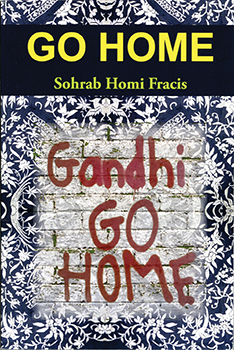
 Go Home is Sohrab Homi Fracis’ first novel following a collection of short stories Ticket to Minto: Stories of India and America which was published in 2001. The central theme of Go Home is one of displacement, of living in a state of homelessness, of finally finding oneself.
Meaningless violence seems to be the dominant motif of the novel. The first chapter begins on a crowded train which Viraf Adajania has to catch to reach the Indian Institute of Technology, Kharagpur. The coolie who is carrying his suitcase wants to move luggage already stored beneath the seat and this causes an altercation between the owner of the luggage and Viraf’s father. The rather innocuous situation gets more and more violent with repeated threats to "break open” the man’s head.
The second chapter moves from Kharagpur to Delaware, USA, where 22-year-old Viraf has moved to further his studies in civil engineering. He is thrown headlong into the American way of life. Viraf has his first taste of acid (LSD) and realizes the sexual freedom of America where "People did, in fact, live together without getting married.” But if America is the home of "deadheads,” the name given to the fans of an American rock band music which Viraf enjoys, it also is the haven for "rednecks,” politically reactionary, white working class types who make life unbearable for Viraf.
Viraf faces violence and threats in USA. America is still recovering from the Iran Hostage Crisis of 1981 and he finds himself targeted as an Iranian. He is told in colorful terms to go back home. But where is the home the Americans want him to return to, he wonders? They don’t refer to the comforts of South Bombay, his home and his family. They seem to think that home is Iran, "a place he’d never seen. Go back a thousand years. Reverse his ancestors’ voyage into the unknown...”
The central violent episode in the novel which takes place on a highway in USA seems to parallel the situation on the train between Viraf’s father and the fellow traveller in India. Viraf is driving his Ford Pinto when he is stopped by a policeman who informs him that his left taillight is not functioning and he needs to get it repaired. Some days later, when he is driving down a deserted highway in the dead of night, a large van scrapes past his car on the left. The blame is evenly divided: on the one hand, the van is driving at top speed; on the other, Viraf’s left tail light is not working. The result is a long and seemingly never ending chase which results in Viraf being insulted by being called a "Goddam dago” (disparaging term for a Latino) and a "stupid wop (disparaging term for person of Italian descent).” The driver and his companion take turns in the violence. One slams his hand into Viraf’s jaw, the other drives his fists into his stomach and raining blows on him, ends up kicking him in the groin. His eye glasses are shattered and so is his view of America, a vision which he has acquired under the influence of acid in Longwood Gardens where everything was a purple haze, "a shifty lavender world.” He thinks about the hostile visa officer at the US consulate at Warden Road who is suspicious that Viraf will stay on after his master’s degree. "The assumption, apparently, was that anyone would prefer America, a country from which he now had standing instructions to go home.”
 Viraf returns to Bombay for his summer break but the city has its own share of problems. His grandmother seems to be suffering from senility; the surrounding poverty which he was earlier inured to, now bothers him; his girlfriend had married a fellow student; the political discussions seem distant and meaningless, as he is unaware of the current situation; his father insists that he works at the family business where he feels he is under the thumb of his cousin, Percy; he gets into a scrap with the local policemen for kissing his girlfriend in a car; and, once again, faces violence when their car is caught up in a mill strikers’ procession when the side of the car is thumped by agitating workers and made it rock like a boat.
The novel ends happily for Viraf who survives the violence and the xenophobia and finds "home;” but this need not necessarily be the case for other immigrants. Fracis has dealt with the same theme in Ticket to Minto: Stories of India and America and is best captured in "Stray,” one of the short stories published in this collection. In this story, Fracis poignantly captures the plight of the immigrant in an objective yet compassionate manner. The very first sentence of the story is an indication of the author’s concerns: "Hullo! And where do you belong?” which is addressed to a cat, which stays with the protagonist, Pesi, throughout winter but scampers into the open countryside when summer arrives. This parallels Pesi’s condition as he seems to be living in a limbo and is undecided about this future.
The novel is well written but sometimes descriptions of music festivals and the car chase tend to drag and slow down the pace. Fracis seems to be more at home with the short story form. And for the author’s information, Parsis do not serve dhansak at weddings.
FIRDAUS GANDAVIA
Gandavia holds a doctorate in English literature and is a retired chartered accountant. He is a compulsive reader of fiction.