Deputy commissioner of police Jamshed Nagarwala pursued
the conspirators with “promptitude
and precision”
Dhirendra K. Jha
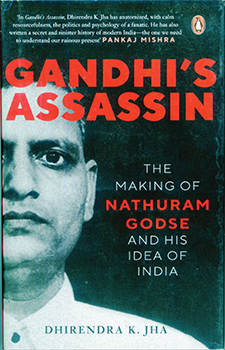
These extracts from Gandhi’s Assassin: The Making of Nathuram Godse and his Idea of India by Dhirendra K. Jha are reprinted here with permission from the publishers, Penguin Random House.
Vinayak Savarkar’s (an accused in the conspiracy to assassinate Mahatma Gandhi) attitude was no different. Like Madhav Golwalkar (Rashtriya Swayamsevak Sangh’s leader), he too grew frantic as soon as the fallout of the assassination became visible. Known for being protective of his reputation, the (Hindu) Mahasabha leader, now in his mid-60s, was equally prompt in deserting Nathuram Godse (Gandhi’s assassin) the moment mobs attacked his residence in the morning of January 31, 1948. By evening, Savarkar issued a brief statement expressing strong denunciation and condemnation of the murder. Stating that "the news of the assassination of Mahatma Gandhi was too shocking and sudden,” he appealed to the "people to stand by the Central Government of free India and maintain order in the country.”
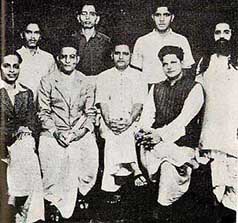
A group photo of the accused in Gandhi’s assassination
(standing from l): Shankar Kistaiya, Gopal Godse,
Madanlal Pahwa, Digambar Badge; (sitting) Narayan Apte,
Vinayak D. Savarkar, Nathuram Godse, Vishnu Karkare Photo: Wikipedia
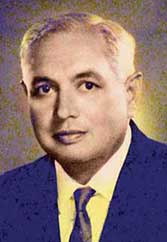
Like Golwalkar, he too made no specific reference to his protégé and ardent follower (Godse). Savarkar’s fear and vulnerability were recorded by Jamshed Dorab Nagarwala, deputy commissioner of police, Criminal Investigation Department (CID), Bombay, in his crime report filed based on a search of Savarkar Sadan on the afternoon of January 31, hours after the police quelled a mob attack. "When the police party under me arrived for searching Sawarkar’s house (sic), Mr V. D. Sawarkar met the party in the front room and asked me whether I had come to arrest him in connection with Gandhiji’s murder,” noted Nagarwala. "However, on being told that I had come to search his house in connection with Gandhiji’s (conspiracy) case, Savarkar pretended to be ill and went into the inside room to lie down. During the course of the search, from time to time, he came out to see the search being conducted by the police…”
Nagarwala, the young officer who investigated the conspiracy behind Gandhi’s murder, was known for his famed powers of perception which, it was said, had never failed him. At 32, he was one of the youngest heads of the Bombay CID Special Branch’s Sections One and Two and was responsible for gathering political intelligence and surveillance of foreigners. His unit was the glamor division of the Bombay CID. A man of sterling character and practical imagination, Nagarwala — called ‘Jimmy’ by friends — had been asked to nab the co-conspirators hours after Madanlal Pahwa (active member of the Hindu Mahasabha) blasted the guncotton slab on January 20. Accordingly, Nagarwala had set the intelligence machinery in motion, quickly identified some of Pahwa’s accomplices and then asked Morarji Desai for permission to arrest Savarkar. To his surprise, Nagarwala was denied permission to arrest Savarkar. Roadblocks of this nature considerably decelerated the progress of the investigation.
Still, when Gandhi was killed 10 days later and Nagarwala was entrusted with the investigation, his colleagues and he moved with promptitude and precision. At 5.30 a.m. on January 31, just 12 hours after the assassination, Digambar Badge (an activist of the Hindu Mahasabha) was apprehended. That very same afternoon, Savarkar’s house was searched. Though he was not arrested at the time, all the documents at his residence were seized and their scrutiny began. Now follow-up plans were devised by Nagarwala and his colleagues. Gopal Godse (part of the conspiracy to kill Gandhi) was picked up from the family’s ancestral village of Uksan on February 5 while Shankar Kistaiyya (a domestic employed by Badge) was arrested in Bombay on February 6. But Narayan Apte (one of Gandhi’s assassins) and Vishnu Karkare (Hindu Mahasabha activist) were still at large. All raids in different parts of the province failed to turn up any clue about their hideout.
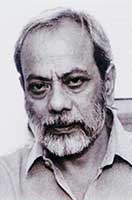
Nathuram was then brought into the picture, and the information extracted from him became critical for the investigators. "Immediately on arrival in Bombay from Delhi, i.e. at about 2.15 a.m. on February 12, the interrogation of accused Nathuram, a close associate of the absconding accused Apte and Karkare, was vigorously started as it was quite likely that he may be able to furnish information about them,” noted Nagarwala, "It was also quite possible that Nathuram Godse may be able to throw more light on his associates Apte and Karkare.” Nathuram told the investigators about Manorama. He described her as "a student of Wilson College” who was "very intimate” with Apte. Nathuram also revealed that Apte was in the habit of meeting her in hotels whenever he was in Bombay. "Without any loss of time enquiries were set afoot,” noted Nagarwala in his daily crime report. "But as February 12 was the public mourning day in connection with the immersion of Gandhi’s ashes, Wilson College was closed. Therefore, enquiries were made from the lady students in Pandita Ramabai Hostel for Women... and it was learnt that Miss Manorama Salvi was a Senior B. A. student and her father was a doctor in the Police Hospital.”
Nagarwala rushed one of his colleagues to trace Manorama and bring her to the CID office. By afternoon she was in the interrogation room, her father by her side. She had left the hostel and had been living with her parents after her father was transferred to Northcote Police Hospital, Bombay. Her interrogation that day lasted for almost four hours. After giving evidence to the police team, Manorama slumped in her chair. She was as stunned as her father. The interrogators had given her a tough time and she had not expected that. Until then, she had always felt uncomfortable speaking about her secret relationship with Apte in public. She had met Godse a few times and knew that he had killed Gandhi but she had no idea that Apte too was involved in the crime.
She was caught in a nightmare. Apte had not said a word about his involvement in this horrific murder though he had spent hours with her on February 2 at Sea Green Hotel and then again on February 5 at Arya Pathik Ashram. On both occasions she had been surprised at how much he had changed. His appearance had been similar: the lean physique, the black hair thrown back to make the face even more defined and his penetrating eyes which had lost none of their sensitive intelligence. It was his attire that had changed: from shirt and trousers, he had suddenly shifted to traditional Maharashtrian clothes. He seemed less passionate somehow — his gait less confident — and he always seemed to be on high alert, as if the hunter she had once known had now become the hunted.
They had been lovers. But now, as she answered the policemen’s questions, she found herself hating him (Apte). For a few moments she sat there, uncertain what to do. Suddenly, she told her interrogators that she was sure he would contact her again in a day or two. This was the assessment of the interrogators too. "I, therefore, deputed two police constables to receive every telephone call that came to Miss Salvi on telephone No. 305 at the Police Hospital,” noted Nagarwala. Her residence was also watched.
The wait didn’t last long. At 8.30 a.m. on February 14, the constable deputed at the Police Hospital telephone informed Nagarwala that a phone call had been received from a person who said he was speaking from Apollo Hotel and that it was for Manorama. Nagarwala immediately rushed two of his trusted lieutenants to the Hotel. For a whole day, they waited in the Hotel in plain clothes. "At 5.30 p.m., one person answering to the description of Apte walked into the Apollo Hotel. Deputy Inspector Sawant (one of the cops) accosted him and patted him saying, ‘Well, Apte, when did you come to Bombay?’ He answered, ‘Two days ago.’ This confirmed his identity with Apte and he was arrested (sic),” noted Nagarwala in his daily crime report.
Three hours later, Karkare too emerged at the entrance of the Hotel. As had become his routine since he had returned from Delhi, he sometimes took one route and at other times he took another to shake off anyone tailing him. He looked over his shoulder before getting into the Hotel lobby just to be sure that no one was following him. Before he could move another step, the policemen in plain clothes grabbed him.
Nagarwala’s questioning of Manorama had at least one virtue, from her point of view — that it took place almost entirely in private. Far more painful was the condemnation of her relatives and friends. In the emotional climate that prevailed in the aftermath of Gandhi’s murder, they felt they had no choice but to end all relations with Manorama. No one explicitly asked her to leave the family or keep her distance from the community but this could be freely interpreted from their decision to cut ties with her.
Manorama belonged to a traditional Christian family of Ahmednagar. In the post-Partition turmoil, which was filled with rampant Hindu majoritarian onslaught, Gandhi’s murder held great political interest for minorities, especially Muslims and Christians. Upholding equal rights for minorities, Gandhi had stood not just against the death dance of those days but had looked down on the idea of a theocratic state. The worst fears of the minorities came true when Gandhi was murdered.
A relative of Manorama’s, who preferred to remain anonymous, said: "To them, Manorama’s sin was not just that she was in relationship with a criminal but also that this criminal was part of the conspiracy to murder a Christ-like figure. It was because of this that the family and the community backed away from her, and she was left alone.”