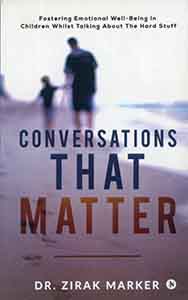
Conversations that Matter: Fostering Emotional Well-Being in Children Whilst Talking About The Hard Stuff by Dr Zirak Marker. Published in 2021 by Notion Press, No. 8, 3rd Cross Street, CIT Colony, Mylapore, Madras 600004. Pp: 150. Price: Rs 199.
Is it the parent addressing the child? One parent talking to another? Or the author educating the reader? It is only after reading several chapters from Dr Zirak Marker’s (pictured) book that one comprehends his approach to Conversations that Matter. Each of the 13 chapters into which the book is divided starts in the reassuring voice of the parent, patiently and confidently speaking to the

child. In the pages that follow Marker fortifies the caregivers with facts and figures as part of Overview, and ultimately suggests the ideal course of action under Guidelines.
The chapter on "Entitlement” sees the parent reminding the child: "Nothing comes easy in life. … And so, nothing should be taken for granted… Every comfort or privilege we have been blessed with must be cherished, respected and thanked for.” Over-involved parents end up creating overprotected children, cautions Marker, explaining the pitfalls of ‘helicopter (constantly hovering) parenting’ or ‘snow ploughing (seeking to remove every obstacle) parenting’ in the Overview section. Under Guidelines, parents are reassured, "Never fear being firm and taking disciplinary measures or taking away privileges when required.”
Parents may prefer to defer discussing sensitive topics like "Death,” "Divorce,” "Sexuality,” which form the first three chapters of his book. For Marker, a reputed child and adolescent psychiatrist and psychotherapist with over 20 years of experience in educational psychology, "it is important for parents to ‘normalize’ these conversations at home… Communicating with our children invests them with knowledge, awareness, compassion and character… It gives them all the tools they need to lead emotionally healthy and fulfilling lives.”
Through his interactions with "hundreds of children and teenagers who have opened up and shared with me aspects of their life with honesty, pain and hope during their most trying times,” Marker has learnt that "addressing the ‘hard stuff’ early-on goes a long way… The reality is children know.” But what continues to confound parents is how much do their children know and how much should they know?
Since children are confused when confronted by reality and virtual reality, ideally parents should set an example whereby their offspring can learn that "judging others on their looks is a superficial personality trait to have. It says more about the person who is judging than the person being judged…Labels are for merchandize, not for human beings,” declares the author.
While ‘cool’ kids may feel compelled to experiment with alcohol, cigarettes or drugs, do they understand that these can be destructive? Explains Marker: "Teenage brains feel pleasure and pain in ways similar to adults but the decision making areas of the brain are immature and under-developed” because of which they act more on impulse and emotions rather than after assessing situations and risk. The emphasis on building a rapport with their children rather than being reproachful is a message repeatedly reinforced to parents. Always be an approachable and "ask-able” parent, recommends the author (see "Sans stigma or shame,” Books, Parsiana, January 7-20, 2024).
"Suicide or its attempt should never be perceived or projected as a sign of weakness or courage,” states Marker citing research findings that show children who are under 18 years of age when their parents or loved ones commit suicide are three times as likely to commit suicide later in life.” Sadly, LGBTQ (lesbian, gay, bisexual, transgender, queer) youngsters are more than twice as likely to feel suicidal and over four times as likely to attempt suicide compared to heterosexual youth.
The succinct book does not need to be read in the order in which the topics are presented for each of the chapters stands independently. While those who have endorsed his work commend it as a "go-to guide,” and "a lifeline,” the author surprisingly describes it as a "playbook.” Although Marker may be able to navigate the delicate topics that could prove traumatic with relative ease, considering the effort that parents need to put in to maintain open lines of communication, perhaps this paperback could be considered a workbook!
"There is no perfect child and no perfect parent,” sums up Marker. It is the same sentence he had used in his earlier book Parenting in the Age of Anxiety: Raising the Careworn Generation that was published in 2016. Perfection may not be possible but there is room for improvement. Hence in his "Epilogue” Marker suggests the path parents should tread, starting with self-love and ending with resilience. The other intervening mechanisms are: acceptability and adaptability, introspection and reflection, responding and not reacting, realistic expectations and rationality, perception, mindfulness, empathy. Having enjoyed the responsibilities of parenthood, Marker believes, "Parenting is one of the most fulfilling journeys undertaken in the course of one’s life and yet the most daunting.” PARINAZ GANDHI