A liberal approach and a willingness to find amicable
solutions has kept the Delhi Parsis close knit
Ava Khullar
Former Delhi Parsi Anjuman (DPA) president Ava Khullar who passed away on October 5, 2025 wrote this article on her presidency at Parsiana’s request. "She had been in the respiratory ICU (intensive care unit) at Max Hospital for around 10 days,” wrote DPA trustee Dr Niloufer Shroff. "She had a stent put for the blockage in an artery. All through this time, she kept up her effort at writing the article for Parsiana. When she was not allowed even a phone in the ICU, she used pen and paper and sent it to me to get it typed. She also sent photos. The doctors were so impressed by a person in the ICU working so hard on an article that a junior doctor actually interviewed her.”
In a WhatsApp message to Parsiana on September 16, 90-year-old Ava had written: "It kept me busy, stuck in the ICU. Am still here and trying to read, to fight the boredom… We Parsi girls were brought up in the Protestant ethic of haat chalaao (never sit idle) and I find that it is now creating boredom in the lCU. If we were used to sitting idle and dreaming for some stretches, I could have managed, but l am one with many interests and am happy only when ‘doing’ things, so lying idle is a pain!... Unfortunately my hearing has gone so bad that that is another handicap. Can’t wear hearing aids in the ICU as machines hanging over each bed make such sounds, they get magnified and the hearing aid has to be turned off. Old age speaking. Wish me a quick shift out of this place.”
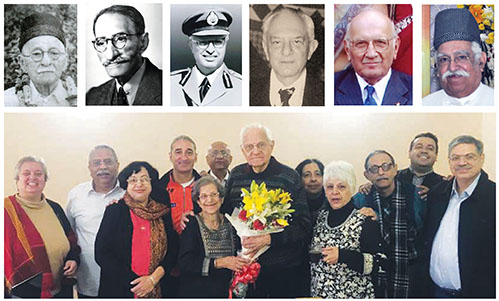
Top row, from l: Delhi Anjuman past presidents Nowroji Kapadia, Dr Sorabji Shroff,
Khusro Rustamji, Shiavax Nargolwala, Lt Gen Adi Sethna and Dadi Mistry;
bottom: Ava Khullar (center) taking over from Yezad Kapadia with
trustees and committee members
As I look back on my years as president of the Delhi Parsi Anjuman (DPA) from 2018, which I relinquished due to a spell of ill-heath, my mind goes back over half a century when I arrived in Delhi in 1965 to join a multidisciplinary social science research center, the Center for the Study of Developing Societies (CSDS). I became a permanent resident of the capital after my marriage to Gopal Khullar in 1967.
Why, you may ask, do I have to go so far back? I found it was impossible to talk about my role as president for six years without reference to the origins of the Anjuman in the mid-19th century when a few families came to settle in Delhi after the British moved the country’s capital to Delhi. These enterprising persons took steps to integrate the growing number of families into what became the Parsi community of Delhi.
Initially, they came mainly to join the railways, Delhi Power Station, Singer Sewing Machine Company, Central Bank of India, Godrej, etc. Their families were mostly located in Kashmiri Gate, Old Delhi, the elite area before Lutyens’ New Delhi was built.
Over the years, Parsis strengthened the infrastructure required for community and religious living and molded a happy, united community, introducing progressive and liberal rules for the Anjuman keeping in view the changing social and demographic conditions. Delhi was fortunate in having such selfless leaders who took the first steps to establish the physical infrastructure for a religious community.
Unlike the present times where Parsi families are spread over Old and New Delhi, Gurgaon in Haryana and Noida in Uttar Pradesh as well as the National Capital Region (NCR), the early group was close knit and interacted on a daily basis in social and religious activities, as recorded in Rukshana Shroff’s book At Home in the Capital: The Parsis of Delhi.
The earliest Parsi cemetery, dating back to the 1860s, was located on the border with Shahjahanabad. As the community grew, this became inadequate. Thanks to the efforts of Nowroji Kapadia, the first DPA president, who persuaded the government to grant an additional piece of land, a plot was allotted alongside the Christian and Jewish cemeteries in what had once been a jungle where my husband, a resident of Delhi, remembers going on hunting expeditions. Today the prestigious Taj Man Singh Hotel stands close by!
Clockwise, from above: Kaikhushru Pallonji Katrak Dar-e-Meher; Mengusi Dharamshala;
Bhiwandiwala Hall Godrej Cultural Center
Due to the persistent efforts of the next DPA president, Dr Sorabji Shroff, a noted ophthalmologist, a large piece of land adjoining the old aramgah was obtained for setting up a dharamshala, community hall and dar-e-meher. He was also responsible for the construction of the Dharamshala in the early 1950s, using donations. The plot was central and conveniently placed at the border of Old and New Delhi with two major hospitals next to it. Sorabji, a true humanitarian and philanthropist, established the Shroff Charity Eye Hospital close to the Anjuman premises in Daryaganj. For over a century this has been a boon for poor patients who are provided first-class treatment free of cost.
Khusro Rustamji, who succeeded Sorabji as DPA president, was a dynamic police officer who set up the Border Security Force. He permitted non Parsis to attend funeral ceremonies of Parsis so that members of interfaith families as well as others could be present, a convention introduced when a young Parsi defence officer passed away and friends and colleagues wished to pay their last respects.
The two stalwarts I worked closely with as a trustee for nearly 50 years (1960 to 2006) were Shiavax Nargolwala, a senior Indian Civil Services officer, and after his untimely demise in an unfortunate accident, Lt Gen Adi Sethna who was president till 2006. Both shared the same liberal ideas for the Anjuman, though outwardly very different in personality: Nargolwala, a strict task master, exacting but fair in his dealings, and Sethna the most kind and lovable person, but firm and dedicated, carrying all along with him in his military style.
Nargolwala, on assuming office, set about right away to complete the community’s religious requirements — setting up a dar-e-meher. Thanks to donations by philanthropic Parsis, the Kaikhushru Pallonji Katrak Dar-e-Meher was completed in 1961 and Ervad Daraius Bagli was appointed head priest and manager of the Dharamshala. Nargolwala’s forte was his financial acumen and he brought financial stability to the DPA.
With the infrastructure in place, Nargolwala turned his attention to the betterment of the community, bringing about pragmatic reforms in the Anjuman.
Faced with a dismal demographic picture at a meeting of the North Zone of the Federation of the Parsi Zoroastrian Anjumans of India in 1978, he immediately sought further clarification with hard data and authorized a 100% socioeconomic and demographic survey of the Parsis of Delhi, which was conducted under me at the CSDS. It revealed that 33% of Parsi families were out-married. The data showed that the Parsis marrying out were mainly from the higher educational, occupational and income levels and chose to marry into similar strata in other communities. These mixed married families were interviewed for the survey.
Many of them had come on government postings, jobs or with the armed services or for business to Delhi from places with more orthodox Parsi communities and, anticipating similar rejection from the DPA, had not so far associated with the Anjuman.
Nargolwala’s first reaction was: "We cannot afford to lose them.” He invited them to the Anjuman, changed the rules and offered non-Parsi spouses and children social and cultural membership as well as the right to vote. He encouraged them to have their children’s navjotes performed, whether they were born of Parsi fathers or Parsi mothers who had married out.
Reforms require foresight and courage, which Nargolwala had in good measure. Supported by his fellow trustees and the general body, the DPA rules were suitably amended. The new invitees were happy to join the DPA on the terms offered. This major reform proved a blessing and a boon to the Delhi Parsis who have enjoyed the benefits of a warm, united and homogenous community. Non-Parsi members have joined various Anjuman committees which look after its different functions. Their quiet participation has proved a real asset, making the Delhi Parsis a confident, happy group.
Further reforms were introduced and the Dharamshala, which was running partially empty, was opened up to non-Parsi guests. It is now running at near full occupancy.
In the case of one deceased member who had requested cremation, Nargolwala even volunteered to perform the funerary prayers himself if the priest was not willing. However, the matter was amicably resolved and subsequently several members have opted for cremation where the last prayers are said at the aramgah before the body is taken for cremation.
Sethna, who succeeded Nargolwala as DPA president held similar liberal beliefs. His forte was to organize mega events with military precision. He successfully conducted a Parsi festival at the India International Centre in Delhi in the 1980s which displayed the faith, culture, customs, food and other aspects of the community to the general public of Delhi. This was a first exposure for fellow Indians, as many were not familiar with the Parsis of India. This was followed by the celebration of the 300th anniversary of Zoroastrian Culture at the National Centre for the Performing Arts in Bombay.
Realizing the need to join and interact with interfaith groups, during Sethna’s tenure the DPA started participating in inter-community events, a practice that continues to bring harmony among various faiths.
After about 26 years in office Sethna passed away and Dadi Mistry took over as president. He worked tirelessly to raise funds to increase the Dharamshala’s accommodation to 42 rooms, a step many thought foolish at the time as there was low occupancy. But with the opening up of the Dharamshala to non Parsis, his foresight paid rich dividends, more so during the Covid pandemic. The next president, Yezad Kapadia, strove to bring discipline to the functioning of the DPA administration. A professional manager now runs the Dharamshala which is showing excellent results resulting in the DPA’s finances being in a healthy state.
When I took over as president, on Yezad stepping down for personal reasons, I realized the wonderful legacy I was inheriting from my predecessors who had laid a strong foundation both with regard to physical infrastructure as well as a reformist and pragmatic ideology.
It was now for us to strengthen and continue this legacy.
I do not imply that in its 100 years of existence, things have been conflict free, that there have been no differences within the community. It is how these differences are resolved that is the crux of the matter.
For instance, when Nargolwala spoke of his plans to rebuild the community hall, which would have opened the DPA complex to outsiders, the general body objected at the annual general meeting (AGM). The president immediately bowed down and the project was scrapped. Great humility and fairness from a leader so tall and fair!
More recently, an ill thought out change in DPA rules created a stir of opposition and the item was immediately removed even before the AGM. However, members still insisted on a discussion on the matter at the AGM. This was allowed and all views were aired openly and fairly.
During Sethna’s tenure the displeasure of a member over some issues led to disparaging and insulting words addressed to the president. While community elders would have liked to rebuke the member, the genial president himself settled the issue amicably.
It is this culture of not turning differences into disputes or resorting to fisticuffs that has kept peace and unity within the Anjuman.
On taking over as president, I felt that all that had been achieved needed to be recorded for posterity, not only as an example of how an organization can be built steadily over the years on a firm foundation, but also to ensure that we are not forgotten by history.
At my first AGM as president in 2018 we decided to start work on writing a history of the Parsis of Delhi. And when Rukshana Shroff showed her willingness to undertake this study, we were delighted. After a career teaching in the English department of the Lady Shri Ram College and the close association her family had with the Anjuman over generations — she is Sethna’s daughter and married to Sorabji’s grandson — made her the right person. After diligent research for five or six years her book was released by Lord Karan Bilimoria in April 2025.
It was simultaneously proposed to bring out short histories of Parsi communities residing in towns and cities of North India. Some of us started this exercise, but as the written records were very meager, we had to identify and interview old residents of places like Allahabad, Lucknow (Hatras/Bareilly) and other cities, as they were repositories of the histories and stories of those places. Unfortunately because of Covid the will and energy to visit these elders became difficult, leaving that study in limbo.
Our main task was to upgrade the infrastructure by repairing and renovating the aging buildings. What I found most heartening was that the trustees and members not only worked diligently, but made handsome voluntary financial contributions towards the costs or got donations.
We have another great asset in dealing with community issues, especially in the legal field as renowned Parsi lawyers like the late Fali Nariman, his illustrious son, retired Supreme Court Justice Rohinton Nariman and others have readily helped, facilitated by trustee Dr Sanaya Nariman. When a public interest litigation was brought against the Delhi Anjuman in 2000, along with some other religious minorities, we were capably guided by these legal luminaries and supported by Karanjawala and Sons, all of whom helped pro bono.
From l: Arijay and Zayan Chaudhry; Ava and Gopal Khullar,
Yasna and Keerti Chaudhry; inset: Sonali Chaudhry
During Covid, the enterprising spirit of the trustees and staff kept the Anjuman running normally while most hotel rooms and restaurants remained unoccupied. We are fortunate to have two major hospitals and a medical college next to the DPA complex — the Maulana Azad Medical College and Hospital and the G. B. Pant Hospital. Our Dharamshala rooms were fully occupied by medical students and doctors who were fighting the Covid war, and consequently our coffers remained full enabling payments and financial activities to continue as normal.
The Shapoorji Pallonji Group being involved with government construction projects at Pragati Maidan and the new Lok Sabha, Shapoor Mistry would visit our fire temple. He made a welcome offer to renovate the agiary at their expense as was done earlier for the Iranshah in Udvada. This meticulous renovation work is going on with the design and aesthetic guidance of Ashdeen Lilaowala and Kavas Kapadia. A new stained glass panel is also being installed.
When our well-known member Dr Piloo Jungalwala passed away, her gravestone at the aramgah needed to be set up and members Jimmy and Shelley Subawalla promptly offered to have this done. We were surprised to find that the work had already been completed by Jungalwala’s long-time cook and help, Ramesh, whose children she had educated at her cost. And while we were trying to choose suitable words for her epitaph, we saw the simple words from the heart of a grateful family.
We have started the practice of keeping members who reside in the NCR as well as outstation members informed through a half-yearly president’s letter of all work and activities at the DPA so that they feel part of our Anjuman, wherever they be located.
With such a board of trustees and supporting members what can the president do but sit back, appreciate, and become a cheer leader?
My only wish for the future, as we complete the centenary of our Anjuman this year, is that the pragmatic and forward looking approach followed since the 1970s remains unchanged and that the harmony and peace between all members, workers and trustees which this approach has made possible become forever the hallmark of the DPA.