The first visit of the all Parsi cricket team to England proved disastrous
Prashant Kidambi
Edited extracts from Cricket Country: The Untold History of the First All India Team by Prashant Kidambi reprinted with permission of the publisher Penguin Random House India.
The idea for a Parsi Gymkhana was first aired at a meeting held in February 1885 at the Ripon Club which was attended by prominent patrons of Parsi sport. Backed by the leading lights of the Parsi community — men like Sir Jamsetjee Jejeebhoy, Jamsetji N. Tata and his elder son Dorab, Dinshaw Petit, Pherozeshah Mehta, Kharshedji N. Seervai and S. S. Bengalee — the newly constituted Gymkhana succeeded in obtaining a grant of land from the government on the Kennedy Sea Face which lay to the northwest of the contested Esplanade.
Even as plans for the new Parsi Gymkhana began to take shape, an English businessman named Mr Poole arrived in Bombay in August 1885 to explore the possibility of the Parsee Victoria Theatrical Company undertaking a tour of Britain. He was presumably drawn to this venture by the high reputation that Parsi theater had established for itself in the late 19th century. Parsi threatrical companies such as the Victoria were known for their sumptuous production values and spectacular presentation of Persian, Urdu and Gujarati dramatic tales and texts. During his stay in Bombay, the English visitor attended a cricket match between the Bombay Gymkhana and the Parsis. This fixture had resumed the previous year when the struggle between the native cricketers and the European polo players was at its most intense. After watching the Parsis battle the Bombay Gymkhana on the cricket field, Poole asked Shapoorjee Sorabjee if he could put together a team to tour England the following year. Sorabjee agreed and drew up a draft proposal that he showed to two or three men who were thought fit to be included in the proposed team. But these players considered the terms most inadequate since they believed that there was almost the certainty of making a goodly little fortune for each member of the team, after deducting expenses.Poole, too, disappeared after one or two communications in regard to the proposed cricket adventure. However, the elusive Englishman’s expression of interest in a Parsi cricket tour of Britain stirred up again the hitherto dormant ardor of some of those who were prepared in 1877 to undertake such a venture…
The Parsi cricketers sailed from Bombay on April 23, 1886 aboard the Peninsular and Oriental (P&O) steamer Clyde. They were accompanied by (their coach Robert) Henderson who was given an exceptional mark of Parsi respect at the time of his departure. "When he was leaving,” reported a British newspaper, "they decorated him with wreaths of flowers, with a large bouquet in his hand, and provided by the forethought of his hosts with a painted coconut to throw into the sea, to ensure calm in the event of it being rough, he was driven through the streets of Bombay to the docks.”
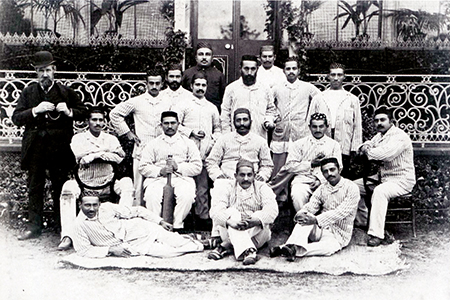
Members of the first Parsi cricket team, photographed at Sheffield Park,
venue of the opening match of their 1886 tour of Britain
An illustration in The Penny Illustrated Paper (June 5, 1886) of the Parsi cricketers
practising at Lord’s during their first tour of Britain
The first Parsi cricket team landed at Plymouth on May 18, 1886. They were not the only colonial cricketers in Britain that summer. A team of Australians was shortly due to commence a cricket tour of the country. Nor was the Parsi cricket team the sole Indian contingent in town. A few months earlier, an exhibition called "India in London” had opened in Langham Place in Regent Street. Among the 42 Indian performers on display in this Oriental variety show were Parsi gymnasts and wrestlers, Hindu musicians and snake charmers, Muslim jugglers and a troupe representing the Parsee Victoria Theatrical Company of Bombay. The Parsi cricketers’ visit also coincided with the highly-publicized "Indian and Colonial Exhibition,” which was inaugurated in London by Queen Victoria a few weeks before they disembarked at Plymouth.
Like the other artists and artisans from the subcontinent, the Parsi cricketers too were viewed by many in Britain as Oriental curiosities. The tourists kicked off their cricketing campaign with a match against a team put together by the Earl of Sheffield. One spectator, who braved the incessant downpour that prevented play on the first day, put down his impressions of the Indian tourists: "The Parsis showed at luncheon, and I am bound to say did not win the enthusiastic admiration of certain Sussex veterans of the game who ran the rule over them. They are handsome young men of the Eastern type, but with more of the cut of students than athletes. Elegance of form — I might almost say effeminacy — rather than strength is their characteristic. The caps they wear are what we call smoking caps. This kind of thatch does not by any means contribute to appearance – as cricketers. One of those caps, by the way, attracted a good deal of attention. It was richly embroidered, and exhibited as part of that form or ornament, a repetition of the word ‘God (The Sporting Life, May 29, 1886).’”
Another Parsi cricketer at lunch that day reportedly drank nothing but champagne in honor of his first match at the charming and hospitable seat of the cricketing Earl. The contest eventually began the following day but was left unfinished because the visitors were anxious to witness the race for the Derby at Epsom Downs.
The opening fixture set the tone for the rest of the Parsi cricketers’ tour. Many of their matches were affected by rain. When they were able to play, the visitors struggled to make an impression on their opponents. Of the 28 matches they played, the Parsis lost half by an innings. One of these resounding defeats came very early in the tour, against a strong team representing the Marylebone Cricket Club (MCC), which included the great W. C. Grace. The sole Parsi victory came against a village team fielded by Sir Thomas Brassey, a prominent railway entrepreneur, at Catsfield in east Sussex.
Some observers were inclined to excuse the Parsi performance on the field, citing in their defence the visitors’ unfamiliarity with the conditions. But others were less generous. "Since the days when the clown cricketers used to perform, no such farce has been seen as the playing of the Parsee Eleven, who for some mysterious reason have visited this country,” scoffed the Cheltenham Chronicle. Enumerating the deficiencies in their play, another newspaper commented: "They cannot bat nor bowl, neither can they field. Even on their own wickets they would not, so far as we could judge, be a match for many an English village club.” Yet another went a step further and declared that, "to call these men cricketers is a misnomer. They are a part of rich gentlemen from Bombay, who have come over here for their own amusement, and if they go on as they are doing now they will afford us some amusement also before their return.”
As the tour progressed the Parsi cricketers began to feel the strain of the relentless schedule, constant bad weather, and endless defeats. "It will be a relief to them,” one English correspondent reported in early August, "when a month hence, they run through the program of their present cricketing tour.” In a conversation with this reporter, the Parsi captain Dhunjisha Patel lamented "the accidents that had happened to his team.” They had been 16 strong at the outset, he informed the journalist, but a series of injuries had reduced them to 10 efficients. He was also "very sore on the hard work his team had to do (sic).” "They came over from India to enjoy themselves, and intended to play cricket only half their time, but their agent in London had compiled a program with not a single break in it,” Patel confessed to his interlocutor. No doubt the captain’s own workload in managing the team had increased because their manager, Ardeshir Patel, had been forced to return to Bombay mid-way through the tour. However, mindful of the fact that his remarks might be misconstrued as unmanly, Dhunjisha declared: "We no like the Americans. They come over, get beat, and run away; we get beat, no run away; no, we play out all our matches.” And "slapping his breast, he said: ‘British pluck.’”