After almost two centuries, the Bombay Parsi
Punchayet run Godavara Agiary struggles to survive
Farrokh Jijina
Attempting to secure funds to repair the dilapidated 192-year-old Godavara (Gamadia) Agiary, the Bombay Parsi Punchayet (BPP) has managed to raise Rs 23,59,939 till September 9, 2018. Chairman of the apex body Yazdi Desai is expected to contribute about Rs 10 lakhs personally, said BPP trustee Kersi Randeria in a telephone conversation with Parsiana on September 10. The total required is Rs 40 lakhs. An appeal for funds in the Parsi Press a few months ago stated that the 1826-established fire temple is in urgent need of repairs to its building on Cawasji Patel Street in Bombay’s Fort area. Renovations to be carried out include external repairs, replacement of the roof, new bathrooms and toilets, major plumbing and electrical re-hauling, painting, and floor and furniture polishing, said the notice seeking donations. The advertisement had said that Rs 10,51,436 was already collected.
Godavara is one of the two BPP-run fire temples, the other being the Shapoorji Fakirji Jokhi Agiary in Godrej Baug. The BPP also manages the dadgah at Doongerwadi. Approximately eight worshippers visit the Godavara Agiary daily, panthaky Ervad Firdaus Pavri told Parsiana. About eight clients get death prayers for their departed loved ones performed here monthly and approximately 14 their annual khushali na jashans. Thirty-year-old Pavri who resides in Dadar has been the panthaky since September 2010. He is the only mobed to serve here. One kamdar (worker) is attached to the firetemple.
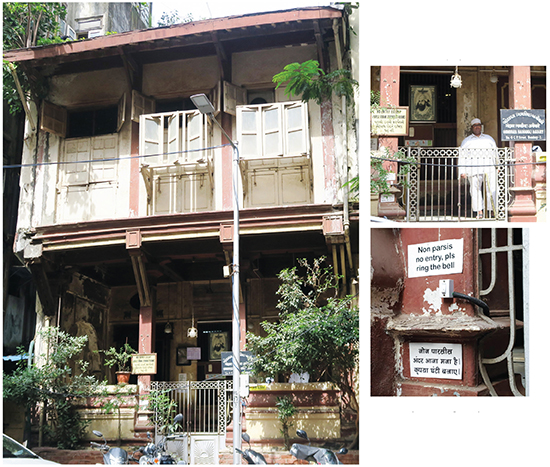
Clockwise from above left: facade of Godavara Agiary;
Ervad Firdaus Pavri on the verandah (Photos: Farrokh Jijina);
sign at entrance (Photo: Er Firdaus Pavri)
Muktad, 2018 Photo: Er Firdaus Pavri
When the Parsiana representative visited the Agiary during muktad, Pavri said that no religious ceremonies are performed on the first floor. "Only my personal belongings are there,” he said. This representative remembers that till the early 1980s, muktad prayers were held on the first floor, with row upon row of gleaming vases with fragrant pink roses, tube roses and lilies. This year there were only 10 muktad tables placed in the downstairs hall, of which one was for a family member of Pavri.
In early June this year, people objected to a non-Parsi caretaker sitting on the open verandah of the Agiary while her elderly Parsi employer went inside to pray (see "Of greater import,” Editorial Viewpoint, Parsiana, June 21, 2018). The verandah is the only access point to the fire temple. About four steps lead from the street level to the verandah on which is fixed a large window that looks into the somewhat unkempt hall; the hall is accessed via two doors on either side of the window. The sanctum sanctorum is behind the hall, screened off by a wall.
Randeria revealed that the BPP trustees had summoned Pavri to their 209, Dr Dadabhai Naoroji (D. N.) Road office after the event and explained that the WhatsApp messages condemning the trustees (and Pavri) for the presence of the helper on the verandah had gone viral. He narrated that the panthaky’s view point was that anyway electricity meter readers, courier staff, flower vendors and other non-Parsi suppliers step onto the verandah to deliver their services, and have been doing so for decades. Both parties agreed that non-Parsi vendors would now summon the Agiary worker via a door bell to take deliveries. Electricity meter readers may still have to step on to the verandah.
But, according to some reports, the meeting, for which Pavri was made to wait over two hours past the appointed time with applicants for homes, was a stormy one. Desai allegedly threatened Pavri with "taking off his pugree [taari pugree ootaaras (defrocking)],” to which the priest purportedly replied that the BPP could fire him but not make him to forfeit his priesthood.
Armaity Paghdiwalla, who lives opposite the fire temple, has been a worshipper at Godavara for the last 30 years. "I have complete faith in the holy fire,” she told Parsiana on August 24. Surely the premises can be better maintained, she pointed out, especially the area near the well (where the roof and supporting wall are decaying)… I have written to the Punchayet twice… two monsoons have come and gone…The leakage gets so bad that the stored kathi gets wet.” Commending the panthaky, she said "Firdaus is doing his best.”
Charni Road resident Zubin Kamdin has been going to Godavara from 2008 onwards to get prayers performed for a now deceased client of the fire temple. He is the executor of the deceased’s estate. "I hope the repairs at the rear portions of the Agiary are taken up expeditiously… Something should be done to get more behdins.” Prayers for Kamdin’s own family members are performed in the nearby Pirojbai Dadabhoy Maneckji Vachha Agiary which costs less. "I have reduced the amount of prayers I have had performed at Godavara for the family members of the person whose estate I am the executor of,” he said.
The JJ connection
Based on her discussion with Dastur (Dr) Firoze Kotwal, researcher Firoza Punthakey Mistree said that the first group of priests who came to Bombay to serve the needs of the community were the Bhagaria priests of Navsari, many of whom were escaping poverty in that south Gujarat town, and had nothing to lose by coming to Bombay around the late 1700s.
They were followed by priests from the various villages of Gujarat, including the Godavara priests. The region between the rivers Tapi and Narmada is generally known as the godaru, and the priests living in it are called Godavara (see "Origins of the Parsi priesthood,” Parsiana, March 2002). Although agriculture was the mainstay in the area tended to by the Godavaras, the land was not well irrigated. Money was hard to come by and priests were largely paid in kind.
A barely readable plaque on the verandah of the fire temple details its history. Author Marzban Giara notes in his Global Directory of Zoroastrian Fire Temples that the dar-e-meher was consecrated at a cost of Rs 10,064 from public contributions of Rs 6,933 and balance amount from Punchayet funds. Punthakey Mistree revealed, in response to Parsiana’s request for details of the Agiary’s history, that by 1860 the building seemed to have become dilapidated and the mobeds of the Agiary appealed for funds. Sir Jamsetji Jejeebhoy (JJ), in his will, had bequeathed money for a newly expanded building to be built. His three sons gave money from JJ’s estate for the fire temple to be rebuilt.
"The apocryphal story narrated to me by the priests of the Godavara Agiary, including Pavri, was that this building was the first baronet’s residence, presumably when he moved out of Yatha Ahu Vairyo Street (now Abdul Rehman Street, near Crawford Market),” she said.
Sometime in the 19th century Godavara priests came to Bombay in search of work. They wanted an agiary, specifically to serve the needs of eminent Parsis of the erstwhile Godavara region. "They appealed to Sir JJ, who was a sort of bank of last resort for the disenfranchised... According to oral sources, he gave them his house (where the present Agiary is located) as it (was) vacant and he had shifted his residence to his Fort House (on the current Dr Dadabhai Naoroji Road, a stone’s throw away from the BPP office),” said Punthakey Mistree.
"Architecturally speaking it seems to me like it was a personal residence and the kitchen was converted into an urwis gah (where higher liturgical ceremonies are performed) and the sanctum was accommodated in the living-cum-dining room. If you go upstairs, there is a large dormitory-sized bedroom where several members of the family all slept together in one room as was the custom at the time. The beam work and structure suggests it is an early 19th century house,” surmised Punthakey Mistree.
The Agiary featured in the famous 1908 Bombay High Court case of Sir Dinsha Manockji Petit and Others vs Sir Jamsetji Jeejeebhoy and others (commonly referred to as "The Parsi Punchayet Case”), arguably one of the most important legal cases pertaining to the Zoroastrian community in India. Ratan D. Tata’s French wife Suzanne Briere sought entrance to the fire temple since she had her navjote performed. The Court denied her admittance as she was not a Parsi.