Parsis were among the pioneers of magic in India
John Zubrzycki
It is June 1946 and the Society of Indian Magicians is holding its monthly meeting at Nasik Chambers on Frere Road in the Fort district of Bombay. Among those present is Minocher Nowroji, better known by his stage name Mino the Mystic. Forty-five years after his first show, Nowroji is being bestowed a silver medal inscribed with the title "Grand Patriarch of Indian magic.”
Nowroji, like many of the prestidigitators at that meeting was a Parsi and his award was also a reflection of the community’s contribution to the making of modern Indian magic. Before the appearance of the giants of Indian magic such as P. C. Sorcar, Gogia Pasha and K. Lal, many of India’s best magicians were Parsis. The roll is a long one and includes Manek Shah, Rustomji Dittia, Ardeshir Medivala, Homi Mehta, Homi Tavadia, Jal Engineer, and Fram Nasikvala who as president of the Society of Indian Magicians bestowed the title on Nowroji.
Mino the Mystic (standing) in a J. B. Wadia movie
Traditionally India’s jadoowallahs or street magicians came mainly from marginalized castes and tribes and were both Hindus and Muslims. When Western-educated Indians began taking up magic as a hobby and then as a profession in the 1880s they came from all of India’s religious and ethnic communities including Jews, Christians, Hindus, Jains, Muslims and Parsis. One of India’s best known magicians of the 1930s and 40s was Eddie Joseph, an Anglo-Indian, and a close friend of Nowroji’s.
References to Parsi magicians in India go back to at least the 16th century when the first Dastur Meherji Rana appeared before the Mughal emperor Akbar. According to legend, Rana outwitted another necromancer who used a brass thali or tray suspended in the air to fool the Mughal into believing that there were two suns. Meherji Rana caused the false sun to disappear using verses from the Avesta. He was also known as an exorcist of evil spirits.
Parsis were among the first Indians to take up Western-style magic in the 1870s, learning the craft from books such as Prof Hoffman’s (Angelo Lewis) Modern Magic, one of the most influential practical and theoretical textbooks on the magician’s art. Magic societies were established in India almost a quarter of a century before they appeared in the West, providing a place where new tricks could be rehearsed, resources such as books and props could be shared and new ideas in magical practice could be discussed.
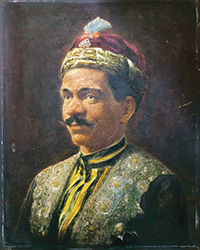
Manek Shah: entertainer extraordinary
(Above l): Rustomji Dittia featured in the January 1935 volume of The Linking Ring
published by the International Brotherhood of Magicians; (r) Mino the Mystic featured
in the February 1908 volume of The Wizard
Nowroji was not the first Parsi to take up magic, but he was among the earliest to make a successful career as a conjurer. Born in Bombay in 1881, he was "bitten by the magic bug” at the age of 10 when he found a collection of tricks in his dead uncle’s effects. He took up conjuring as a hobby and started entertaining his classmates during recess hours. To reward his good marks in English his teachers gave him a copy of The Boy’s Own Conjuring Book.
The turning point in Nowroji’s life came when he saw a poster of Charles Bertram who was touring India in 1899. Pooling his savings he attended one of his shows in Bombay and later introduced himself to the Englishman who invited him back to his hotel. Nowroji visited Bertram every day during the magician’s stay in the city learning various tricks and presentation techniques.
Nowroji’s next opportunity to learn from the masters came in 1905 when Howard Thurston toured India with his Aga Levitation routine. He travelled to Calcutta to see the American who was considered the greatest magician of his day. He watched closely as Thurston executed his levitation trick, passing a hoop around his female assistant as she floated in the air. Successive magicians used improvements in technology to refine the deception to the point where a person appeared to soar effortlessly around the stage. After the performance, Nowroji met Thurston and suggested how the artifice could be improved. The two men became close friends and Thurston allowed him to adapt some of his other tricks for his shows.
By the time he was touring internationally, Nowroji’s repertoire consisted of Japanese, Chinese and Egyptian acts, a handcuff and packing case mystery, a full black art act and sleights of hand that he executed dressed as a Pharaoh. "Try and be wide away from the old trodden path. Originality is the KEY of success,” he would later write. "Do not copy your friends’ programs, but try to do something else.”
In the late 1910s Nowroji married a Burmese woman, Ma Yee Cooper, who became his assistant and was almost nightly sliced in two by a giant guillotine, one of his signature acts. In 1933, he became one of the founding members of the Society of Indian Magicians and later its president.
Unlike Nowroji, Manek Shah did not set out to become a magician. Born in Bombay in 1875, he studied music. He went to America in 1904 and joined one of San Francisco’s leading orchestras as a violinist. But his music career was cut short when the San Francisco earthquake of 1905 destroyed much of the city. Most of his possessions were lost in the quake including his precious Stradivarius violin.
From music Shah moved to stage magic, performing in theaters in America before moving to England. Billing himself as the "Genuine East Indian Necromancer direct from Bombay,” he presented the Indian Rope Trick "as performed at Delhi during the Durbar,” alongside the Human Water Fountain Trick, The Gurkha’s Gong and other "wonderful feats.” In the 1920s he reinvented himself as Prince Yuga, "Mystical Entertainer Extraordinary” and was assisted by his daughter Retta Shah.
Another well-known Parsi magician of the early 20th century was Rustomji Dittia. As an eight-year-old he saw a troupe of jugglers performing in Bombay who insisted he join them at a burial place in the middle of night to learn their secrets. Four years later in 1912 he met the touring Australian magician Doc Rowe who presented him with a copy of Alexander Herrmann’s Book of Magic and mentored him to improve his skills.
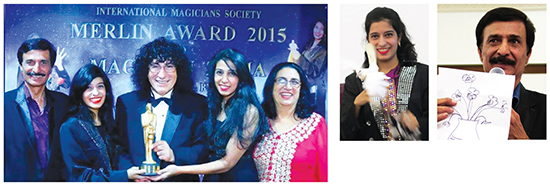
Mhelly, Zenia, Pearl and Kaizad Bhumgara (1st, 2nd, 4th & 5th from l); above: Zenia and Mhelly display their craft
One of his closest friends was Les Cole, another Australian wonder-worker whose stage name was Levante. On Christmas day in 1932, Levante did a Houdini-style leap into the sea at Apollo Bunder, manacled in chains and handcuffs. Dittia organized the jump, a publicity stunt for Levante’s Boxing Day show at the Cowasji Jehangir Hall. When not performing, Dittia worked at Prince and Company, manufacturers of high class aerated waters at Belvedere Road in Mazgaon.
The coming of World War II saw many magicians offer their services to entertain foreign troops on their way to the frontlines on the India-Burma border. As president of the Society of Indian Magicians during much of the war, Nasikvala used his position to place Indian magicians with the Entertainments National Service Association. He also raised money for various war-related charities.
Another Parsi magician who toured the frontlines during the war was Jehangir ‘Jean’ Bhownagary. Born on March 5, 1921 in Major Porter’s Nursing Home in Bombay to a French mother and a Parsi father, Bhownagary took up magic after seeing one of Levante’s shows. In 1932 while performing a puppet show behind the sea-wall at Cuffe Parade, he was asked by a boy named Deryck Jefferies if he could help him backstage. Bhownagary changed his stage name to Fu Ling Yoo and Jefferies became his stage manager and chief prop builder.
Bhownagary’s career included stints at United Nations Educational, Scientific and Cultural Organization (UNESCO) in Paris, as the head of India’s Film Division and as chief advisor (films), in the ministry of information and broadcasting. In 1968 he became only the second magician (the other was Sorcar) to be conferred the title of Padma Shri. He was also a member of the Inner Magic Circle, the most prestigious society of prestidigitators in the world.
Magic together with other art forms flourished in India’s post-Independence euphoria. Parsis played a disproportionately prominent role in magic relative to the size of the community. Rutton Bharucha, Mino Khadivala and Bahadur Ghadially joined greats such as Pasha and Hamid Sayani on the magic circuit.
Today there are only a handful of Parsi magicians in India. Foremost among them are Mhelly Bhumgara and his daughters Pearl and Zenia. Mhelly’s passion for magic started as a hobby in school in 1975. In 2000 he decided to leave his high-level corporate post to pursue his passion full-time. "I never looked back after that! Ever since, every day has been an exciting day,” Mhelly says.
Pearl and Zenia took to magic at the ages of five and four respectively and now have a string of national and international awards to their credit. Pearl is the only Indian to ever win the junior stage contest of The Society of American Magicians. Zenia received the Merlin Award from International Magicians Society, New York in 2015. "Magic is an integral passion of my whole family and our lives revolve around this fascinating art,” adds Mhelly. "It has brought us fame, travel, friendship and an exciting way of life.”
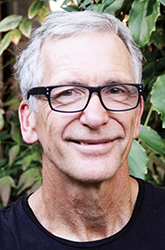
John Zubrzycki is a Sydney-based author. His latest book is Jadoowallahs, Jugglers and Jinns: A Magical History of India published by Picador and priced at Rs 699.