The saga of the Vakil family narrates
the economic ups and downs they endured
Mitra Sharafi
"‘Life writing’ includes memoirs, autobiographies, letters, diaries and family histories that recount the story of the author’s life or that of his or her family,” notes Mitra Sharafi, associate professor of law at the University of Wisconsin Law School in Madison.
"In the Parsi context, life writing encompasses a rich collection of texts by men and women in British India and beyond... The authors may not frame their texts as Parsi community history, but their works also contribute to the preservation of Zoroastrian heritage,” states the legal scholar.
Parsiana carries extracts from the article "Parsi Life Writing: Memoirs and Family Histories of Modern Zoroastrians” in Holy Wealth: Accounting for This World and The Next in Religious Belief and Practice. Festschrift for John R. Hinnells (Wiesbaden: Harrassowitz, 2017), 251-77 with permission from the author, the editors Almut Hintze and Alan Williams and the publisher.
In our August 7, 2017 issue we carried "The Burmese legacy” pertaining to Burjor Mistry and P. D. Patel. In this issue we carry extracts concerning the Vakil family.
Jehangir Vakil’s A Brief History of the Vakil Family of Ahmedabad span0s six generations, from the author’s great-grandfather Sardar Pestonji Framji Vakil (1796-1870) until the author’s own life. His family history dwells on the loss and disintegration of structures from the past — physical, corporate and philanthropic — through waste and mismanagement by family and government.
Jehangir’s family history consists of several narratives nested within each other like Russian wooden dolls. Part I (approximately 90 pages) is an overview of the six generations of Vakils. Part II (roughly 47 pages) focuses on the three most colorful figures of history: the author’s grandfather, the kindly, resourceful and illustrious Khan Bahadur Sardar Sir Rustom Vakil (1878-1933); his wife Tehmina, also known as "Lady V” or "Granny” (1886-1966), a notorious figure; and their son, the dashing and adventurous Major Sardar Jehangir Vakil (1907-1952) who was the author’s uncle. Part III (approximately 42 pages) is a corporate history of the family business, Pioneer Magnesia Works (PMW). Created by Sir Rustom in partnership with Behramji Lalkaka and Parajanyarai Vaikunthrai Mehd, around the time of World War I, the company harvests magnesium salts in the Little Rann of Kutch, the salt-water marsh and mud desert in India’s far west. Today, the author, Jehangir Vakil, is managing director of PMW.
A Brief History is replete with stories of adventure and glory. On his maternal side, the author’s Kothawala ancestors were soldiers of fortune in the Gulf of Cambay region. On his father’s side, the Vakils were translators and intermediaries working with the Portuguese and British. From the 1810s, Pestonji ran a ‘Europe shop’ for a British regiment in Camp Kaira (now also known as Kheda, outside of Ahmedabad), and then followed to Jalalabad Fort (1837-40) during the first Afghan War. Sir Rustom was part of the Tibet Frontier Commission in 1903-1904, an expedition that reflected Britain’s involvement in the Great Game. A photo (now lost) showed Sir Rustom and others in their full Masonic regalia during this trip. (Like several generations before and after him, Sir Rustom was a Freemason.) He later joined the war effort in World War I. He tried to organize a Parsi battalion for Bombay, but "got into trouble with his own squabbling community.” (Here was a rare reference in Vakil’s account to politics within the Parsi community.)
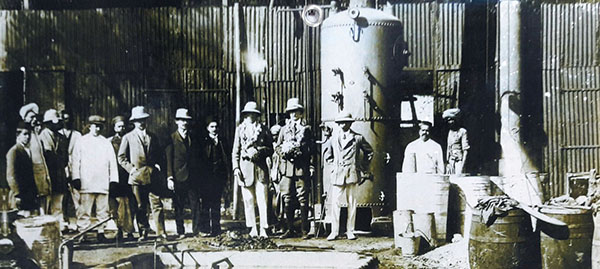
Khan Bahadur Sardar Sir Rustom Jehangir Vakil (standing in front of the boiler) with other dignitaries
at the Jehangir Vakil Mills outside Delhi Darwaja, Ahmedabad, January 13, 1914
"The Desert Rats" in North Africa during World War II, September 1942.
Capt Sardar Jehangir Vakil is third from the front, driving the center jeep
Photo courtesy: Jehangir Vakil
Sir Rustom’s son Jehangir was part of the "Long Range Desert Group” in the North African theater during World War II. This Group, also known as "The Desert Rats,” was a reconnaissance force based behind enemy lines in the Sahara Desert "like a tribe of Bedouin nomads in British uniforms.” Uncle Jehangir was also part of the Allied assault on Sicily. Operation Husky was the biggest amphibious operation in history, exceeding by two divisions what would be used in Normandy a year later. Jehangir returned from World War II alive, but his vision was permanently damaged and his nerves shattered by the blinding flashes of "Long Tom” howitzers and the "shimmering glare” and abrasive sands of the Sahara, where he had spent one-and-a-half years. He died seven years after the end of the War, at the age of 45, leaving behind a wife and young children.
The corporate history of the family business, PMW, was also full of drama. Sir Rustom created PMW in a rush, foreseeing in 1910 after a trip to the Balkans that rising tensions between Britain and Germany would lead to war. Germany was the world leader in chemical research and industry in the early 20th century, and enjoyed a monopoly on the production of magnesium chloride. This form of magnesium salts was used in the finishing process for cotton cloth and viscose silk. It was also employed in fixing certain dyes, as well as for fireproofing and strengthening steamer decks. Sir Rustom met with western India’s mill owners to warn them about their dependence on German supplies in the early 1910s. He implored them to start stockpiling the chemical while they could. By 1915, he had created PMW. He had realized that the Little Rann of Kutch was one of the few places in the world where magnesium salts could be naturally harvested. The company prospered, and presumably helped western India’s textile industry survive World War I.
From 1934 to 1936, tough new competition emerged from the British-mandate-ruled Palestine, where natural magnesium salts could be extracted from the Dead Sea. German production was also revived and became a source of competition in the 1930s. After World War II, PMW faced a number of difficult periods, including a post-war slump, the first decade of Indian independence, and from the 1960s, the production of new synthetic fabrics that did not require magnesium salts.
In the 1980s and 90s, two natural disasters struck. A fire destroyed PMW’s main office and seven decades’ worth of company records in 1986. In 1998, a cyclone devastated production and storage areas that were only nominally insured. The author became head of PMW in 1989. His efforts to revive the struggling company succeeded, amidst lawsuits and labor disputes triggered by automation and despite a few of his own "big blunders” along the way. He continues to be managing director of PMW, and now also operates a heritage resort in former colonial inspection bungalows near the PMW salt works in the Little Rann of Kutch.
Despite the relatively happy ending for PMW and the narrator, regret remains a dominant theme in this family history. He laments the loss and waste of collective assets through neglect, mismanagement, selfishness and misplaced values. The family history aims to restore to former glory an illustrious series of individuals and their achievements, and to shame those responsible for the subsequent disintegration of these legacies. The Vakil family history shows flashes of outrage over avoidable loss and waste. The author focuses on the loss of material assets during peacetime, rather than on the extreme physical suffering and economic desperation caused by war.
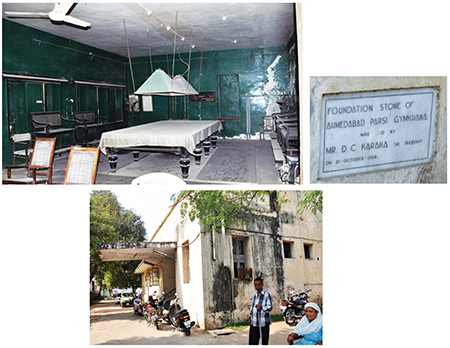
Clockwise from top: Hall, foundation stone and facade of the Ahmedabad Parsi Gymkhana
Nowroji Hall
Bust of Sir Nowroji Vakil
By the time of his death, Sir Rustom had amassed an impressive fortune of 90 lakh rupees (USD 1,40,372). His will planned for the management of this wealth in ways that ought to have lasted for generations. But Sir Rustom died too soon. His eldest son (the future WWII soldier) was 26 and already managing some of the family’s important business assets. However, he had his heart "set on soldiering.” The middle son was Percy (the author’s father), who was then a "teenage(d) playboy of 16” and was "thoroughly irresponsible, to put it mildly.” The youngest son, Toos, was a young child. Five years after the family patriarch’s death, his eldest son Sardar Jehangir received an emergency commission in the 19th Hyderabad Regiment, and was posted to Baluchistan early in 1938. The middle brother, Percy, had recently married and was away on a six-month honeymoon in Europe.
The person who stepped in to take charge of the family business was Nasarwanji Anklesaria, the son-in-law of Sir Rustom. (Although the family history says little about them, Sir Rustom also had three daughters.) Anklesaria was older and more experienced than any of Sir Rustom’s sons, but he was also a chronic gambler. He speculated with the family wealth in the Bombay stock market, causing the loss of the family’s biggest business, the Western India Oil Distributing Company. Anklesaria was arrested. The author’s father and mother, then young newlyweds on the French Riviera, returned to India in haste. They sold their new Italian sports car and with Sardar Jehangir, sold many of the family properties in Bombay and Ahmedabad to raise money for their brother-in-law’s bail. They could not save the oil company, though. The new shareholders "grabbed a real bonanza for a paltry sum,” and made a huge fortune during World War II. "That was gone forever thanks to Nasarwanji.”
Some family assets survived, but Sir Rustom’s widow and sons "ploughed through” the remaining wealth in the next few decades. "It was not even theirs for keeps, it was all in trust and they were merely trustees thereof,” lamented Vakil. "It was meant for the children of his three sons.” The two eldest sons (Sardar Jehangir and Percy) also died when their sons were young. The result was three widows — the fierce and difficult "Lady V” and her two beautiful young daughters-in-law, Ketayoun and Shirin. The latter two women had to contend with Lady V’s "tantrums” while fending off a string of suitors, raising their own children, and fighting "tooth and nail” with their late husbands’ creditors "right up to the Supreme Court” while adjusting to a newly austere lifestyle. They sold family valuables to finance litigation and the "education of the six brats.”
Lady V was certainly the dominant female figure in the Vakil family history, and one of the most notorious personalities in the work. She had a vicious temper. She "threw an almighty tantrum” after giving birth to her third daughter in a row, refusing to feed the baby girl and "throwing a fit if her mild husband who loved children went near the child.” (The next child was a boy.) She again flew into a rage when her husband’s will was read. The will denied her certain jewels, but her son placated her by giving them to her. She mistreated her servants and other family employees. "This chronicler has seen her chucking flower pots from the high porch of her late husband’s Munim (comptroller).” She suffered from insomnia "like a shark” and looked like a vampire on the rare occasions when she smiled. She made tactless and insulting comments to her husband’s political colleagues, and famously told a German baron in Berlin that he resembled "the back side of a buffalo.” She experienced "convulsions of jealousy” at the "attention and affection” showered upon her son’s bride at their wedding. Although the "stunningly beautiful” Ketayoun was also the daughter of Lady V’s own cousin, Lady V "resented her till the end of her life.”
Finally, when Sir Rustom died, he left "several most valuable objets d’art, old china, several old time-pieces, two grandfather clocks, paintings, bronzes, old carved Parsi furniture, antique arms and armor, priceless rugs, crockery, cutlery and glassware.” According to the will, all of these "rightly belonged” to his son Jehangir and Jehangir’s son (Zaheer) and daughter (Niloufer). However, Lady V "grabbed everything.” She sold many of these precious items and gave the rest away.
Lady V’s actions were characterized by greed and selfishness, and fit into Vakil’s larger themes of mismanagement and waste. But it was not only family members who were blamed for avoidable loss in Vakil’s account. The state was also responsible, particularly post-colonial Indian governments operating at the municipal and national levels. Like a number of Vakil’s family members, governments of independent India lacked the insight and long-term planning abilities to preserve the heritage that fell into their hands. As a result, much was lost. The Ahmedabad Parsi Gymkhana is now only a shadow of its former self. The Lal Darwaja area of the old city used to be full of beautiful Parsi estates, but is now a congested, ramshackle area. Other former sultanate-era palaces in the area have been demolished so that hotels, bus depots and cattle pounds could be built on their sites. An obscure lane was named after an important Parsi donor, but the main road (which was actually the donor’s original property) was named after "some unknown petty political leader” instead. The bust of the great Parsi philanthropist and salt baron, Sir Nowroji Pestonji Vakil had been allowed to fall into decay. Elsewhere the images of colonial-era Parsi donors of the land occupied had been removed. "So much for gratitude.”
Vakil also commented on the fact that the socialist leanings of the post-colonial state had paralyzed most public undertakings — and that these huge new state structures were tainted by corruption. PMW was not skilled at obtaining government contracts for its chemicals during the 1960s in this new atmosphere. In addition, PMW struggled with the introduction of labor unions and heavier taxes on industry in the decade after independence. "Honesty and integrity were no longer appreciated by the new and unscrupulous regime,” commented Vakil, concluding that "the general climate was no longer conducive to (running) an industry.”
To be continued
Mitra Sharafi is an associate professor of Law and Legal Studies (with History affiliation) at the University of Wisconsin–Madison in the USA. A Canadian scholar of part-Iranian descent, she is the author of Law and Identity in Colonial South Asia: Parsi Legal Culture, 1772-1947, published by Cambridge University Press (US/UK ed, 2014) and Permanent Black (South Asian ed, 2017). The book won the Law and Society Association’s 2015 L. Willard Hurst Award for best book in socio-legal history.