With the 2020-21 season for weddings/navjotes being assailed by Covid-19, service providers are finding alternate avenues to generate income
Parinaz Gandhi
The invites were being planned and the guest list was being readied when arrived an unwelcome visitor in the form of Covid-19 that threw celebration plans into disarray. That too after the date was decided, the baug venue was booked, as were the caterer, the photographer, the florist, and other service providers. But with coronavirus showing no signs of departing, celebrations will perforce be muted this festive season starting November 2020.
Surviving in the hospitality, travel and entertainment industries in the current scenario requires drive and determination. Parsiana attempted to understand how the trusts and businesses are coping by sending out 180 email questionnaires to those listed in our Celebrations Guide in our annual November 7 calendar issue. Only 24 responses were received despite sending one more round of reminders. With the exception of one, not a single service provider contemplated closure of his/her business. Willing to adapt to the demands of social distancing and sanitization, they were hopeful the situation would improve by next year.
Viable venues
Used to celebrating their joyous occasions with extended family and large circle of friends at the popular venues for wedding/navjote receptions in Bombay — Jeejeebhoy Dadabhoy Agiary, Allbless Baug and Cama Baug — the prevailing government guidelines restricting the number of guests to 50 has left many hosts in a quandary. Should they hold their function or reschedule their celebration, as permitted by all baugs at no extra cost? Or should they seek a refund, as permitted by some venues?
At the Jeejeebhoy Dadabhoy Agiary, they have decided not to permit any functions this season until March 2021. They fear "if the government declares at the last moment that no functions can be held from tomorrow,” it could greatly upset patrons’ celebration plans. Hence those with prior bookings are requested to postpone their celebrations to end 2021-2022, subject to availability of the premises on their preferred date, at no extra cost. Whilst they have received two enquiries regarding refunds, fortunately no one has demanded refunds yet, stated Jeejeebhoy Dadabhoy Agiary Trust assistant secretary Parizad Diventri.
"In spite of there being no impossibility of holding functions, if clients are not interested in having their functions as per the bookings, we are giving them an option of choosing any date of their choice, in the future, for which they are requested to contact our office and get the needful done,” was the clarification issued by Eduljee Allbless Baug. "All future bookings are most welcome subject to availability.”
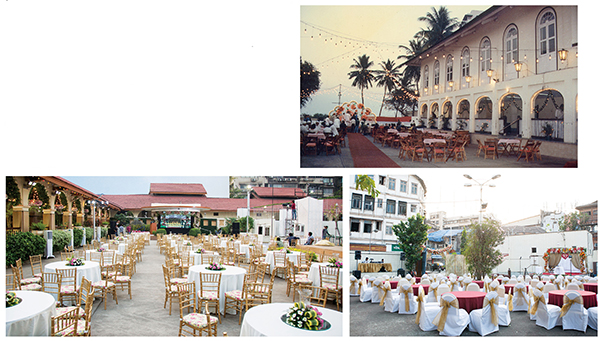
Clockwise from top: Jeejeebhoy Dadabhoy Agiary, Cama Baug, and Allbless Baug
Clockwise from top: Dadysett Atash Behram, Ripon Club Photo: Jasmine D. Driver, and Banaji Atash Behram Hall
Cama Baug permits holding of functions "as long as it is done within the legal framework. Such functions can be held by those having prior bookings, as well as those who wish to book,” stated managing trustee Khushroo Press. "We Parsis marry late anyway, so asking them to postpone a wedding by a year would be ‘counterproductive’ (pun intended)!” he added, but if a patron chooses to postpone the function, they offer an alternative date. Those who wish to cancel the celebrations are offered a full refund (less GST already paid).
"In spite of total drying up of cash flow, and multiple cancellations (and resultant refunds), our entire staff is being paid their full salary, on time, throughout the pandemic,” stated Press. He further referred to their facilities being put "to good use during the lockdown. The Bombay Parsi Punchayet was given use of the Baug, free of cost, to enable them to run a community project where meals were daily delivered to over 150 people living alone in Bombay with no means to either cook or fetch groceries from outside their homes…
"In spite of severe financial constraints, we are constantly upgrading facilities at the Baug as well as the Agiary, though our charges for Baug bookings are dismally low, as compared to other similar venues. This is to ensure that a traditional function is affordable to all members of our community. We also have an undertaking from caterer Tanaz Godiwalla, that she would charge substantially less for functions held at Cama Baug, for the same level of food and service.” For a trust with a meager corpus to be able to offer improved facilities like a large air-conditioned hall and green room, fire compliance certificate, full CCTV coverage, upgraded lighting, etc the trustees give credit to "angels, waiting in the wings, to see us through. We just plod on, doing His will and He has never failed us.”
Although anticipating a "considerable” financial loss during the year, Behram Ardeshir, trustee of the Dadysett Atash Behram Trust said they would permit postponement of functions or refund of sums paid by families who had booked their premises in advance. They did not need to lay off any of their employees as "all our staff are like family members and we always look after each other in the best interests of our Trust.”
Burjor Antia, managing trustee of the Cawasji Byramjee Banaji Atash Behram Trust clarified that income from their hall charges constitutes barely 10% of the Trust income. Every year the Trust receives interest on bank fixed deposits and large amounts of donations. Estimating a loss of five lakh rupees due to the pandemic restrictions, Antia stated, "We permit postponement of the function or full refund of sums paid due to Covid-19.”
The Ripon Club hall which is booked around 12 times a year by members did not see a single booking this year, stated chairman of the managing committee Xerxes Dastur. For the first four months they paid their staff full salaries and thereafter 50% to those who have gone to their hometown and not returned. Assuming clubs are permitted to reopen, he was not sure when they would reintroduce their luncheon service considering that "a majority of our members are seniors.” Going forward, it is difficult to determine how many will opt for an enclosed hall space, he said. Estimating a loss of around Rs 10 lakhs this year, he regretted it is "eating into our capital unfortunately. Quite a few of our members have come forward with offers to help the community institution.”
Photographers/videographers
Among all the service providers, a maximum number of responses came from photographers/videographers. Of the six who responded, Rustom Havewalla maintained that he has not experienced a loss due to the pandemic as his "business is small and there are no massive overheads.” The five others admitted to a loss, with Sarosh Daruwalla and Jamshed Havewala pegging the figure at around 50%, Homyar Mistry at 70% and Arish Patel at 90%. Regarding measures adopted to minimize losses and introducing a survival strategy, the need for cutting down on major expenses was alluded to by all. While Jamshed Havewala, Mistry and Patel were planning to reduce their rates, Daruwalla, Rustom Havewalla and Jansher Banaji felt they would be putting in the same skills, expertise, effort and hours so why should they reduce their charges?
Mistry stated that at Homz Prints photography and video shooting has been their main activity for 41 years with Parsis constituting a major part of the business. Online activities were given a boost during the lull period and they "also handle related activities like scanning, lamination coating, framing, video conversions, transfers, etc.” Mistry felt the need to maintain superior service standards to meet the client’s expectations and to accept unavoidable changes brought by Covid-19 with a "new wave of creativity.” Earlier, photography "was an art; now it’s become a craft,” he declared.

Clockwise from top l: Aarish, Sarosh and Rehan Daruwalla, Rustom Havewalla,
Jamshed Havewala, Jansher Banaji, Arish Patel and Homyar Mistry
"At present we have more confirmations for Parsi functions for the season of 2021-2022,” revealed Daruwalla of Mazda Studios, a "38-year-old company with qualified second generation involvement in the business.” While one son, Rehan, is also a photographer, other son, Aarish, is an event co-ordinator and disc jockey.Their expansion plan has been kept on hold, currently although their "studio is functional with product shoots, portfolios and helping professionals to create masterclass videos for online purposes.” Around 50-60% of their business comes from Parsi clientele but Sarosh does not expect the Parsi festive season to pick up in the next six months due to uncertainty on government regulations. "We are managing to get work from another business vertical which is not related to events and celebrations,” he added, not planning to lay off any of his staff members for "we all intend to pull through together in these disturbing times.” Conscious that they are entrusted by clients to capture "once in a lifetime occasion,” rather than focus on competition they used their time during lockdown to "upscale our expertise and have put lots of innovative ideas in place.”
"Balance is the key to success,” stressed Patel of A. F. T. Digital, sharing his life philosophy: "Make hay while the sun shines and save for the rainy days.” He regrets that there are others in his field who choose to constantly spend to upgrade their equipment and are therefore left with barely any savings or family time. Patel maintained, "I have never competed with anybody. I let my work speak for itself. If people are happy, they will give us work; if not, they will go somewhere else. If I don’t get a job, I never ever get disheartened. I take it as God’s will and move on.” With wearing of masks mandatory, requesting guests to lower their mask each time "is a pain and taking a picture with a mask on is like shooting a surgery,” felt Patel whose Parsi clients constitute 95% of his business. With the restriction on guest numbers, he expects to be better able to focus on close family members and friends.
"I always believed in keeping my business small enough that I could handle. When you try to eat more than you can chew, you run the risk of visiting doctors or going hungry in the future,” noted Rustom Havewalla. He counseled, "Don’t throw away money on new equipment unnecessarily. If it is not necessary to do something, it is necessary not to do it.” The investments on professional equipment can be used for family members and personal trips. Fortunate to have made good savings and investments, he added, "I am comfortable with net banking and online trading. These are better saviors than the business.” Conceding that masks are necessary so that people learn to be considerate and not cough and sneeze on others, Havewalla noted, "The fear factor is affecting the clients and that is affecting the business.” Ninety percent of his business comes from Parsi clientele. With fewer guests, "it will be boring but more sensible if the function winds up early,” he maintains. According to his estimates, hosts get to spend less than three minutes per guest when there is a large congregation. "Does it make any sense?” he asks rhetorically. He knows though that restricting the number of guests could cause heartburn.
"Although no work could be undertaken during the complete lockdown, it gave me an opportunity to work at home and hone my graphic skills,” reported Jamshed Havewala for whom business resumed after partial lifting of the lockdown. While around 50% of his business comes from shooting Parsi lagan and navjote functions, "none of my products, fashion and hospitality photography business is from Parsi clientele,” he specified. Although he has not laid off any employee, one of his assistants who resides in a distant suburb has not been able to report to work as trains are yet not available for commute. Looking at his "quality of work, and sincerity and dedication,” he did not need to amend his service package much. Although trying to get into some related activities,
he maintains, "I do not crave to be ahead of others.”
According to Banaji of JYB Photo & Video, "Tough times are always there but you have to face the wind and move on.” He needed to lay off two of his staff. With barely five percent of his business coming from Parsis, he felt to stay ahead of competition, one has "to deliver quality.” On a photography assignment, whether there are fewer guests or whether their faces are covered by masks does not unduly bother him for he knows that it is at "the post production where all hell breaks loose!”
Catering, food and beverages
New norms have been introduced in the Parsi catering business by both Tanaz Godiwalla and Kaizad Patel with daily temperature checks, use of sanitizers and frequent hand wash, mandatory use of face masks, hair covers and disposable gloves for the production and packaging teams. With lagan nu bhonu being their forte, both of them plan to continue with their popular menu.
Realizing that spending capacity may decline post the pandemic, Godiwalla will offer "varied options to our guests with customized menus/offerings to suit a spectrum of budget aspirations,” stated Cyrus Shroff on behalf of Godiwalla. Although "a significant portion” of their business is patronized by Parsis, as awareness spreads they are witnessing a wider clientele willing to experiment with the cuisine. "Loss of business has been significant… The industry players have witnessed a very drastic adverse impact. The next six to nine months will be challenging for the food industry as a whole. While we have started our operations and the response from (customers) is encouraging, demand continues to remain subdued” at Godiwalla’s.

Tanaz Godiwalla ( l) Photo: Kainaz Amariaand Kaizad Patel
To counter this bleak scenario, in addition to their catering business for celebratory and festive occasions, Godiwalla extended her business to two other areas, café and condiments. The café division has a daily pre-order menu and they are active with food aggregators like Zomato, Swiggy, bro-eats. Additionally they have launched an online ordering platform to facilitate ease of ordering even during non-business hours. They will shortly be launching their condiments component "to address the ready to cook and easy to cook market, especially given the extant scenario,” with plans to expand to a larger geography, noted Shroff. Running "an agile operation that holds us in good stead,” they did not need to lay off any of their employees.
Even though 90% of his turnover will be impacted and he does not expect the situation to improve in the next six months, Patel has not laid off any of his staff members for he is hopeful "the situation will improve eventually.” As a survival strategy he has started undertaking home orders and minimizing the risks associated with catering. Parsis constitute 70% of his customers.
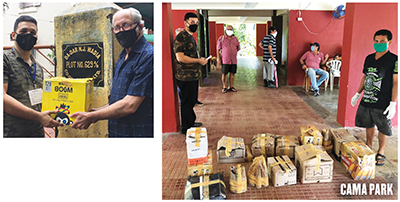
During lockdown, Peekay Wines arranged for delivery at Parsi colonies
The only other response we got in the food and drinks sector was from Zorben Zend of Peekay Wine Merchants Pvt Ltd who claims that their store at Crawford Market stocking products priced from Rs 500 to Rs 5,00,000 has given "liquid happiness all the way to Malcolm Baug” at Jogeshwari. "I give original and official stock at the lowest possible prices. Now as the government allows delivery during this lockdown, I can compete on that front too,” he says. Although permitted to operate from May 26, 2020 after observing strict pandemic protocols, he expects to suffer at least 40% losses this year as there may not be celebratory functions either by Zoroastrians or non-Zoroastrians this season. Prior to the lockdown, business from the Zoroastrian community constituted 10% of his total clientele but during the semi-lockdown from May 26, it increased to 50% as "we focused mainly on serving/delivering to our community and tried to reach out to all our baugs/colonies” when no delivery charges were permitted by the government. To minimize losses, until August 1 when the stocks were in short supply, they charged the full market retail price but after that they started introducing discounts once again.
To close down the business was never an option for this businessman: "We’ve been around since 1902 as National Stores and then Peekay Wines since 1971. We adapt and survive!” Valuing the loyalty of his staff who have been with them for generations, he asserted, "there is no option or need to lay off.” Whilst they have started curtailing their expenses, full salaries have been paid to employees, although the non-essential or elderly staff have been asked to stay at home for safety reasons.
Beauticians
Despite suffering a 50% loss in the current financial year, Monaz Cooper of Kamal’s Salon noted that they did not need to lay off any of their staff members. "At this stage one can only plan to tighten the costs and hope to strengthen the bottomline,” she stated, adding, "We are currently very active on social media. If you follow #kamalssalon and #monazcooper there are a series of videos that we have customized for our clients all through this lockdown. Right from home hair care tips to client testimonials. This has helped us tremendously to win back our client trust and enhance our equity.” Offers incentivizing clients to come and avail of services at certain discounts are promoted.
L-r: Assistants, suitably attired in their gear at Kamal’s Salon; Monaz Cooper attending
to a client; Khushnuma Master’s online reach; bridals are Master’s forte
Adhering to the government guidelines meant for beauty parlors, they currently fumigate their premises more than twice a day and have set up three sanitization zones at their Salon. The staff wear their PPE (personal protective equipment) kits when attending to clients. There is routine temperature check for staff and clients. Clients are given a mask if they haven’t got their own as well as gloves to avoid touching surfaces. Social distancing with stickers for stand points is strictly followed. "Clients are only taken via appointments” to ensure there is no waiting or crowding, clarified Cooper. Parsis comprise 10% of her customers.
Khushnuma Master plans to compensate for her 50-70% loss during the year by "being resilient and going with the times.” She says she has initiated online tutorials and has done social media sessions on the new sanitation practices that have been introduced. Her outfit, Makeup By Khushnuma, that teams up with freelancers has worked with renowned bloggers like Maia Sethna, Khushnaz Turner, Freishia, brands like Rudraksh Dwivedi, Dhwaja Couture, Meena Prints, Prar designers, Aurnument and other influencers. She has done interactive sessions with corporates like Housing Development Finance Corporation (HDFC). Viewing bridals as her forte, she reports that Parsis constitute 60% of her clientele.
Florists
Having sustained "at least 50%” loss in the current year, Khushroo Dubash of Orchids Etc admitted that they were considering winding up their operations "several times and are still pondering.”Although he did not need to lay off most of his staff as they agreed to a pay cut, he is hopeful that with "severe cost cutting” and early recovery of outstanding revenues, they will be able to surmount the crisis. Since flowers and plants are available in the market and he would like to give his clients "a better product and service,” he candidly states, "At this point in time, it is all about survival.” Parsis constitute a negligible component of his clientele.
Wadiwalla Florists have been back in business since September 2020, reported Neville Wadiwalla specifying that "ours is a very small business.” Though the pandemic has caused them a 20% loss, he was confident of being "able to tide over and bounce back.” With Parsis constituting 75% of his clients, he plans to remain in the market "by keeping our business alive and kicking” and catering to customer demands.

Floral arrangement by Orchids Etc
Saris and duglis
"As a conscious entrepreneur, my role is to find solutions and strategies to wade over this pandemic. At ASHDEEN we employ more than 150 skilled karigars (craftsmen) who depend on us for their livelihood. It is imperative that we give them financial support to sustain themselves and take care of their families,” asserted Delhi based designer Ashdeen Lilaowala, the only one from the 19 listed under our Saris section who responded to the Parsiana questionnaire. Whilst admitting that sales are down, he added, "We have focused on various strategies to generate income rather than think about losses. I can proudly say that we have not fired a single employee and have given full salaries since June 2020” when full business was resumed.
Ashdeen Lilaowala at his store in Delhi
Focusing on social media sales and engagement, they are trying to reach out to as many customers as possible with their new repertoire of hand-embroidered designs influenced by the gara tradition. Besides video appointments and meetings on Zoom or WhatsApp with clients, at their ASHDEEN store customers may visit after a prior appointment. "Some customers are comfortable getting measured. With others we do virtual consultations and have created detailed measurement charts which they can personally fill. There is a strict process of sanitization after each client’s visit,” he related. Twenty to 25% of their business comes from the Parsi community in India and around the world.
Zubin Mehta (inset) of Dezenzia and Uniforms Unlimited
"We will fight and fight till we get back on our feet. We aren’t gonna give up so easily,” conveyed Zubin Mehta who knows that his apparel firms Uniforms Unlimited and Dezenzia have made "huge losses” and they needed to lay off 25-30% of their employees. Although known in the community for their designer duglis, Parsis constitute only 0.3% of their clientele. Since they fall in the classification of micro, small and medium enterprises (MSME), they will approach MSME authorities to tide them through the crisis if the need arises. Since theirs is primarily a B2B (business-to-business) operation, they are not required to entertain walk-ins. Their interactive website, online forms and standard sizes serve their purpose of measurements. Well aware that their customers want quality and value for money, as of now they are not planning to change their prices. They continue to be guided by their philosophy of "best prices, best services, best products.”
Invitation cards
"Keep working; keep networking. Stay focused on what can be realistically achieved with a little innovation and a lot of determination,” believes Zinia Chaina whose business ZiniacJC was down to 20% but she hopes to make up for it in the coming six months with her creation of e-invites and the online store that she has launched
www.ziniajc.in/p/store.html.
"Offer a package that suits a potential client’s requirement and budget. One has to offer as per demand or create demand by offering extra services that make it simpler for the client to convert, to approach you and choose you to work with,” she has learnt. As a graphic designer "I can work from anywhere in the world. Production and delivery will continue through my tie-ups in Bombay,” she stressed. Parsis constitute 50% of her clientele.
Print and e-invites designed by ZiniaJC
Multiple muses
A chalk designer, event coordinator, bar service, recorded music and transport provider, Firdosh Khambatta of Unicorn Entertainment wears five hats with Parsis comprising 80% of his customers. Having now shifted to the media platform and conducting virtual DJ events he is open to "doing things differently… based on requirement to requirement” to satisfy customers.
"Mine is more a hobby or service to the community than a business, so financially I have not been affected by the pandemic,” explained Roshan Rivetna of Chicago who takes orders for Parsi sweetmeats and savory snacks as also floral decorations. She used to call her food venture Badam-ni-Boi & More but since the last couple of years, Rita Kapadia who manages
www.ParsiCuisine.com has given Rivetna space on her website and called it ParsiMithaiShop. This has gained her wider popularity across USA and Canada. "I continue to get orders — this has not been affected by the pandemic at all — for mithai, especially my signature dish Badam-ni-Boi. In the last week of October she received an order for 41 agharni-na-larva; one large one for the khoro (expectant mother’s lap)and 40 small ones to be gifted.
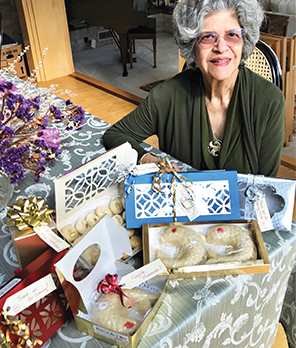
Roshan Rivetna with her signature dish Badam-ni-Boi
Additionally for weddings and navjotes in the Chicago area, she makes garlands and bouquets, centerpieces, boutonnieres, etc. She also has a mandap and silk flower decorations – torans and basket/vase arrangements that she loans out at no cost for events in Chicago. For this committed lady, her staff comprises her husband Rohinton and occasionally their grandchildren. When all plans for a large celebration had to be cancelled, Roshan helped with the "chalk, toran and haar for a couple of navjotes and a wedding held at home with a tent set up in the backyard with only close family present — all wearing masks and social distancing! Friends of the wedding couple joined the ceremony on Zoom.”