"There was a robustness to (Rashid Irani’s) film criticism…It was straight from the heart…When he liked a film, he spoke about it with enormous conviction… When he did not, he could be very angry… but he was always generous… He respected the art of filmmaking,” noted photographer and filmmaker Rafeeq Ellias, about cinema critic Irani who passed away at 72 years of age on July 30, 2021. Irani wrote for The Times of India and Hindustan Times, among others. Ellias is making a documentary on Irani and hopes to release it "in a few days’ time,” he told us on August 20.
Irani "was wide open to any genre, as long as it met his standards.” During his extensive career, he was part of the selection committee for the Mumbai Academy of Moving Images (MAMI) festival. "The MAMI work was extremely hard… He took it on most happily… He would have to look through 200 films each year… MAMI has been his spiritual home, in a sense,” noted Ellias, who counts himself as Irani’s "newest” friend. "I only knew him for 25 years… everyone seems to know him for 35-45 years,” he quipped.
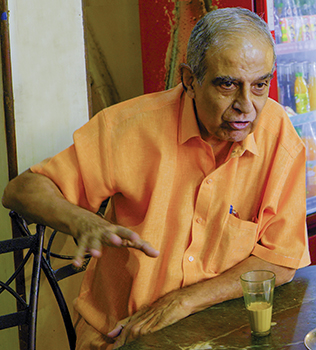
Rashid Irani at Edward Restaurant Photo: Rafeeq Ellias
Irani’s co-selector for the international competition section of MAMI 2012-2014 was Deepika Sorabjee. "I still cannot process Rashid not being with us,” she told Parsiana on August 19. "It was wonderful seeing hundreds of films together, and because the competition was for first films and debut filmmakers, it was contemporary cinema from around the world which was exciting for us both.” Calling Irani’s knowledge of cinema history "unique,” Sorabjee stated that "in an era of no streaming platforms, he had, for decades, travelled from film festival to film festival across India and had managed to keep up with world cinema as it happened.” During the selection process, "for months, we would travel to Andheri every weekend, to watch films along with the rest of the panel. For Rashid, who was not techno savvy, and loved watching films with others, these were years he said he cherished… The hour-long drive would be spent in discussing films.”
Irani who resided at Dhobi Talao never once traveled outside India but spent "decades watching world cinema. This honed a sensibility you didn’t see commonly in critics here. He stressed on bringing contemporary world cinema that would otherwise not get a theatrical release to the festival — that was what we both agreed built a true cinema literate audience. A festival shapes an audience, it should not cater to an audience’s preconceived tastes,” stated Sorabjee.
The film critic was a regular at the Press Club’s Saturday film club that yet another film historian Rafique Baghdadi ran. "We would rush to the Press Club from Andheri… Irani reveled in the classics that were shown — his passing remarks about when he’d seen it before or at which festival, that visual memory, always startled me… That single-minded pursuit of building that knowledge without the internet astounds even now.”
On August 2, the Instagram handle of MAMI posted, "May we be able to carry forward your enduring love for cinema…Thank you Rashid for making MAMI a richer place by building our programing over the last 13 years.” Four days later came their announcement that "from this year onwards, we dedicate our initiative Young Critics Lab to Rashid. We hope his passion, rigor, selfless engagement with fellow film lovers and the sheer joy he felt whilst watching a film continues to inspire us.”
Sorabjee commented on the renaming: "It remains to be seen if (the Lab) deserves to carry his name… Rashid was not a sycophant neither did he mince his criticism. It is ironic, however, that MAMI has done away with the international competition section, the very section that Rashid loved and was connected to the festival for, a section he said was the soul of MAMI… He will be heartbroken up there.”