An expansion of their solar energy capacity by 10 to 20 KW and financial contributions to "community-driven, emission-reducing projects” will help St Michael’s Church to "go carbon neutral within the next two years,” a church spokespersons told The Hindustan Times on June 17, 2022. Emission reducing projects "could mean supporting nature conservation efforts, tree plantations, sustainable agriculture and biogas plants. We are looking at a few options and will make a decision on it soon,” parish priest Fr Lancy Pinto stated.
The initiative is based on a greenhouse gas inventory analysis made by the Church to see how it can cut back on carbon emissions. Conducted by local resident, frequent churchgoer and environmental engineer Emmanuel D’Silva, the study revealed that the Mahim church emitted a total of 44 mt of carbon dioxide equivalent (CO2eq) emissions in 2021. (Carbon dioxide equivalence is a measure that describes the amount of carbon dioxide for a particular mixture of greenhouse gases that will have the same global warming potential over a given period.)
Electricity consumption headed the list of the Church’s carbon footprint, emitting over 38 mt of CO2eq annually. "Transport, which is usually a big emitter, was not so large in its share, contributing only 6 mt CO2eq annually,” D’Silva said. "This is because many of the church’s visitors and employees live in the vicinity, and simply walk to church or use public transport,” stated the news report. D’Silva’s findings were independently verified by a Hyderabad-based private company working in the climate and energy space.
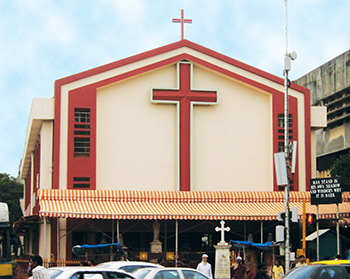
St Michael’s Church: Making efforts at greening
The news report stated that the Church’s decision is in line with the Bombay Municipal Corporation’s Mumbai Climate Action Plan (MCAP), unveiled in March this year, which aims to make the city carbon neutral, by achieving a state of net zero emissions, by 2050. "This is 20 years ahead of India’s global commitment, made by Prime Minister Narendra Modi at United Nations’ Climate Change Conference in Glasgow last November,” stated the report. (Net zero means balancing out the greenhouse gases emitted by polluting activities through capturing or storing carbon dioxide.)
Pinto said, "Though our carbon footprint is a small amount by world standards, we hope that our commitment to reducing emissions will encourage other places of worship to think along the same lines. It is our small way of making a difference.”
Ervad (Dr) Ramiyar Karanjia, principal of the Dadar Athornan Institute, whose opinion Parsiana sought, believes that "to replenish the wood used in fire temples, kathi wood plantations have been initiated. About a decade back a scholarly Zoroastrian delegation had represented Zoroastrianism at the ARC (Alliance of Religions and Conservation) Summit, formed under the World Wildlife Fund to address climate change issues by various religions. However in the present, to my knowledge, no initiative has been undertaken and I firmly believe that we do not contribute significantly to carbon pollution, apart from the normal submissible levels.”
Karanjia continued, "Zoroastrianism has been an ecologically conscious religion right since its inception… Carbon footprint is a modern concept. The problem has arisen not on account of the normal living of humans and normal religious activities like burning of firewood, which by any stretch of imagination is exceedingly minuscule, but the wanton, unharnessed industrialization and mindless deforestation… it is not the use but abuse of nature that has caused this problem. The blame is very often shifted to innocuous human and religious activities.” He did advise that "humans should make efforts to reduce carbon dioxide emissions” by making alterations in their personal lifestyle, compliant gadgets, use of public transport, avoidance of wastage, recycling and reuse.” F. J.