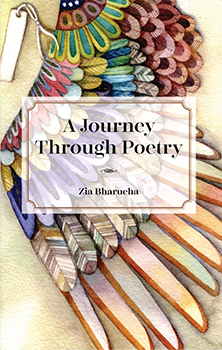
A Journey Through Poetry by Zia Bharucha. Published in 2018 by White Falcon Publishing; website: www.whitefalconpublishing.com. Pp: 43. Price: Rs 225.
Zia Bharucha (pictured) has published a collection of her poems A Journey Through Poetry. We understand she is a teacher, she runs her own business, and has been training students in speech and drama and performance arts examinations for the Trinity College, London. That she finds the time to write poetry with this busy schedule is a wonder.
 That she is a teacher, is evident from her poetry. The reader often feels he is being lectured to, albeit in a gentle manner. This probably is also the result of the "spiritual” nature of her poems and, as mentioned in her backnote what she intends to achieve with her collection of poems. It "is about life and living. Life is what is happening to you and living is the way in which you think about it, feel about it and react to it.”
 In Evil, Bharucha declares that "Evil is not the bad within you.” It is more the result of allowing negative emotions to control you, sticking with a "bad ideolog,” the inability to understand, accept, to forgive, the striving to be a god when you are merely an impotent human being. Every person is a mixture of good and evil, it is the choice you make which determines who you are. Life, she suggests, is difficult and not for the faint hearted. The choice is based on knowledge: "Knowledge that you know nothing,/You control nothing,/You are on a journey of discovery/The discovery of you,/Of the good, that is you.”
These may seem like platitudes but the repetition of the first line "Evil is not the bad within you” and last line "Regardless of the consequences” in the first three verses create a sort of chanting effect.
In Division, Bharucha speaks against division based on color or wealth. The only way forward is to forget the past "misery” and move forward. There should be an end to the blame game and we need to realize that division is merely a means to arouse suspicion. She concludes with these simple lines: "There is no difference,/Just ignorance./We will come undone,/If we do not understand that we are all one.”
In a poem like Fear, Bharucha describes the devastation caused by fear. She allows it to "impersonate” her, "rule” her, "breed chaos” within her, kill "rational thought.” She strongly believes that fear needs to be acknowledged only then: "I am me, laid bare./Strengthened through my weakness,/Ready to face another day.”
Even though much of what Bharucha writes in her poems is sincere and valid, the moral tone does tend to get a bit monotonous. The poems are all serious; gravity, and possibly a lighter touch, some imagery, a bit of humor may have made the collection more reader friendly.